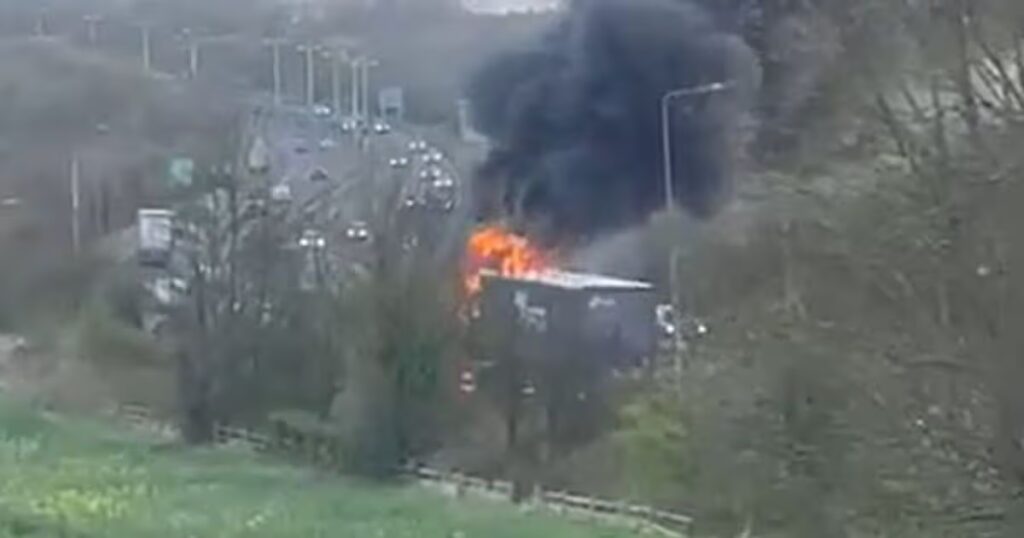

A major traffic incident near the Humber Bridge caused long delays on Tuesday morning after a lorry caught fire on the slip road to the northbound A15 near the Barton interchange. Thick smoke was seen rising over the area as emergency services moved in, with disruption quickly spreading across one of the most important road links for drivers crossing between North Lincolnshire and East Yorkshire.
The incident, reported close to Barton-upon-Humber, led to heavy congestion around the bridge approaches as queues built on the surrounding roads. Motorists travelling toward the Humber Bridge faced a difficult start to the day, with traffic affected on both sides of the route while crews worked at the scene. Early updates indicated that smoke from the blaze was clearly visible to drivers approaching the interchange, adding to the sense of urgency and confusion on the road.
As the fire unfolded, the disruption quickly became more than a local hold-up. The Humber Bridge is one of the region’s most important transport crossings, and any incident near the A15 approach can trigger knock-on delays across a wide area. For commuters, delivery drivers, and businesses relying on the route, the closure created immediate pressure, especially during the morning rush when traffic volumes are usually at their highest.
A spokesperson for the Humber Bridge said there was heavy traffic on the bridge northbound because of ongoing incidents in the surrounding area. Later traffic updates indicated that an earlier closure on the southbound carriageway had been lifted, but the northbound side of the A15 remained closed. That detail mattered for drivers already caught in the build-up, as it confirmed the disruption was not clearing as quickly as many had hoped.
Eyewitness images from the scene showed a plume of dark smoke rising beside the road, with the fire appearing severe enough to halt movement around the junction. Incidents involving goods vehicles often create longer delays than standard breakdowns because of the time needed to contain the blaze, secure the area, and inspect the road surface afterward. Even once flames are under control, traffic can remain slow for some time as stranded vehicles begin to move and diversions feed into already-busy routes.
Why disruption near the Humber Bridge escalates so quickly
The Humber Bridge is far more than a striking regional landmark. It is a daily working route used by thousands of drivers, linking communities, businesses, and freight traffic across the Humber. When an incident strikes close to the Barton interchange or the A15 approach, there is very little room for traffic to absorb the shock smoothly. Queues form quickly, diversions add pressure to nearby roads, and drivers can find themselves delayed long before they reach the bridge itself.
That is one reason stories like this attract immediate attention online. People are not only searching for what happened but also whether the route is still moving, which side is closed, and how long they may be stuck in traffic. The bridge has such a prominent place in regional travel that even a single vehicle fire nearby can become one of the day’s biggest local news stories. For many people living or working in the area, disruption here is not minor inconvenience but a direct interruption to work, school runs, appointments, and scheduled deliveries.
The scale of the response also reflects the seriousness of any fire involving a lorry. Emergency crews must deal with the immediate risk of flames and smoke while managing vehicle build-up in a confined road network. Traffic officers and police then have to balance public safety with the need to keep the wider route operating. In cases like this, the result is often a patchwork of partial reopening, lane restrictions, and rolling delays that continue even after the most visible danger has passed.
For local businesses, the timing of the incident was especially awkward. The A15 is a key artery for commercial movement in the area, and delays on the northbound side can affect everything from service appointments to freight schedules. Drivers who rely on predictable crossing times were instead faced with uncertainty, while others turned to alternative routes that can themselves become congested once traffic begins diverting away from the main approach.
There was also a wider public safety concern because of the smoke drifting over the road. Reduced visibility can make an already dangerous traffic situation worse, especially near busy junctions where vehicles are changing speed, attempting to merge, or reacting suddenly to stopped traffic. Authorities typically take a cautious approach in those conditions, which is one reason full reopening can take longer than drivers expect.
Motorists seeking updates were advised to follow live traffic information and official route notices. Real-time updates from Humber Bridge remained one of the most useful sources for drivers trying to judge whether conditions were improving or whether it was better to delay travel altogether.
By late morning, attention had shifted from the fire itself to the larger question facing drivers across the region: when would traffic return to normal. That is often the final phase of incidents like this, where the flames may be out but the disruption lingers well beyond the dramatic first images. With the northbound A15 still closed and queues already formed, the route remained under pressure as emergency services and road teams continued their work.
For anyone travelling in the Humber Bridge area, the incident served as another reminder of how fragile major road networks can be when one key route is blocked. A single lorry fire near the Barton interchange was enough to send traffic conditions spiralling into a long and frustrating morning, with drivers across the region forced to wait, reroute, and keep checking for the moment the road finally began to clear.
About Author
Ankit is an experienced digital writer with more than 9 years of professional writing experience in business, technology, entertainment, finance, and online news coverage. He specializes in building concise, informative, and engaging content designed for modern readers. His work reflects a strong understanding of fast-paced publishing, editorial clarity, and content performance across digital platforms.

Make Swikblog your go-to source on Google for reliable updates, smart insights, and daily trends.