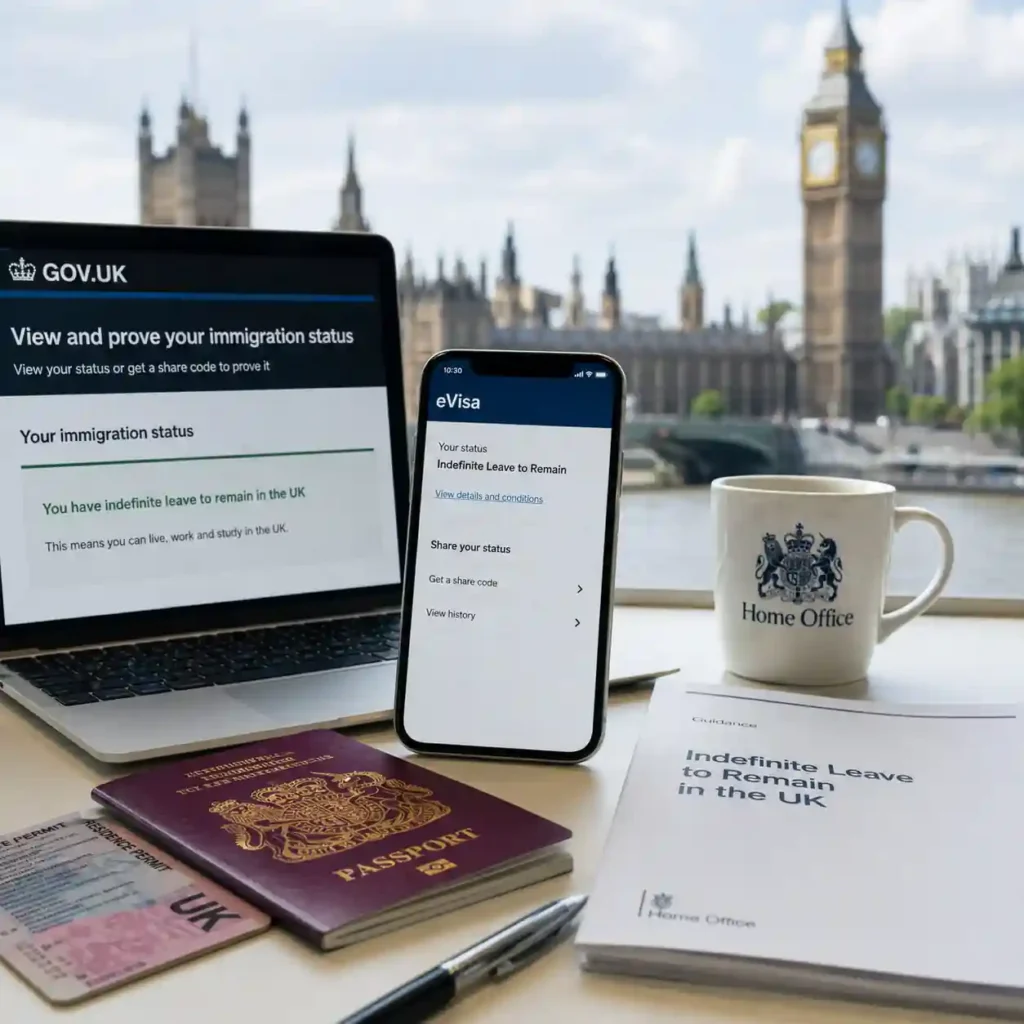

The Home Office has updated its 2026 guidance on Indefinite Leave to Remain in the UK, giving settled residents a fresh reminder to check how they prove their immigration status, how long they can stay outside the country, and what their rights mean in daily life.
Indefinite Leave to Remain, widely known as ILR, allows a person to live in the UK without a time limit on their stay. Indefinite Leave to Enter, or ILE, gives a similar form of settlement to people granted indefinite permission before entering the UK. In both cases, a person is generally treated as settled if their main home is in the UK.
The latest official Home Office guidance on Indefinite Leave to Remain confirms that the UK is continuing its shift from physical immigration documents to digital status records. That means people who previously relied on a BRP, passport endorsement, vignette sticker or older Home Office paper document may need to make sure their status is visible through an eVisa.
For people who believe they have ILR or ILE but cannot prove it, the No Time Limit route remains important. A successful NTL application can confirm settled status through an eVisa. This may help where an old passport has expired, been lost or stolen, where a previous NTL endorsement is no longer available, where no documentary proof exists, or where someone has legally changed their identity and needs the record updated.
eVisa checks, expired BRPs and travel rules
The guidance says all biometric residence permits have now expired. An expired BRP can still be used for up to 24 months after the expiry date printed on the card, or until 31 December 2026, whichever comes first. However, the card should not be treated as permanent evidence of status.
ILR holders whose permission continues beyond the expiry date on their BRP should create a UK Visas and Immigration account to access their eVisa. Access is not automatic, so people need to set it up themselves. Once the account is active, they should keep details such as name, gender, facial appearance and travel document information updated.
The Home Office also advises people to keep expired BRPs, as they may help with future immigration applications. If a BRP is lost or stolen in the UK, it must be reported so it can be cancelled. If it is lost or stolen abroad, the holder may need to report it and apply for temporary permission to return to the UK.
Before international travel, settled residents should check that their eVisa is linked to their current passport or travel document. They should also carry that document when travelling. A carrier may ask for a share code to confirm immigration status, and the code is valid for 90 days.
The move towards eVisas is part of a wider digital border environment. Travellers are already seeing similar pre-travel checks through systems such as the UK Electronic Travel Authorisation system, where permission and identity checks increasingly happen before a person reaches the border.
Absence rules remain one of the most important points for ILR holders. Standard ILR or ILE can automatically lapse if a person stays outside the UK, Ireland, the Isle of Man, Guernsey or Jersey for two years or more at a time. If that happens, they may need to apply for a returning resident visa before coming back to live in the UK.
People with settled status under the EU Settlement Scheme have a longer absence limit in most cases. Their status can usually lapse after five or more years outside the UK, Ireland and the Crown Dependencies. Swiss citizens with settled status, and their family members, usually have a four-year limit.
Work, study, healthcare, family and citizenship
ILR gives settled residents broad rights in the UK. They can work in any lawful business, profession or employment, including self-employment. They are also free to study in the UK without needing a separate student visa.
Healthcare is generally available free to people who are settled in the UK. Access to benefits and public services depends on the rules for each individual benefit or service. For the new State Pension, people usually need 10 years of UK National Insurance contributions.
Voting rights depend on nationality and the type of election or referendum. Holding ILR does not automatically give every settled resident the same voting rights as a British citizen.
Children born in the UK while a parent is settled will normally be British citizens automatically at birth. A child born in the UK after 1 January 1983 who is not already British may be able to register as a British citizen once a parent becomes settled.
Family members who are not British citizens may be able to apply to join an ILR holder in the UK under the family immigration route. People with EU Settlement Scheme status should follow the separate rules for family members under that scheme.
The guidance also makes clear that ILR is not completely unconditional. It can be invalidated if a person is deported. It can also be revoked if it was obtained by deception, if a person is liable to deportation but cannot be removed for legal reasons, or if someone was granted leave as a refugee and later ceases to be a refugee.
Read More
For many people, ILR is also the stage before applying for British citizenship. Applicants must usually have lived in the UK for at least 12 months after being granted indefinite leave, although they still need to meet the wider nationality requirements.
The 2026 update does not remove the core rights attached to ILR. Its practical message is that settled residents should protect their status by moving to digital proof, keeping their UKVI account updated, checking their passport link before travel, and understanding how long absences from the UK can affect their right to return.

Make Swikblog your go-to source on Google for reliable updates, smart insights, and daily trends.