
Updated: June 29, 2026
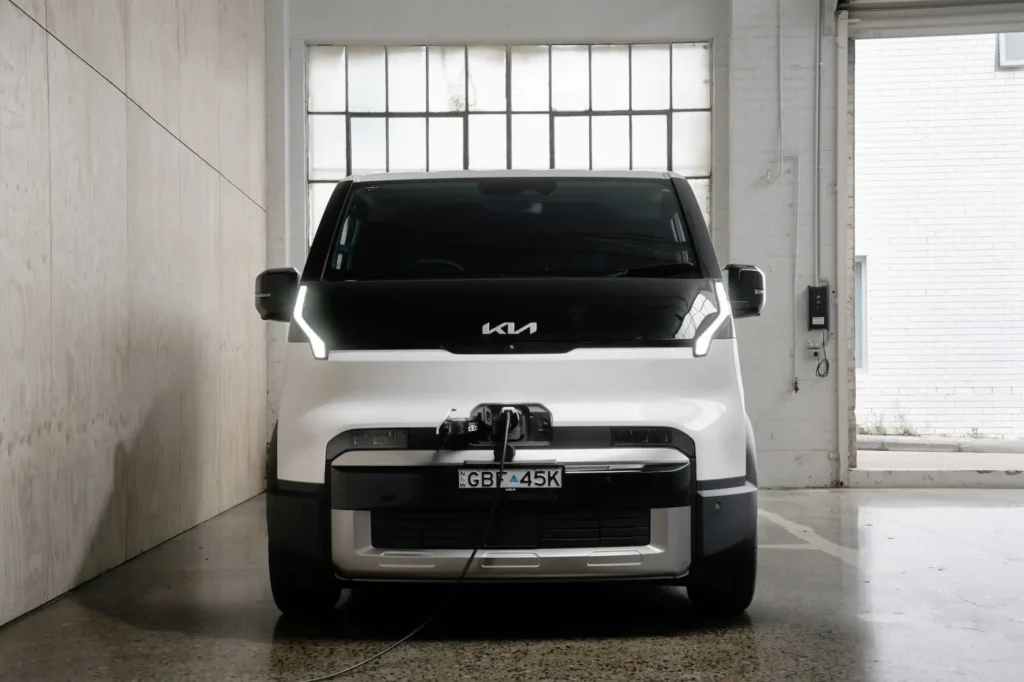
Kia has officially launched the PV5 Cargo in Australia, marking the company’s first purpose-built electric commercial vehicle for the local market. Starting from AU$55,990 before on-road costs, the electric van is designed for businesses that want lower running costs without sacrificing everyday practicality. With a claimed driving range of up to 416km, rapid charging and a flexible cargo area, the PV5 represents Kia’s first step into a new generation of commercial electric vehicles.
The launch is significant because it introduces Kia’s dedicated Platform Beyond Vehicle (PBV) strategy to Australia. Instead of adapting an existing diesel van into an EV, the PV5 has been engineered from the ground up as an electric vehicle, allowing better space efficiency, improved technology integration and a layout tailored for commercial use.
Purpose-Built Electric Platform Sets the PV5 Apart
Unlike many electric vans that share their foundations with diesel models, the PV5 uses Kia’s dedicated E-GMP.S electric platform. The battery sits beneath the floor, freeing up more interior room while helping improve weight distribution and vehicle stability.
Australian models are powered by a 71.2kWh lithium-ion battery driving a front-mounted electric motor that delivers 120kW of power and 250Nm of torque. Kia quotes a WLTP driving range of up to 416km, making the van suitable for many urban delivery routes and day-to-day business operations.
Charging downtime has also been kept in mind. Using a compatible DC fast charger, the battery can recharge from 10% to 80% in around 30 minutes, allowing businesses to return vehicles to service quickly.
The launch comes as more Australian companies continue exploring alternatives to diesel fleets, particularly as fuel costs remain unpredictable and operating expenses become a bigger consideration. Recent growth in electric vehicle adoption across Australia has encouraged many fleet operators to evaluate long-term ownership costs instead of focusing only on purchase price.
Designed Around Everyday Commercial Use
Kia has focused heavily on practicality. The PV5 Cargo offers up to 4,420 litres of load space and a maximum payload of 740kg. Wide dual sliding doors and rear cargo access make loading easier in busy city streets where space can be limited.
One feature that could prove especially useful for trades and service businesses is Vehicle-to-Load (V2L) capability. This allows the van’s battery to power electrical tools, equipment and small appliances directly, reducing the need to carry a separate generator to many job sites.
Inside the cabin, Kia has taken a more modern approach than many traditional commercial vans. A 12.9-inch infotainment display works alongside a 7.5-inch digital instrument cluster, while wireless phone charging, USB-C connectivity and over-the-air software updates are included as standard.
Driver assistance technologies include forward collision avoidance, lane keeping assistance, lane following assistance, blind-spot monitoring, intelligent speed limit assistance and a surround-view camera system.
Passenger Version Will Expand the Line-Up
Kia has confirmed that a seven-seat PV5 Passenger model is expected to arrive in Australia later in 2026. The people mover will target families, airport shuttle services, ride-share operators and government fleets looking for a fully electric transport option.
Official pricing has not yet been announced, although Kia Australia has indicated the model should remain below AU$70,000. Industry estimates currently place the starting price close to AU$65,000.
The Passenger version is expected to retain the same battery and electric motor as the Cargo model. Because of the additional seating and extra weight, its driving range may be slightly lower, with estimates sitting around 390km on a full charge.
Preview vehicles displayed in Australia have featured dual powered sliding doors, a powered tailgate, wireless charging, synthetic leather-style seating, USB-C charging ports across all three rows, household power outlets and a 360-degree camera system.
Where the PV5 Fits in Australia’s Commercial Vehicle Market
The arrival of the PV5 highlights how Australia’s commercial vehicle sector is gradually changing. While diesel utes remain the preferred choice for heavy towing and off-road work, many businesses operating mainly in urban areas have different priorities.
Delivery companies, electricians, plumbers, maintenance contractors and mobile service providers often value secure enclosed storage, easier loading access and lower day-to-day operating costs more than four-wheel-drive capability. For those businesses, an electric van can provide practical advantages that a traditional ute may not.
Electric vans also offer quieter operation, fewer routine servicing requirements and zero tailpipe emissions, factors that are becoming increasingly relevant for businesses operating in metropolitan areas or working toward sustainability targets.
Kia Takes a Measured Approach to Commercial EV Growth
Kia Australia has indicated it expects annual sales of roughly 500 PV5 vehicles across both Cargo and Passenger versions during the early stages of the model’s rollout. Rather than chasing high-volume sales immediately, the company appears focused on gradually building confidence in commercial electric vehicles.
Challenges remain, including public charging availability, real-world driving range when carrying heavy loads and long-term resale values. Even so, the PV5 enters the market with competitive pricing, practical features and technology developed specifically for commercial use instead of adapted from a conventional van.
As more businesses begin replacing ageing diesel fleets over the coming years, Kia’s first dedicated commercial EV could become an important benchmark for Australia’s growing electric van market.
More information about specifications, charging and available variants can be found on the official Kia Australia PV5 Cargo page.

Make Swikblog your go-to source on Google for reliable updates, smart insights, and daily trends.