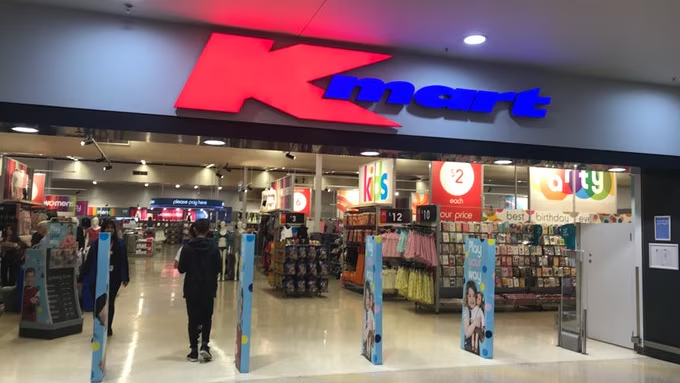

Kmart is facing a fresh legal storm after a class action was filed in the Federal Court of Australia, alleging “systemic” wage underpayment of its salaried store managers over the past six years. The case adds to growing scrutiny of how major retailers structure pay for managerial staff, particularly under annualised salary arrangements.
The lawsuit centres on claims that Kmart failed to comply with the Fair Work Act and relevant retail industry awards, with managers allegedly required to work well beyond their rostered hours without receiving overtime, penalty rates or mandated allowances. According to the statement of claim, the issue was not isolated but part of a broader, systemic failure in how working hours were recorded and compensated.
Specifically, the filing alleges that managers were routinely pressured to perform “off-the-clock” work — including starting early, finishing late, working through meal breaks and completing administrative duties from home. These additional hours, it is claimed, were not properly captured or paid under the company’s salary structure.
In some instances, managers reportedly worked up to 60 hours per week during peak trading periods without any additional compensation. That figure has become central to the case, raising questions about whether salaried arrangements were masking what would otherwise be significant overtime obligations under the retail award system.
The lead applicant, Jordana Williamson, a former full-time Kmart store operations manager who worked across multiple Brisbane locations, alleges that the company’s internal payroll systems failed to accurately reconcile annual salaries against the actual hours worked. The claim suggests that while employees were paid a fixed salary, there was no proper mechanism to ensure that those payments met minimum award entitlements for each pay period.
The class action is limited to salaried store managers and does not include casual or part-time employees. The allegations have not yet been proven in court, and Kmart has not filed a defence at this stage.
The case arrives at a time when Australia’s retail sector is already under heightened legal and regulatory pressure. In September 2025, the Federal Court ruled that supermarket giants Coles and Woolworths had unlawfully relied on annualised salary arrangements without properly reconciling those payments against award requirements. The court found that both companies failed to maintain accurate records of actual hours worked and instead relied on rostered hours, which proved insufficient under the law.
That ruling sent a clear message across the industry: annual salaries do not override award obligations. Employers must ensure that workers are paid correctly for the hours they actually work, not just what is scheduled. The Kmart case appears to test similar issues, particularly whether salaried managers were effectively working beyond what their pay legally covered.
Retail wage compliance back in focus
The allegations against Kmart highlight a broader challenge within large retail operations. Store managers often sit in a grey zone between frontline staff and senior leadership, carrying operational responsibility while being paid on a salary that assumes a certain level of flexibility. In practice, however, that flexibility can translate into consistently longer working hours — especially during peak periods such as sales events, stocktakes or holiday trading.
What makes this case particularly significant is the claim that these additional hours were not occasional but routine. If proven, it would suggest a systemic issue rather than isolated incidents, potentially exposing gaps in payroll systems, time tracking and compliance processes.
For employees, the case touches on a familiar concern: the expectation to “get the job done” regardless of the hours required. Tasks like opening and closing stores, managing staff issues, handling deliveries or completing reports often extend beyond standard shifts. When those hours are not formally recorded, they can fall outside payroll systems entirely.
For employers, the legal and financial risks are growing. Underpayment cases in recent years have shown that even large, well-resourced companies can face significant liabilities if their systems fail to align with workplace laws. Beyond back pay, businesses also face reputational damage and increased regulatory scrutiny.
Guidance from the Fair Work Ombudsman on annualised salaries makes it clear that employers must keep accurate records of hours worked and conduct regular reconciliations to ensure employees are not disadvantaged. Failure to do so can result in breaches, even if staff are on seemingly higher annual salaries.
The Kmart proceedings are still in their early stages, and the outcome remains uncertain. However, the filing alone underscores how wage compliance has become a central issue for Australia’s retail sector. It also signals that salaried roles, once seen as straightforward, are now being closely examined to ensure they meet legal standards.
As the case progresses, it is likely to be closely watched not only by Kmart employees but across the wider retail industry. For many, it raises a simple but critical question: when does a salary stop reflecting the reality of the hours worked?
You may also like: Good Friday 2026 (April 3) – Traditions, Meaning and Holy Week Significance
Make Swikblog your go-to source on Google for reliable updates, smart insights, and daily trends.