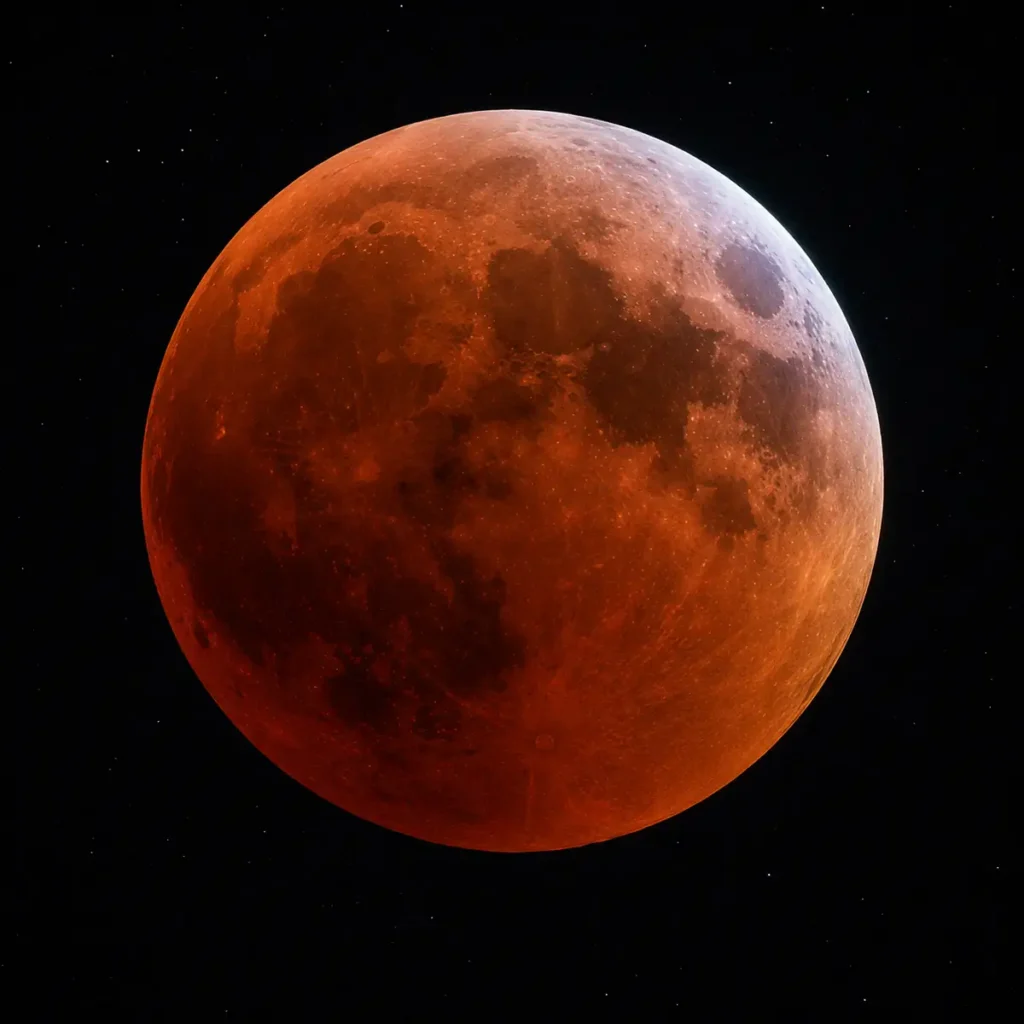

Earth’s lighter penumbral shadow began crossing the Moon at 9:24 p.m. EDT Thursday. The more dramatic partial phase begins at 10:34 p.m. EDT, followed by maximum eclipse at approximately 12:13 a.m. EDT Friday.
At the peak, about 96.2% of the Moon’s visible area will be covered by Earth’s dark umbral shadow. Viewers across most of North and South America can see the entire partial phase if skies are clear.
In the UK, the partial phase begins at about 3:34 a.m. BST and peaks near 5:13 a.m., with the Moon low in the west-southwest before moonset. The eclipse is not visible from India because the Moon is below the horizon during the event.
A deep partial lunar eclipse will transform the full Moon on Thursday night, August 27, into early Friday, August 28, 2026, giving skywatchers across much of the Americas a chance to see an eclipse that comes remarkably close to totality.
At maximum, about 96.3% of the Moon’s visible disk area will be inside Earth’s dark central shadow. Although the Moon may develop the copper-red appearance associated with a “blood moon,” this is officially a partial lunar eclipse because a thin portion remains outside Earth’s umbra.
What time is the lunar eclipse tonight?
The first, subtle penumbral stage begins around 9:24 p.m. EDT on August 27. The more noticeable partial eclipse starts at about 10:34 p.m. EDT, when Earth’s dark umbral shadow begins moving across the lunar surface.
- 9:24 p.m. EDT: Penumbral eclipse begins
- 10:34 p.m. EDT: Partial eclipse begins
- 12:13 a.m. EDT, Aug. 28: Maximum eclipse
- 1:52 a.m. EDT: Partial eclipse ends
- 3:02 a.m. EDT: Penumbral eclipse ends
The entire event lasts about 5 hours and 38 minutes, while the clearly visible partial phase continues for roughly three hours and 18 minutes.
What time does the eclipse peak across the U.S.?
Maximum eclipse occurs at approximately 12:13 a.m. EDT. Across other U.S. time zones, that is about 11:13 p.m. CDT, 10:13 p.m. MDT and 9:13 p.m. PDT on Thursday.
Viewers do not have to wait for the exact peak. The Moon will already be substantially covered before maximum, providing a lengthy viewing window if skies remain clear.
Where will the lunar eclipse be visible?
Much of North America, Central America and South America will be well positioned. Most of the continental U.S. and Canada can see important stages of the eclipse, while Alaska and the far northwestern reaches of Canada have less favorable visibility.
Parts of western Europe and western Africa can also see the eclipse, although the Moon will be setting while the event is progressing in some locations.
Unlike a solar eclipse, there is no narrow viewing path. Anyone on Earth’s night side with the Moon above the horizon can potentially watch it.
Why are both 93% and 96% being reported?
The figures describe two different measurements. Roughly 93% of the Moon’s diameter enters Earth’s umbra, while about 96.3% of its visible disk area is obscured.
The latter figure better represents what observers will see: almost the entire lunar face immersed in shadow, with only a narrow bright section remaining.
Will the Moon turn red?
The eclipsed portion may appear copper, orange or reddish. Earth blocks direct sunlight, but some sunlight travels through the planet’s atmosphere before reaching the Moon.
Blue wavelengths are scattered more strongly, while red and orange light passes more effectively through the atmosphere and illuminates the shadowed lunar surface. Atmospheric dust, clouds and aerosols can affect how bright or dark the color appears.
Is it really a Blood Moon?
Not technically. A true total lunar eclipse requires the entire Moon to enter Earth’s umbra. Tonight’s event stops just short of that threshold.
However, with more than 96% of the disk area shadowed, its appearance may closely resemble a total eclipse. Readers can find additional background in our August 2026 Blood Moon viewing guide.
Perseid Meteor Shower 2026: Peak Time and Best Time to Watch
SpaceX Rocket Hits the Moon: NASA Images Reveal Impact Crater
How to watch the lunar eclipse safely
No eclipse glasses are needed. Lunar eclipses are safe to view directly with the naked eye. Binoculars or a telescope can provide a more detailed look at Earth’s curved shadow, lunar craters and changing colors.
The first penumbral stage can be difficult to notice. The show becomes much more obvious after 10:34 p.m. EDT, when the umbra appears to take a progressively larger “bite” from the Moon.
Why is this happening two weeks after a solar eclipse?
The event follows the August 12 total solar eclipse, which brought totality to locations including Greenland, Iceland and northern Spain.
Eclipses commonly arrive in pairs during an eclipse season. Solar eclipses occur around a new Moon, while lunar eclipses occur around a full Moon roughly two weeks later when the alignment remains favorable.
For more upcoming celestial events and viewing updates, readers can follow the latest science and space news.
When is the next lunar eclipse?
The next lunar eclipse occurs overnight on February 20–21, 2027. It will be a penumbral eclipse, a subtler event in which the Moon passes through Earth’s lighter outer shadow.
For tonight, weather is the biggest variable. A clear view of the Moon is all that is required, and viewers across much of the Americas will have several hours to watch the eclipse develop.
NASA’s August 2026 skywatching guide provides official details about the eclipse and other celestial events this month.

Make Swikblog your go-to source on Google for reliable updates, smart insights, and daily trends.