
M6 traffic ground to a halt during the early morning rush after a lorry overturned on the southbound carriageway near Warrington, while a separate incident on the M60 compounded disruption across Greater Manchester, leaving drivers facing long delays and slow-moving queues.
The incident unfolded just before 6.10am on Wednesday, when traffic monitoring systems first flagged a serious obstruction on the Thelwall Viaduct section of the M6. Within minutes, all traffic on the southbound side between junction 21A at the M62 Croft Interchange and junction 21 at Woolston was brought to a standstill.
Initial reports confirmed that a heavy goods vehicle had overturned across multiple lanes, forcing emergency traffic measures and the temporary closure of the motorway. Commuters heading into Manchester and surrounding areas were among the worst affected, with tailbacks quickly stretching several miles.
Crash triggers cascading delays across key motorway network
By around 6.30am, congestion had extended well beyond the immediate crash site, with traffic building back towards junction 22 near Winwick. Drivers reported being stationary for extended periods as emergency services worked to assess the scene and begin clearing operations.
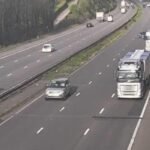
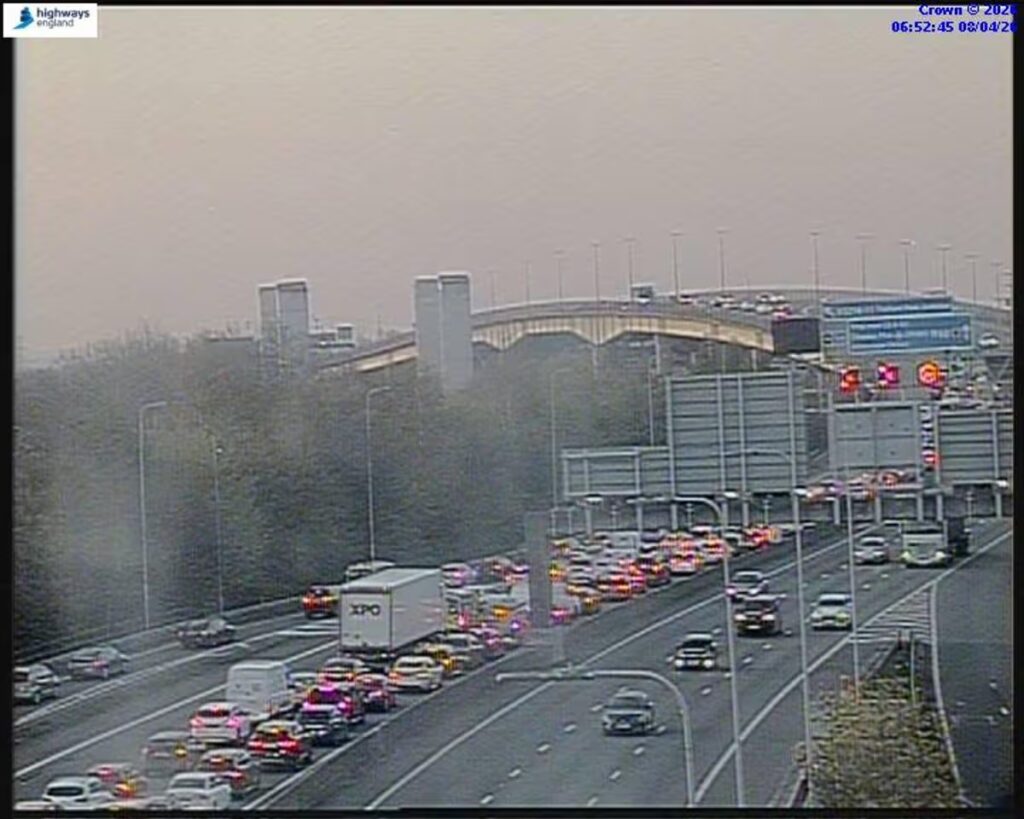
Traffic monitoring service Inrix confirmed that vehicles were being held on the motorway, describing the situation as “stationary traffic due to overturned lorry” on the viaduct. Images from traffic cameras showed dense queues forming rapidly, with brake lights stretching across multiple lanes.
As the morning progressed, partial relief came when one lane was reopened. However, three lanes remained closed, limiting traffic flow and prolonging delays. National Highways later reported congestion reaching up to five miles, with journey times significantly extended for commuters.
The disruption was not isolated to the M6. A separate incident on the M60 anticlockwise carriageway added further strain to the region’s road network. A police-related incident between junctions 10 and 11 near the Trafford Centre led to lane closures and queues stretching back towards junction 17.
Drivers attempting to divert away from the M6 found themselves caught in secondary congestion on connecting routes, including the M62 and M61. The combined effect created a widespread traffic bottleneck across Greater Manchester, particularly during peak commuting hours.
Emergency response and traffic recovery efforts
Emergency services were quickly dispatched to the M6 crash site, with police and highways officers working to secure the area and manage traffic. Recovery teams were also deployed to deal with the overturned lorry, a process that can take several hours depending on the condition of the vehicle and its load.
While no immediate details were released regarding injuries, the priority remained ensuring the safety of those involved and preventing further incidents on the busy motorway stretch. Authorities urged drivers to remain patient and follow diversion routes where possible.
According to updates from National Highways traffic updates, traffic conditions began to improve slightly later in the morning as controlled movement was reintroduced. Even so, delays of up to 30 minutes persisted as queues gradually cleared.
On the M60, traffic resumed movement after the initial incident, though lane closures remained in place for some time. The knock-on effects continued to impact travel across key junctions, with congestion lingering well into the late morning period.
For many drivers, the disruption highlighted the vulnerability of major motorway corridors to sudden incidents. The Thelwall Viaduct, in particular, is a known pressure point on the M6 due to its high traffic volume and strategic importance connecting northern regions.
Morning commuters described the situation as frustrating but not entirely unexpected, given the frequency of incidents on heavily used routes. Some reported delays exceeding an hour, while others opted to reroute through local roads, adding pressure to surrounding areas.
Transport analysts note that even a single-lane closure on a major motorway can significantly reduce capacity, especially during peak hours. In this case, the combination of multiple lane closures and a secondary incident created a near-perfect storm for congestion.
Similar incidents in recent years have demonstrated how quickly traffic conditions can deteriorate following accidents involving large vehicles. The process of clearing overturned lorries often involves specialist equipment and careful handling, further extending recovery times.
As traffic gradually returned to normal, attention turned to preventing further disruption and ensuring the motorway could safely reopen fully. Authorities continued to monitor conditions closely, advising drivers to check updates before setting out.
The events of the morning served as a reminder of how interconnected the UK’s motorway network is, with disruptions on one route quickly spilling over onto others. For thousands of commuters, the combination of the M6 crash and M60 incident turned a routine journey into a prolonged and uncertain commute.
Author Bio
Chetan is a Swikblog writer with 5 years of experience covering global news, stock market developments, and trending topics, focusing on clear reporting and real-world context for fast-moving stories.

Make Swikblog your go-to source on Google for reliable updates, smart insights, and daily trends.