
By Swikriti Dandotia
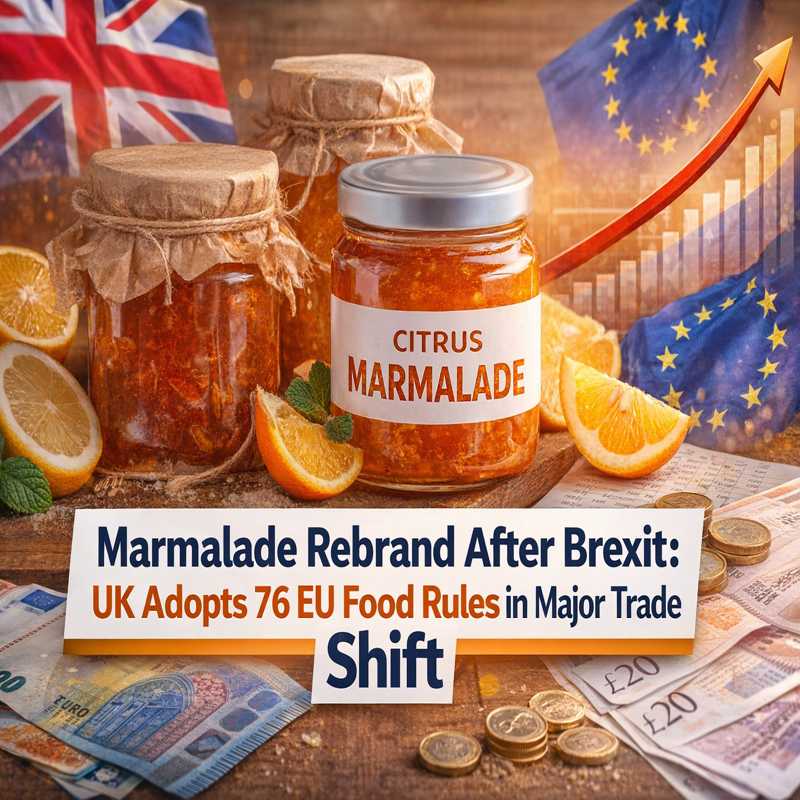
Britain’s beloved marmalade — a staple of breakfast tables for generations — is facing an unexpected identity shift. Under a proposed post-Brexit food agreement with the European Union, the classic spread may soon need to be labelled “citrus marmalade” rather than simply “marmalade.”
The change, while seemingly minor, is tied to a much larger development. The UK is considering aligning with 76 updated EU food regulations to reduce trade barriers, simplify exports, and improve economic ties with the bloc. For consumers, it may just mean a new label on the jar. But for businesses and policymakers, it signals a deeper reset in post-Brexit relations.
Marmalade has long held a special place in British culture. Traditionally made from bitter Seville oranges, it has been associated with the UK for centuries — from royal kitchens to literary icons like Paddington Bear. But its legal definition has also been uniquely British.
Back in the 1970s, the UK successfully lobbied European regulators to define marmalade strictly as a preserve made from citrus fruits. That meant any spread made from strawberries, plums, or other fruits had to be labelled as “jam.” While this protected the identity of British marmalade, it created confusion across Europe, where similar words — such as marmellata in Italy or mermelada in Spain — are used for a wide range of fruit spreads.
Now, Brussels has decided to modernise those rules. From June, EU countries will be allowed to market non-citrus fruit spreads as marmalade for the first time. To avoid confusion, however, products made specifically from citrus fruits will need to carry a clearer label: “citrus marmalade.”
If the UK adopts these updated rules, the change will apply across England, Wales, and Scotland. Northern Ireland is already set to implement the new labelling this summer under the Windsor Framework, which keeps the region aligned with certain EU regulations.
What the Marmalade Rebrand Means for Businesses
For food producers, the impact is immediate and practical. Manufacturers will need to redesign packaging, update product descriptions, and ensure compliance with the new legal definitions. Some companies have already started making changes, with one producer confirming it has renamed part of its product line, while others say all their labels may need to be revised. :
This comes at a time when the food industry is already facing rising costs from inflation, supply chain pressures, and changing trade requirements. Even a small labelling change can carry significant costs when applied across thousands of products.
There is also uncertainty about how far the UK will go. While the EU is broadening the definition of marmalade, it is not yet clear whether British regulators will allow non-citrus products — such as strawberry or plum spreads — to be sold as marmalade in the UK. Officials have previously warned that such a move could confuse consumers.
For now, the likely outcome is a middle ground: traditional citrus-based products will be labelled more specifically, while broader naming changes remain under review.
Consumers May Notice Less Than Expected
Despite the headlines, the average shopper may not see a dramatic difference. Labels like “orange marmalade” or “lemon marmalade” will still be allowed, meaning many products will retain familiar wording.
However, the subtle shift from “marmalade” to “citrus marmalade” could gradually reshape how the product is perceived — especially among international consumers. Over time, the term “marmalade” may become less uniquely associated with British citrus preserves and more broadly applied across different fruit spreads in global markets.
That raises questions about branding and identity. British marmalade has long enjoyed a distinct reputation, built on tradition and protected by regulation. The new rules could dilute that distinction, even if the recipe itself remains unchanged.
A Symbol of a Larger Post-Brexit Reset
The marmalade rebrand is about more than food labelling. It reflects the UK government’s broader strategy to improve trade with the EU while maintaining political distance from full membership.
By aligning with selected EU regulations, ministers hope to reduce red tape for exporters and potentially lower food prices for consumers. But the move also highlights the ongoing balancing act between regulatory independence and economic cooperation.
This is not the first time food rules have sparked cross-border tensions. In the past, disputes over chocolate composition, dairy standards, and even ice cream definitions have exposed how deeply regulation can shape everyday products. Marmalade is simply the latest example — but one with strong cultural resonance.
Traditionalists are already pushing back. The World Marmalade Awards in Cumbria, held annually since 2005, have confirmed they will continue to recognise only citrus-based marmalade, regardless of legal changes. For them, the definition is not just regulatory — it is part of British heritage.
That sentiment reflects a wider truth: while governments can rewrite rules, they cannot easily change how people think about food. Marmalade, for many, will always mean a jar of orange preserve on a breakfast table, no matter what the label says.
Still, the coming years could bring gradual change. With the broader UK-EU agreement expected to take shape around mid-2027, businesses and consumers alike will need to adapt to a new regulatory landscape.
In the end, the taste of marmalade will stay the same. But its name — and what it represents — is evolving, offering a small yet powerful glimpse into how Brexit continues to reshape everyday life in Britain.

Make Swikblog your go-to source on Google for reliable updates, smart insights, and daily trends.