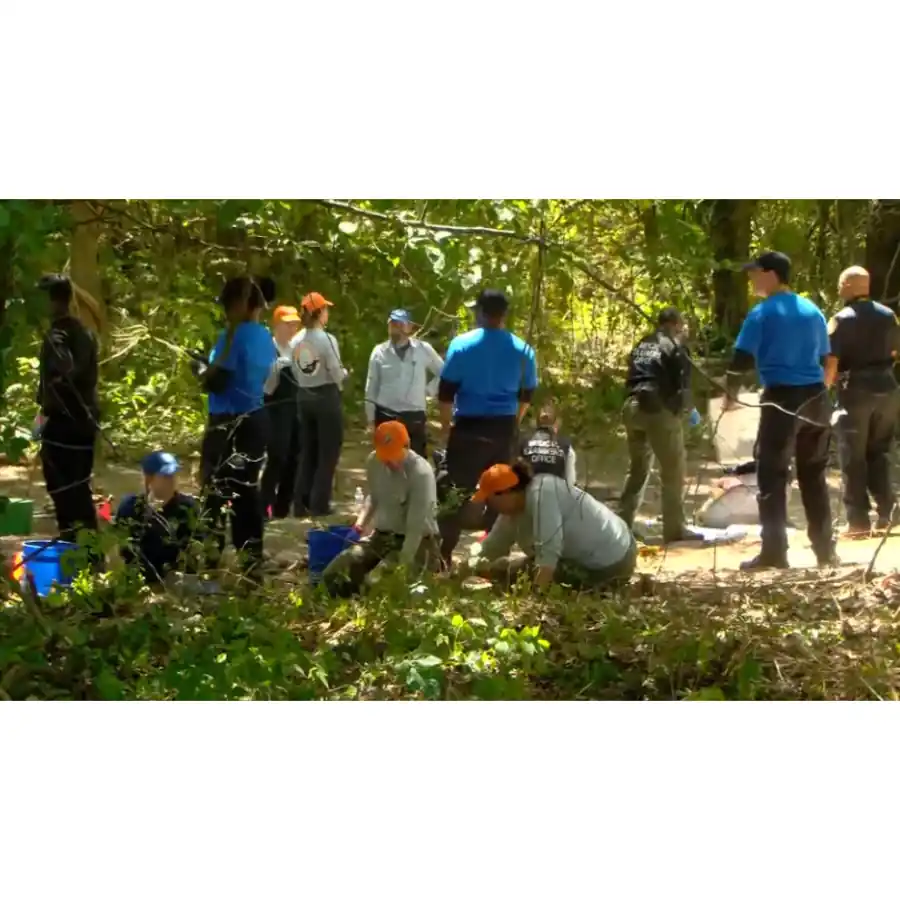

The discovery of skeletal remains believed to belong to three young children in southeast Memphis has turned a quiet stretch of Hickory Hill into the focus of a grim, widening investigation. What police first treated as a disturbing isolated find has grown into a broader search for answers about who the children were, how they died, and why no immediate missing-person match has surfaced.
Authorities say the investigation began on March 8 after a woman walking her dog near the 3400 block of Ridge Meadow Parkway reported seeing what looked like a human skull near a wooded area. Officers responded and confirmed the find, but because it was already dark, a larger search was pushed to the following day. That decision marked the start of a methodical, weeks-long recovery effort that has since drawn in local, state and federal resources.
Read More
When investigators returned, the initial concern deepened quickly. Memphis Police officers worked with the Shelby County Medical Examiner’s Office to search the area, and over the next several days cadaver dogs were used to scan the wooded stretch and nearby drainage areas. One of the key moments in the search came when K-9 units alerted investigators to a drainage pipe, suggesting there could be additional remains nearby or inside the system.
At first, the drainage line was inspected using cameras, but that early look did not immediately produce a major breakthrough. The investigation, however, did not lose momentum. Weeks later, on April 1, authorities accessed the drainage system again from a different nearby point and located what appeared to be a second skull. On April 2, search teams recovered 14 additional bones consistent with human remains, strengthening the conclusion that the remains likely belong to three separate children.
A case that has become bigger than one crime scene
Memphis Police Chief Cerelyn “CJ” Davis said the children are believed to have been between the ages of 3 and 7. She also said forensic experts believe the bones may have been in the area for “a few years,” a detail that sharply changes the nature of the case. This is no longer simply a question of what happened in recent weeks. It is potentially a much older mystery involving children whose disappearance may not have triggered immediate attention in the city where they were found.
That possibility has become one of the most unsettling parts of the investigation. Police say a review of recent missing persons reports in Memphis has not produced a match. Investigators are now looking beyond the city and considering whether the children may have come from outside the area. In practical terms, that means the wooded site in Hickory Hill may only be one piece of a much larger puzzle involving older records, regional databases and the possibility that critical information sits far from where the remains were found.
Officials have been careful not to speculate beyond what evidence currently supports. They have not publicly identified the children, announced a cause of death or detailed whether they believe foul play can already be firmly established. But the seriousness of the response leaves little doubt that authorities see this as a major and sensitive investigation. Around 170 personnel from multiple agencies, including the FBI and the Tennessee Bureau of Investigation, have taken part in search operations and evidence recovery.
Police have also emphasized that the scale of the law enforcement presence should not be mistaken for a current public safety warning. Chief Davis said there is no indication of an active threat to the public. Instead, the extensive search reflects the terrain, the complexity of the evidence recovery and the determination to search thoroughly for anything that might help explain what happened.
That includes the kind of forensic work that often proceeds out of public view. When investigators recover only bone fragments, identifying victims can depend on a mix of anthropology, dental review when possible, and DNA testing. In a case involving children and older remains, that process can be both slow and crucial. The National Missing and Unidentified Persons System is one of the major tools used in cases like this to compare unidentified remains with reports from across jurisdictions.
The hardest question may still be the simplest one
For residents in Hickory Hill, the immediate shock is obvious. The harder part is what comes after the headlines: the realization that investigators now believe the remains may have been there for years. In a neighborhood setting, that detail lands with unusual force. It suggests not only loss, but also silence — time passing without names, without clear reports, and without the children being brought back into public memory until a chance encounter during a dog walk changed everything.
That is part of why the case has resonated so strongly. It is not just the scale of the discovery, but the absence surrounding it. No belongings have been publicly identified. No obvious local missing-child case has lined up with the ages of the victims. And no clear narrative has yet emerged to explain how three children ended up in the same area. Investigators are now working from fragments, both literal and procedural, to reconstruct lives that should never have disappeared into uncertainty.
As search operations continue, the public plea from law enforcement has remained consistent: somebody may know something that matters. That could mean a long-unanswered question about a child who vanished, a memory that once seemed too small to report, or information from outside Memphis that suddenly looks relevant now. Authorities have urged anyone with information to contact police or CrimeStoppers.
For now, identification remains the central task. Before the city can understand how these children died, it first needs to know who they were. Until that happens, the Memphis case will remain defined by a troubling gap between discovery and recognition — and by the hope that persistent forensic work, interagency coordination and public tips will finally give these children back their names.
Also read: UK Biobank data breach exposes 500,000 records on a Chinese marketplace

Make Swikblog your go-to source on Google for reliable updates, smart insights, and daily trends.