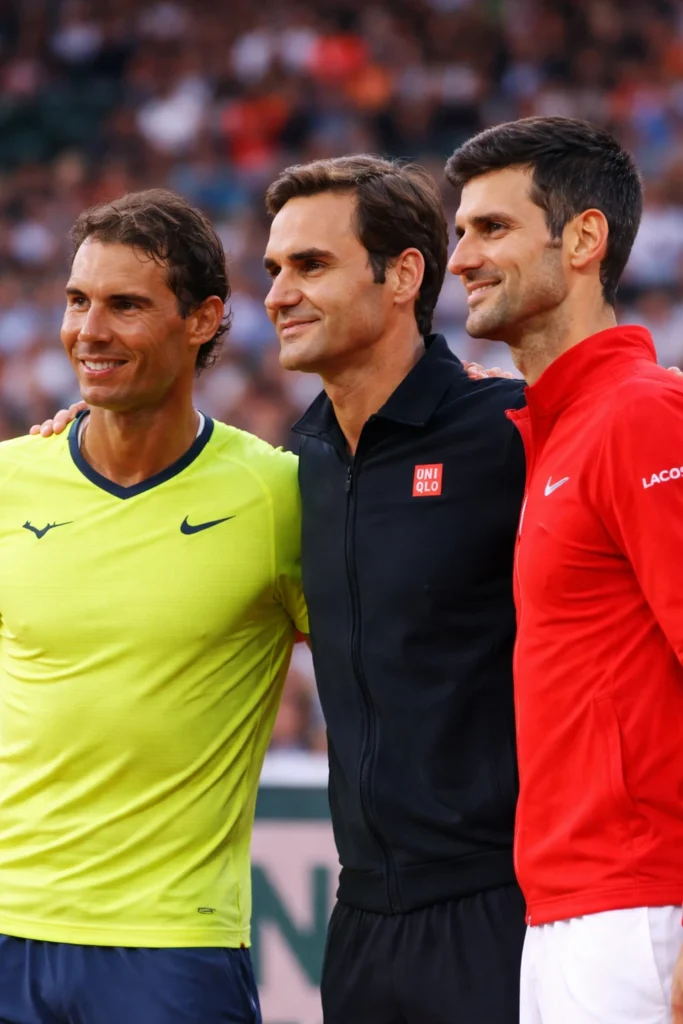

The tennis GOAT debate never stays quiet for long, and Ivan Ljubicic has just given it fresh life. The former world No. 3, who faced Roger Federer, Rafael Nadal and Novak Djokovic during his own career and later coached Federer, offered a view that cuts straight into one of sport’s most emotional arguments. For Ljubicic, the answer is not as simple as counting trophies, because while Djokovic’s record is unmatched in several key categories, Federer and Nadal changed the sport in ways that are still being felt across generations of players and fans.
That is exactly why this debate refuses to fade. On paper, Djokovic has built the most complete statistical case. He owns the men’s record for 24 Grand Slam singles titles, has spent longer at the top than any other man in the ATP rankings era, and has gone head-to-head with both Federer and Nadal often enough to leave no doubt about the scale of his achievement. Yet tennis has never been a sport judged only by numbers. Style, cultural pull, aura, rivalry, timing and influence all matter, and Ljubicic’s comments leaned heavily into that wider picture.
Read also: The GOAT debate in men’s tennis remains split between numbers, influence and legacy, which is why every fresh comment from someone who actually competed against all three instantly becomes a major talking point.
Ljubicic’s perspective carries weight because he did not watch this era from the outside. He lived it. He felt Djokovic’s returning power, Federer’s unpredictability and Nadal’s relentless ability to drag opponents into punishing rallies. His comments are especially striking because he openly called Djokovic the toughest opponent for his own game. That matters. Ljubicic was known for a big serve and first-strike tennis, the kind of approach that could earn free points against many players. Against Djokovic, he suggested, those free points largely disappeared. That is a revealing insight into why Djokovic became such a suffocating force in the sport’s biggest matches.
Even so, Ljubicic did not simply hand Djokovic the GOAT label and move on. Instead, he shifted the conversation toward impact. Federer’s influence on modern tennis was enormous, not just because of his titles, but because of the elegance and control with which he played. He made impossible tennis look smooth, and in doing so drew millions of casual viewers deeper into the sport. For a huge section of the global audience, Federer was the gateway. He turned excellence into a kind of art, and that helped tennis expand beyond its usual core following.
Nadal’s place in that discussion is just as powerful. If Federer represented fluency and grace, Nadal embodied fight, endurance and emotional intensity. His rise reshaped the competitive balance of the era, especially on clay, where he built one of the most untouchable records in sports history. But reducing Nadal to Roland Garros alone has always missed the bigger point. His mentality, physical commitment and refusal to surrender became a model for younger players across the tour. Nadal made resilience central to his identity, and that legacy has outlived many of his biggest matches.
Djokovic, meanwhile, changed the standards of completeness. He became the benchmark for returning, elasticity, movement, problem-solving and mental durability under scoreboard pressure. What separated him from almost everyone was not just his ability to win, but his ability to win against the very best, repeatedly, in the most hostile environments. He beat Federer on major stages. He beat Nadal on major stages. He won across surfaces, across eras and across tactical styles. The statistical mountain he built is the reason so many fans believe the debate should already be over.
But that is where Ljubicic’s comments hit a nerve. He was not dismissing Djokovic’s greatness. He was challenging the idea that greatness can be reduced to one category. That is why this remains the ultimate tennis argument. Federer gave the sport beauty and global magnetism. Nadal gave it emotion and ferocious competitive honesty. Djokovic gave it ruthless efficiency and an almost unmatched capacity to solve every tennis problem placed in front of him. Depending on what a fan values most, the conclusion can still change.
There is also the matter of timing. Federer arrived first and became the symbol of a new era. Nadal arrived as the disruptor who forced that greatness to prove itself under pressure. Djokovic arrived as the closer, the player who refused to let the rivalry remain a two-man story. Together, they did more than dominate tournaments. They turned men’s tennis into a long-running global drama, one built on contrast as much as excellence. Federer’s fluid precision, Nadal’s physical intensity and Djokovic’s cold control made each man’s case stronger because each had to survive the others.
That is why quotes like Ljubicic’s land so hard. Fans are not just arguing over totals. They are defending what they think tennis should reward. Some will always side with Djokovic because the records are too overwhelming to ignore. Others will continue to back Federer because influence, style and inspiration count for something bigger than arithmetic. Many will stand with Nadal because few athletes in any sport have combined durability, emotional connection and single-surface dominance in such a staggering way.
In the end, Ljubicic may have highlighted the one truth that keeps this debate alive: there may never be a single answer that satisfies everyone. Djokovic has the strongest numerical argument. Federer has perhaps the deepest aesthetic and cultural legacy. Nadal has one of the most emotionally resonant careers sport has seen. That is not a weakness in the debate. It is the reason it still matters. The Big Three did not just win titles. They gave tennis three different versions of greatness, and that is why every fresh verdict feels like a headline again.
For now, the sport continues to move forward, with a new generation building its own story. But whenever Federer, Nadal and Djokovic return to the conversation, tennis is reminded of the standard they set. And when someone like Ljubicic, who stood across the net from all three and later worked inside Federer’s camp, says the GOAT discussion cannot be settled by one simple answer, it only adds more fuel to a debate that may never truly end.
For official player records and career statistics, see the ATP Tour.
You May Also Like
Explore more trending sports and global news coverage on Swikblog

Make Swikblog your go-to source on Google for reliable updates, smart insights, and daily trends.