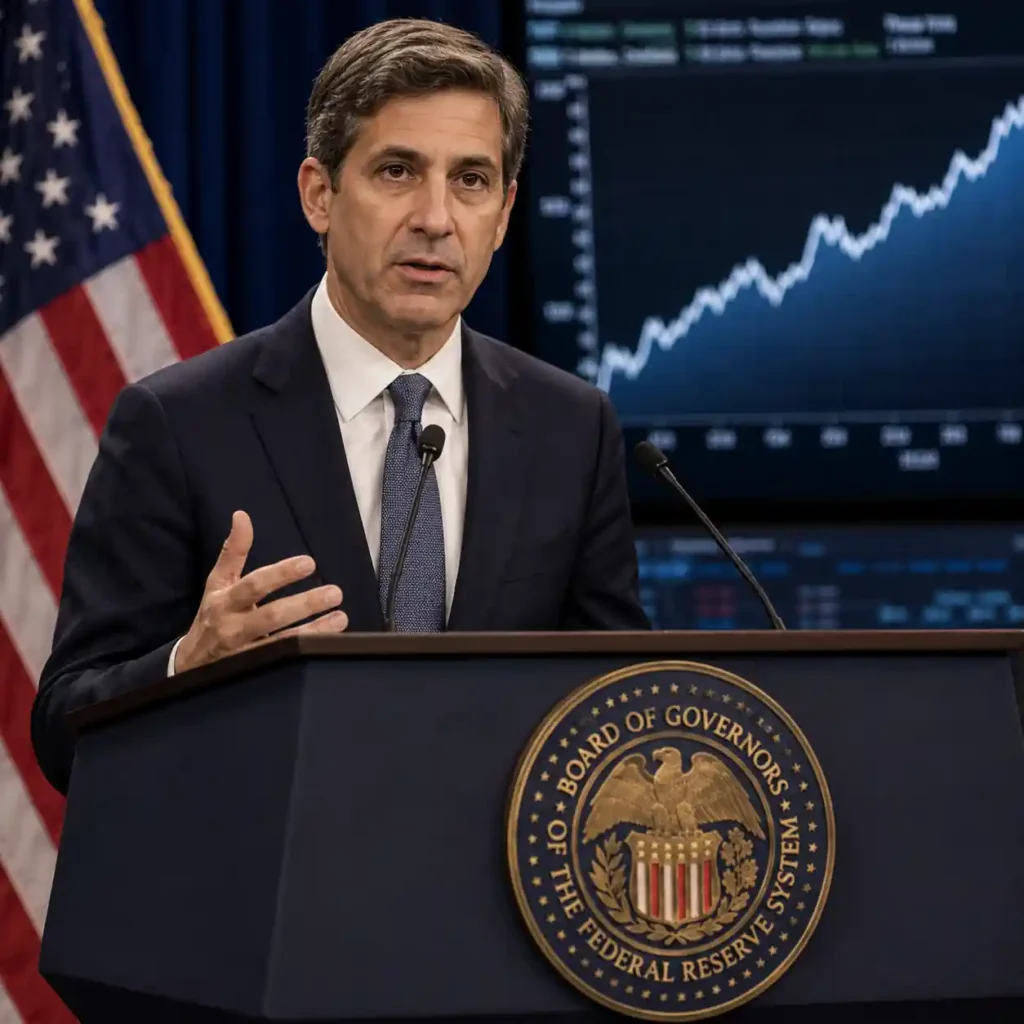

The US Federal Reserve kept its benchmark interest rate unchanged at 3.50% to 3.75% on July 29, 2026, extending its pause for a fifth consecutive policy meeting.
The Federal Open Market Committee, which sets US monetary policy, approved the decision by a 9–3 vote. Although no increase was announced, three officials supported raising the target range by 0.25 percentage points, making the disagreement inside the central bank an important part of the latest decision.
Why Did the Fed Keep Interest Rates Unchanged?
The Fed said the US economy continued to expand at a solid pace despite uncertainty linked partly to the conflict in the Middle East. Officials highlighted strong productivity and capital investment, while job growth had broadly kept pace with the available workforce.
Inflation remained the central concern. The committee said price growth was still above its long-term 2% goal, with supply disruptions contributing to higher costs in sectors such as energy.
Holding rates steady gives policymakers more time to determine whether inflation is cooling consistently or whether another increase may be required. The decision continued the cautious approach seen during the Fed’s earlier interest-rate pause, although the three dissenting votes made the July outcome more significant.
Three Fed Officials Supported a Rate Hike
Beth Hammack, Neel Kashkari and Lorie Logan voted against the majority decision. All three preferred a quarter-point increase, which would have moved the federal funds rate to 3.75%–4.00%.
Their opposition matters because it shows that concern about inflation is not limited to cautious language in the policy statement. A larger group could support tighter policy in September if price pressures remain persistent.
However, nine committee members supported leaving the range unchanged. The official vote therefore represents a pause accompanied by a clear inflation warning, rather than a confirmed move toward an immediate increase.
Latest Inflation Data After the Fed Decision
Fresh government figures released one day after the meeting added more context to the policy debate. The US Bureau of Economic Analysis reported that the Personal Consumption Expenditures price index increased 3.7% in June from a year earlier, compared with a revised 4.1% annual rate in May.
Core PCE inflation, which excludes food and energy, was 3.3% annually. The PCE index is closely monitored by the Fed, and both readings remained above the central bank’s 2% objective.
The monthly headline index decreased 0.1% in June, but a single month does not establish a lasting trend. The earlier increase in the Fed’s preferred PCE inflation measure helps explain why policymakers remain cautious despite the latest monthly decline.
US Economic Growth Adds to the Policy Challenge
The advance estimate released July 30 showed that real US gross domestic product expanded at an annual rate of 1.5% in the second quarter, down from 2.1% in the first quarter.
Consumer spending, investment and exports contributed to growth, while government spending decreased. The figures suggest that the economy is still expanding, although the overall pace slowed.
This combination complicates the Fed’s choice. Slower growth can argue against tighter borrowing conditions, while above-target inflation can support keeping rates elevated or considering another increase.
What the Fed Decision Means for Consumers
The federal funds rate affects short-term borrowing conditions, but it does not directly set every consumer interest rate. Credit-card rates, variable-rate loans and some business financing costs can remain expensive while the benchmark range stays elevated.
Mortgage rates depend more heavily on Treasury yields, inflation expectations and lender conditions. Therefore, a Fed pause does not automatically produce lower home-loan rates.
Savers may continue to benefit from competitive returns on certain savings accounts and certificates of deposit. Individual banks can still adjust their rates independently, so available offers may differ.
Read More
When Is the Next Federal Reserve Meeting?
The next scheduled FOMC meeting will take place on September 15–16, 2026. The interest-rate decision is expected at 2:00 p.m. Eastern Time on September 16, followed by a press conference led by Fed Chairman Kevin Warsh.
The September meeting will include updated economic projections covering inflation, unemployment, growth and policymakers’ expected interest-rate path. The remaining scheduled meetings are October 27–28 and December 8–9, according to the official Federal Reserve calendar.
Before September, markets will focus on new PCE inflation, consumer-price and employment reports. Those figures—not the July pause alone—will provide the strongest evidence about whether the Fed is likely to hold rates again or consider an increase.

Make Swikblog your go-to source on Google for reliable updates, smart insights, and daily trends.