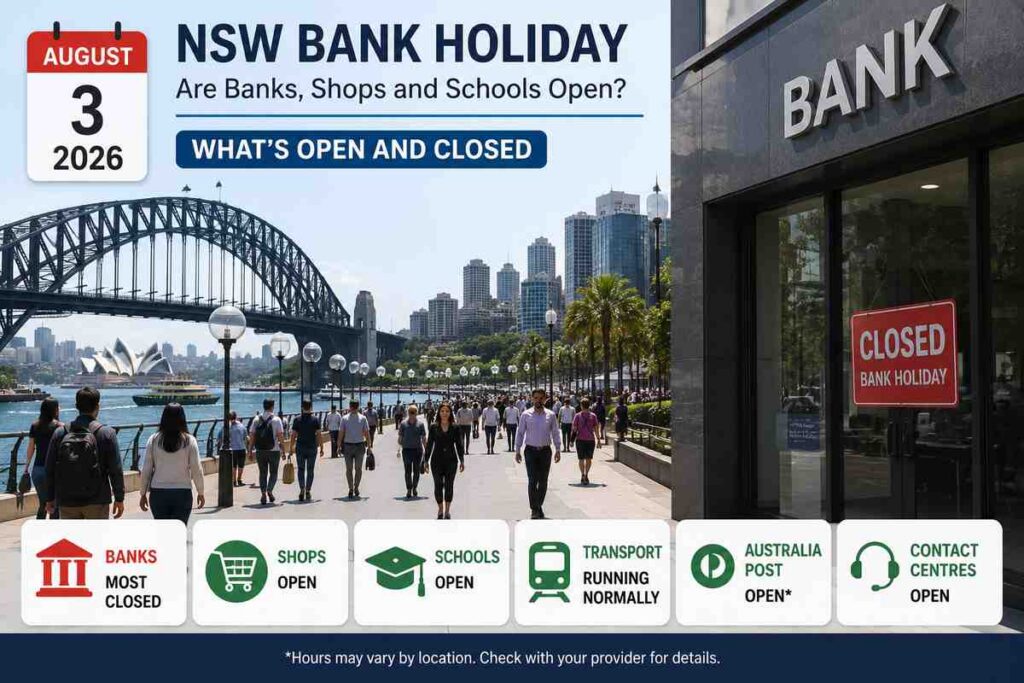

NSW Bank Holiday 2026 falls on Monday, August 3, but it is not a general public holiday across New South Wales.
The day mainly affects retail bank branches and certain financial institutions. Most supermarkets, schools, workplaces, public transport services and government offices are expected to operate normally.
Anyone needing face-to-face banking should complete urgent transactions before the weekend or check their branch’s opening arrangements in advance.
What is open and closed on the NSW Bank Holiday?
The NSW Government public holiday calendar confirms that the Bank Holiday is observed on the first Monday in August. In 2026, it falls on August 3.
Retail bank branches and certain financial institutions are required to close unless an exemption applies. However, the holiday does not apply to most shops, schools or other workplaces.
| Service | Expected status |
|---|---|
| Retail bank branches | Most closed |
| ATMs and online banking | Available |
| Supermarkets and shopping centres | Generally open |
| Schools and universities | Generally open |
| Restaurants and cafés | Generally open |
| Public transport | Weekday services expected |
| Government offices | Generally open |
| Hospitals and emergency services | Open |
Qudos Bank has advised customers that its NSW branches will be closed, while its contact centre will remain open from 7am to 7pm AEST.
Customers of Commonwealth Bank, Westpac, NAB, ANZ and other financial institutions should check their bank’s website or app because individual branches may have different arrangements.
ATMs, debit and credit cards, internet banking, mobile banking and digital wallets should continue working. Services that require branch staff, including bank cheques, large cash transactions, identity verification and document certification, may be unavailable until Tuesday.
Most electronic payments should continue normally. However, traditional transfers, business payments or manually reviewed transactions could take longer, so customers expecting an urgent payment should confirm the processing schedule with their bank.
Supermarkets such as Coles, Woolworths, Aldi and IGA are expected to follow their regular Monday trading hours. Shopping centres, restaurants and local retailers should also remain open.
Readers planning to shop can also check our guide to Australian public holiday store openings and closures, which explains how trading arrangements can differ between retailers and states.
Schools, universities, TAFE campuses and childcare centres are generally expected to operate normally unless an individual institution announces different arrangements.
Sydney Trains, Metro, buses, ferries and light rail services should run according to normal weekday schedules. Passengers should use the official Transport for NSW Trip Planner to check trackwork, delays or timetable changes before travelling.
For more background on rail services in the state, read our report on the upgraded XPT train returning to NSW tracks.
Is August 3 a public holiday for NSW workers?
No. The NSW Bank Holiday is not a general public holiday for most employees. Workers outside affected banking and financial institutions are normally expected to follow their regular schedules.
Most employees do not automatically receive a paid day off or public holiday penalty rates because of the Bank Holiday. Anyone uncertain about workplace entitlements should review their award or employment agreement and consult the Fair Work Ombudsman.
The NSW Bank Holiday should not be confused with major statewide holidays such as the King’s Birthday or Labour Day. Our guide explaining where the King’s Birthday is observed in Australia provides a useful comparison of how public holiday dates vary between states.
Service NSW centres, government offices, pharmacies and everyday services are generally expected to remain open. Hospitals, police, ambulance and other emergency services will continue operating.
For most NSW residents, Monday, August 3 will feel like a normal working day. Physical bank branches will be the main services affected, while shopping, education, transport and government services should continue as usual.
Opening hours can vary by location. Check directly with your bank, retailer, school or service provider before travelling.

Make Swikblog your go-to source on Google for reliable updates, smart insights, and daily trends.