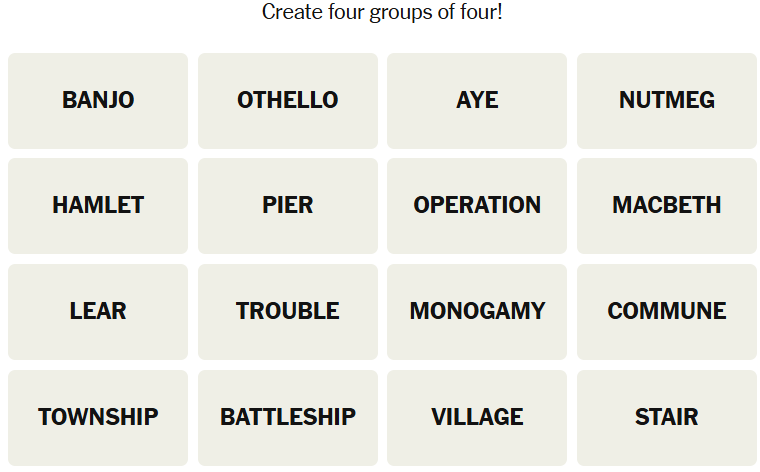
NYT Connections puzzle #1081 for May 27, 2026, looked simple at first glance, but the board was built around clever misdirection. Several words seemed to belong together immediately, especially the literary-looking entries, but the real answers depended on geography, board games, pronunciation and hidden word endings.
The biggest trap came from Hamlet, Othello, Lear and Macbeth, which appeared to point toward Shakespeare. That obvious connection was exactly what made the puzzle dangerous. Only by checking each four-word group carefully could players avoid losing guesses too early.
NYT Connections May 27 Hints
Yellow hint: Think of smaller places where people live together.
Green hint: These four words can all be found on classic game shelves.
Blue hint: Say the words out loud. The connection is based on sound, not spelling.
Purple hint: Look at the final letters of each word. The hidden names are the key.
Main trap: The puzzle strongly suggested a Shakespeare category, but that was a false path. Hamlet, Othello, Lear and Macbeth were placed to distract players from cleaner groupings elsewhere on the board.
Today’s NYT Connections Answers
Yellow Group
Category: Small community
Answers: Commune, Hamlet, Township, Village
Explanation: All four words describe smaller populated communities or settlements. Village and township were the clearest anchors, while commune and hamlet completed the geography-based group.
Why players got trapped: Hamlet looked like part of a Shakespeare set, especially with Macbeth, Lear and Othello also on the board.
Green Group
Category: Classic board games
Answers: Battleship, Operation, Othello, Trouble
Explanation: These are all familiar board games. Battleship and Trouble were likely the easiest entry points, while Othello doubled as a strong literary distraction.
Why players got trapped: Othello looked like Shakespeare bait, while Operation and Trouble can read as ordinary nouns instead of game titles.
Blue Group
Category: Homophones of ways of looking
Answers: Aye, Lear, Pier, Stair
Explanation: These sound like eye, leer, peer and stare — all connected to seeing or looking.
Why players got trapped: The pattern only works when spoken aloud. Lear also kept the Shakespeare misdirection alive.
Purple Group
Category: Ending in the “Little Women” March sisters
Answers: Banjo, Macbeth, Monogamy, Nutmeg
Explanation: The words end with Jo, Beth, Amy and Meg — the names of the March sisters from Little Women.
Why players got trapped: Macbeth again pushed players toward Shakespeare, while the real pattern was hidden at the end of each word.
The best strategy today was to avoid trusting the first obvious literary pattern. This board rewarded players who checked pronunciation, word endings and exact four-word logic before submitting a group.
Swikblog News Desk delivers timely, fact-driven coverage across global markets, business, technology, and trending stories. Focused on clarity and accuracy, the team provides concise updates that keep readers informed on the stories shaping the world.
We use cookies on our website to give you the most relevant experience by remembering your preferences and repeat visits. By clicking “Accept All”, you consent to the use of ALL the cookies. However, you may visit "Cookie Settings" to provide a controlled consent.
This website uses cookies to improve your experience while you navigate through the website. Out of these, the cookies that are categorized as necessary are stored on your browser as they are essential for the working of basic functionalities of the website. We also use third-party cookies that help us analyze and understand how you use this website. These cookies will be stored in your browser only with your consent. You also have the option to opt-out of these cookies. But opting out of some of these cookies may affect your browsing experience.
Necessary cookies are absolutely essential for the website to function properly. These cookies ensure basic functionalities and security features of the website, anonymously.
Cookie
Duration
Description
cookielawinfo-checkbox-analytics
11 months
This cookie is set by GDPR Cookie Consent plugin. The cookie is used to store the user consent for the cookies in the category "Analytics".
cookielawinfo-checkbox-functional
11 months
The cookie is set by GDPR cookie consent to record the user consent for the cookies in the category "Functional".
cookielawinfo-checkbox-necessary
11 months
This cookie is set by GDPR Cookie Consent plugin. The cookies is used to store the user consent for the cookies in the category "Necessary".
cookielawinfo-checkbox-others
11 months
This cookie is set by GDPR Cookie Consent plugin. The cookie is used to store the user consent for the cookies in the category "Other.
cookielawinfo-checkbox-performance
11 months
This cookie is set by GDPR Cookie Consent plugin. The cookie is used to store the user consent for the cookies in the category "Performance".
viewed_cookie_policy
11 months
The cookie is set by the GDPR Cookie Consent plugin and is used to store whether or not user has consented to the use of cookies. It does not store any personal data.
Functional cookies help to perform certain functionalities like sharing the content of the website on social media platforms, collect feedbacks, and other third-party features.
Performance cookies are used to understand and analyze the key performance indexes of the website which helps in delivering a better user experience for the visitors.
Analytical cookies are used to understand how visitors interact with the website. These cookies help provide information on metrics the number of visitors, bounce rate, traffic source, etc.
Advertisement cookies are used to provide visitors with relevant ads and marketing campaigns. These cookies track visitors across websites and collect information to provide customized ads.