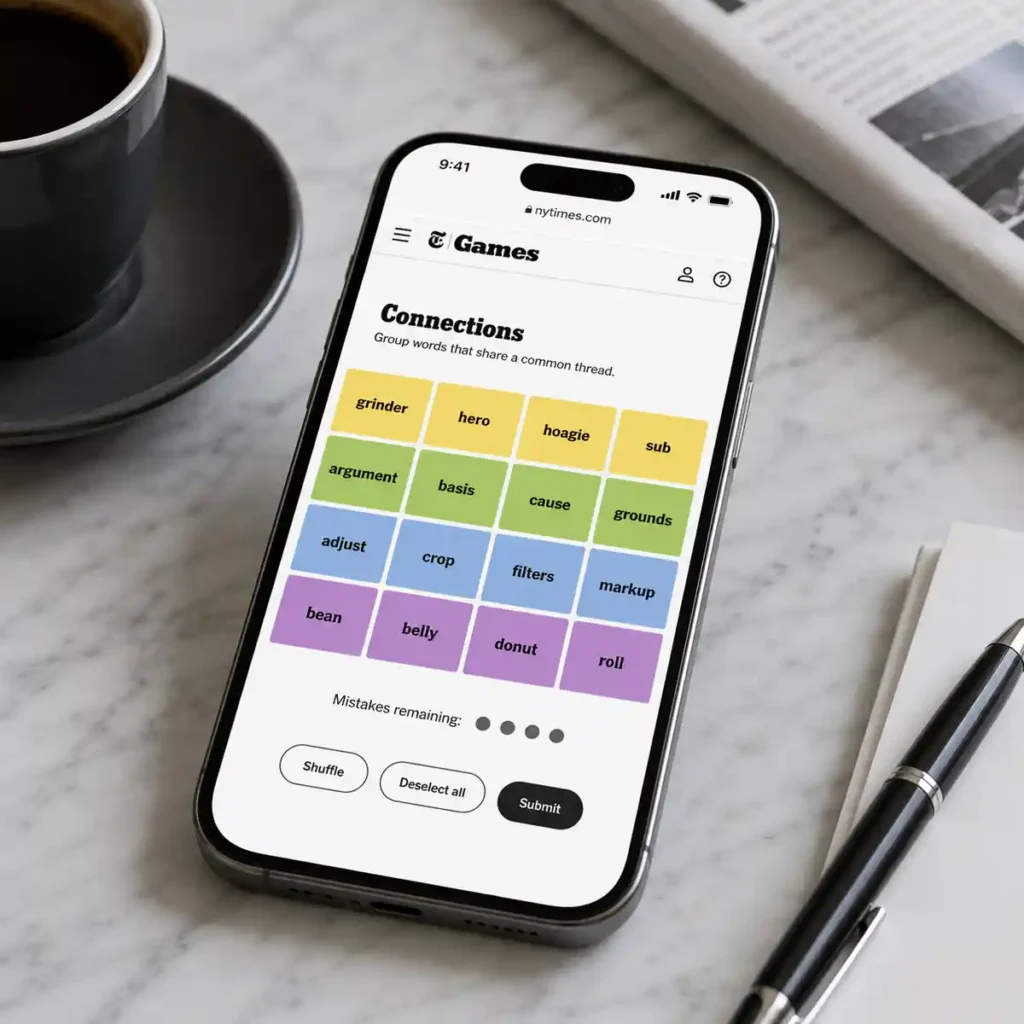

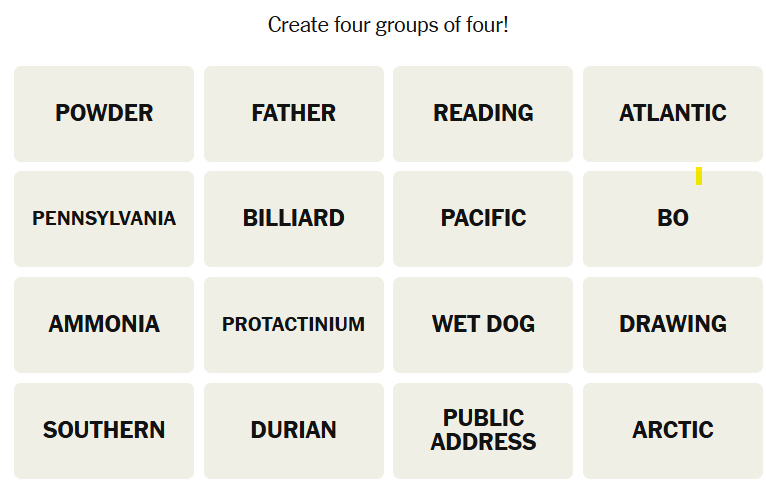
NYT Connections for May 29, 2026, puzzle #1083, was tougher than it first looked because several words appeared simple on their own but changed meaning once paired with the right group. The yellow set was fairly direct, but the green, blue and purple categories required solvers to think beyond literal definitions.
The main traps were “powder,” “drawing,” “father” and “PA.” Some words pushed players toward substances, actions or family terms, while the real solutions depended on odors, mansion rooms and different meanings of the abbreviation “PA.”
NYT Connections May 29 Hints
Yellow hint: Think of major bodies of water.
Sharper clue: These are all named oceans.
Trap to avoid: Do not group them only as directions or regions. “Southern” is the one that may slow you down.
Green hint: These are known for having recognizable smells.
Sharper clue: One is chemical, one is bodily, one is a fruit, and one is a familiar phrase.
Trap to avoid: Do not try to make them all foods, chemicals or unpleasant things. The link is distinctive odor.
Blue hint: Think of rooms in a large old house.
Sharper clue: Each answer can come before the word “room.”
Trap to avoid: “Drawing” is not a sketching action here, and “powder” is not about makeup or chemicals.
Purple hint: Think about what “PA” can stand for.
Sharper clue: The answers come from family language, geography, chemistry and audio equipment.
Trap to avoid: Do not look for one shared topic. This group works through abbreviation and alternate meaning.
Common wrong paths: “Ammonia” and “powder” may look like they belong together because both can suggest substances, but “powder” belongs with rooms. “Father” can look isolated until you read it as “pa.” “Drawing” may mislead players toward art, while the intended phrase is “drawing room.” The purple group is especially tricky because Pennsylvania, protactinium and public address do not feel connected until “PA” becomes the anchor.
Today’s NYT Connections Answers
Yellow Group
Green Group
Blue Group
Purple Group
Today’s board rewarded solvers who checked phrase endings and abbreviations before forcing obvious-looking word pairs. When a set feels scattered, the connection may be hiding in what the words can stand for rather than what they mean on the surface.
For official gameplay and post-game analysis, players can visit the New York Times Connections page.

Make Swikblog your go-to source on Google for reliable updates, smart insights, and daily trends.