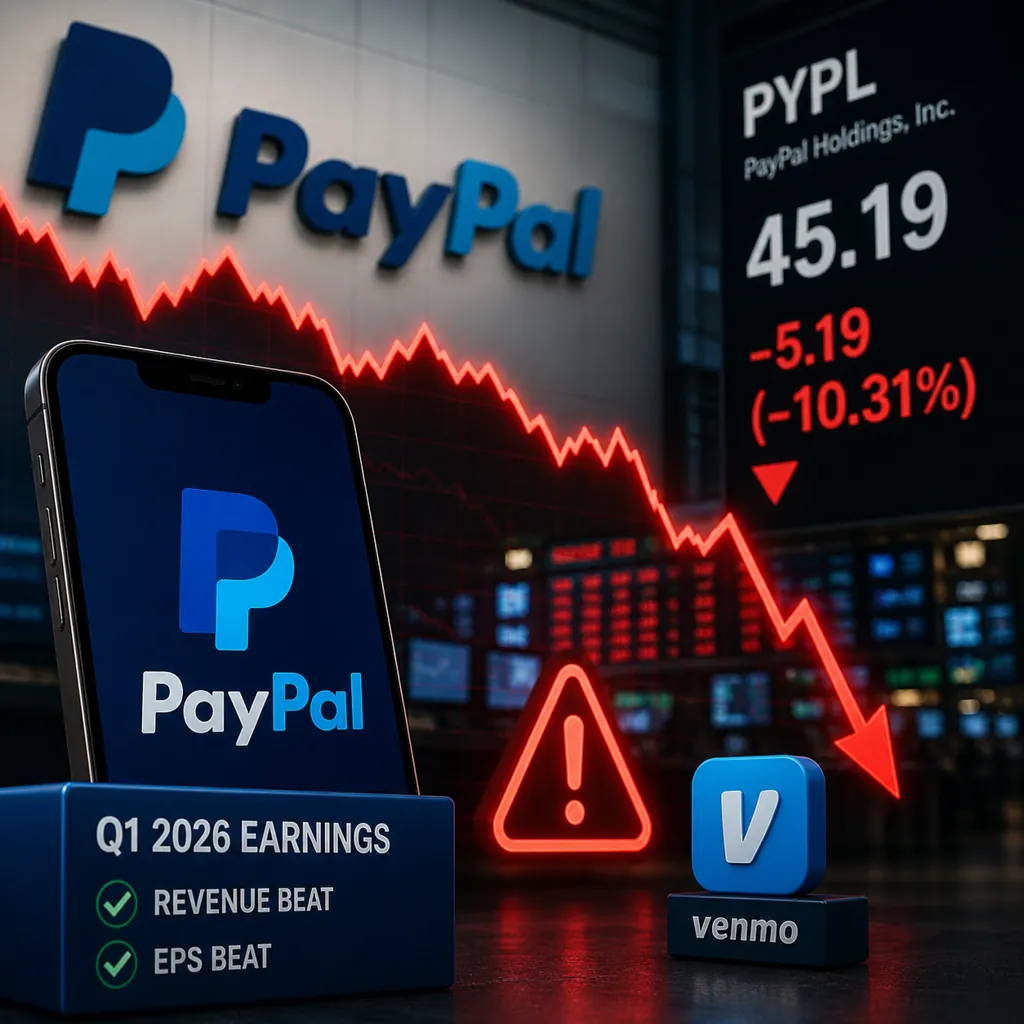

PayPal stock plunged more than 10% on Tuesday even after the payments company reported stronger-than-expected first-quarter earnings, as investors focused instead on a softer near-term outlook, pressure in branded checkout and uncertainty around the future of Venmo.
Shares of PayPal Holdings Inc. (NASDAQ: PYPL) fell to around $45.19 in morning trading, down about 10.31%, after closing the previous session near $50.39. The reversal came after an initial positive reaction to the company’s Q1 results faded during management commentary with Wall Street analysts.
PayPal reported adjusted earnings of $1.34 per share, ahead of analyst expectations of $1.27. Revenue rose 7% year over year to about $8.35 billion, also beating estimates near $8.05 billion. Total payment volume climbed 11% to roughly $463.95 billion, while transaction margin dollars increased 3% to about $3.81 billion.
The stronger headline numbers were not enough to offset concern over PayPal’s second-quarter outlook. The company guided for adjusted EPS to decline about 9% year over year in Q2, raising questions about whether the Q1 beat reflected durable momentum or a temporary backward-looking improvement.
Outlook Pressure Overshadows Strong Q1 Metrics
The sharp move lower showed how heavily investors are weighing forward earnings trends in fintech stocks. PayPal remains profitable and continues to generate strong cash flow, but the market is looking for clearer evidence that its core checkout business can stabilize against growing competition from Apple Pay, Stripe, Block and other digital payment rivals.
Management also reiterated its full-year 2026 guidance while announcing a $1.5 billion cost reduction program over the next two to three years. The company repurchased $1.5 billion of stock during the first quarter, adding to a larger capital return effort that has remained one of the bull-case arguments for PYPL stock.
Still, investors appeared more focused on the earnings call commentary, including concerns around branded checkout trends, softer travel-related activity and pressure in Europe. PayPal’s branded checkout button remains central to the stock’s valuation debate, especially as Apple’s services ecosystem and rival payment rails continue to expand.
For broader company filings and investor materials, PayPal’s latest updates are available through its official investor relations page.
Venmo Review and Restructuring Keep Investors Divided
Another major focus is Venmo, which remains one of PayPal’s most recognizable consumer brands. Management is reviewing strategic options for Venmo, including the possibility of a spin-off, partnership, joint venture or sale. Venmo generated about $1.7 billion in revenue in 2025, according to the provided market commentary.
A Venmo spin-off could help investors value the consumer payments brand separately from PayPal’s legacy checkout business. But it could also create added costs, operational complexity and uncertainty over how much value would actually be unlocked.
PayPal has also reorganized into three business segments: Checkout Solutions and PayPal, Consumer Financial Services and Venmo, and Payment Services and Crypto. The restructuring could improve accountability and make performance easier for investors to track, but the market is waiting for clearer evidence that the new structure can revive growth.
The stock’s valuation is now part of the debate. Bulls point to PayPal’s lower earnings multiple, large buybacks and potential activist interest after years of share-price weakness. Bears argue that lower forward EPS, intense competition and uncertainty around branded checkout make it difficult to justify a quick rebound.
PYPL entered the report already under pressure, down about 14% in 2026 and sharply lower over the past year. With the stock now near the mid-$40s, investors are watching whether shares can hold above the 52-week low of $38.34 if selling pressure continues.
PayPal’s Q1 report delivered the earnings beat investors usually want, but the stock’s sharp reversal showed that the market is demanding more than backward-looking numbers. The next phase of the PYPL story will depend on whether management can show improving checkout trends, provide more clarity on Venmo and turn cost cuts into stronger earnings momentum.

Make Swikblog your go-to source on Google for reliable updates, smart insights, and daily trends.