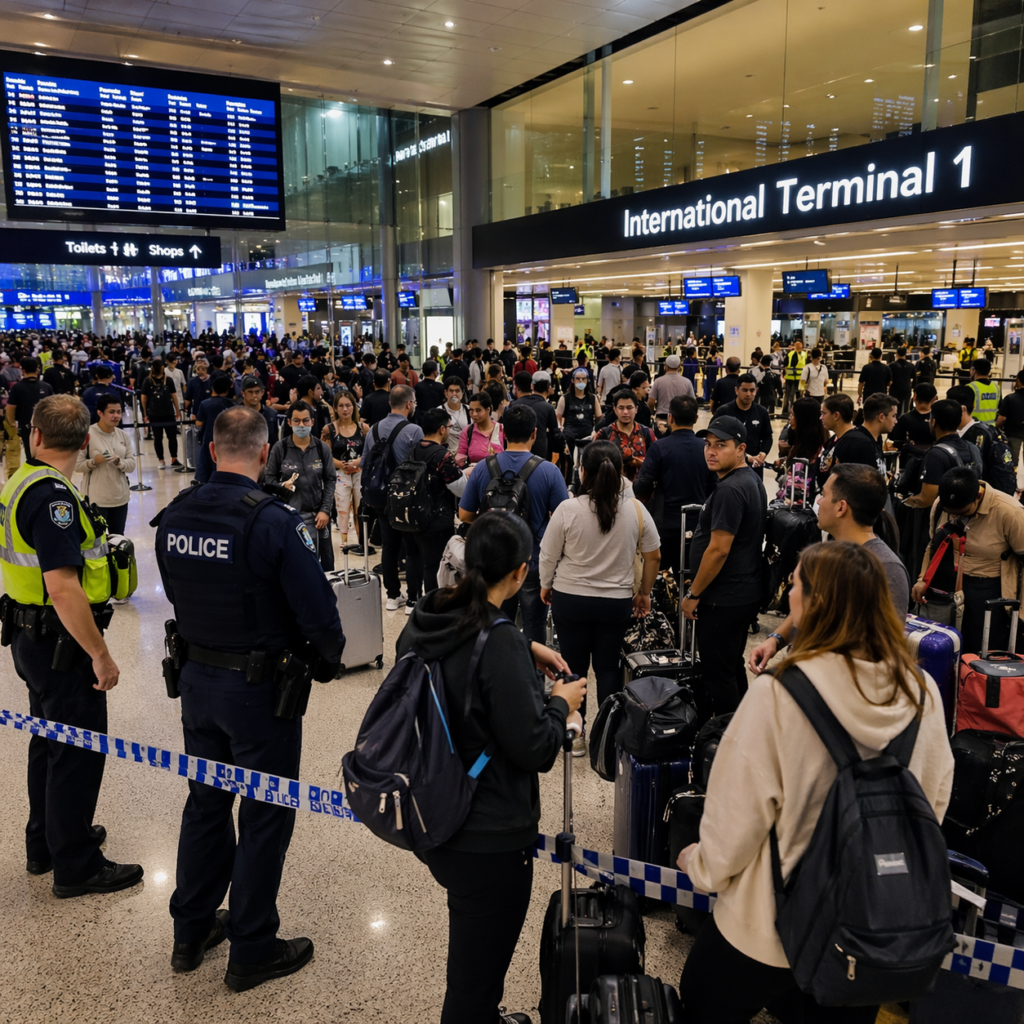

Perth Airport’s international terminal was hit by major disruption on Wednesday after a security response outside Terminal 1 forced authorities to restrict access, pause normal passenger movement and send airlines into delay-management mode. What began as an investigation into an unattended item quickly grew into a wider operational problem, affecting arriving passengers, departing travellers, airport traffic and onward connections.
For people travelling through Perth, the biggest issue was not only the lockdown itself but the speed at which the disruption spread across the terminal. Check-in activity was interrupted, public access points were restricted and movement around the forecourt changed as police worked through the incident. Travellers arriving from overseas were left waiting longer than expected, while others trying to start their journeys found themselves stuck outside or dealing with rapidly changing instructions.
Authorities including the Australian Federal Police and Western Australia Police responded to the scene, and Perth Airport later confirmed that an exclusion zone had been put in place as a precaution. That decision led to the temporary closure of Terminal 1 check-in areas and the Terminal 1 short-term car park, while traffic was redirected elsewhere. Even after the investigation ended, the airport warned that flight schedules would take time to recover.
Why the disruption at Perth Airport escalated so quickly
Airports are built around timing. When one part of the system is suddenly restricted, the effects move fast through check-in, baggage processing, security screening, border control, boarding and aircraft turnaround. That is exactly what played out in Perth. Terminal 1 is the airport’s international gateway, so even a temporary interruption carries consequences for a large number of passengers, including those with connecting flights and families arriving after long-haul travel.
Reports from passengers showed how uneven the experience became during the incident. Some travellers said they were left in customs queues with little clear information at first. Others described being held on the tarmac after landing while the situation outside the terminal was being managed. Parents travelling with young children said the wait became especially difficult once delays stretched on and food, movement and updates were limited. Airport and airline staff were seen handing out water to some affected passengers, but frustration still grew as people tried to work out whether they would miss onward flights or ground transport.
That uncertainty is often what turns a security precaution into a much bigger travel headache. A two-hour disruption on paper can mean far more in practice when passengers miss check-in cut-offs, aircraft depart late, baggage processing slows down and airline crews have to recalculate schedules. International passengers are particularly exposed because missed connections can create extra costs, overnight delays and rebooking pressure across multiple routes.
By early evening, Perth Airport said the police investigation had concluded and the impacted areas were beginning to reopen. But reopening a terminal does not instantly restore normal operations. Aircraft may already be out of position, passenger queues may have built up across several stages of the journey and airlines need time to absorb the backlog. That is why passengers were still being told to expect delays even after access started returning.
What travellers should take from the Terminal 1 lockdown
The Perth incident is also a reminder that airport disruption is no longer limited to weather or airline staffing issues. Security responses, even precautionary ones, can now reshape an entire travel day in minutes. For passengers, the practical lesson is to rely on primary sources when incidents unfold. Airline apps, direct messages from carriers and official airport updates are usually more useful than scattered social posts once schedules begin changing in real time. Perth Airport has advised travellers to check directly with their airline for the latest status, and official operational updates are posted on the Perth Airport website.
Travellers moving through busy airports can also reduce risk by building more buffer into international journeys, especially where onward connections are involved. A short connection may look fine on a normal day, but even a modest terminal interruption can erase that margin. Keeping chargers, medication, children’s essentials, identification documents and a change of clothes in cabin baggage can make an unexpected wait far easier to manage.
From an airport operations perspective, Wednesday’s disruption showed the delicate balance between safety and passenger communication. Security agencies do not always have the luxury of providing immediate detail during a live response, but travellers notice quickly when the information gap grows too wide. In those moments, even simple updates matter: whether passengers can leave an aircraft, whether check-in is paused, whether access roads are closed and whether delays are likely to continue after the scene is cleared.
For Perth Airport, the focus now is on restoring full rhythm after a day that disrupted both departing and arriving passengers. The airport has said it is working with airline partners and relevant agencies to return operations to normal as quickly as possible. That recovery matters not just for those whose flights were directly affected on Wednesday, but also for passengers travelling on later services that can inherit delays from earlier disruptions.
Travel disruptions like this also tend to drive a second wave of problems that are less visible than the initial lockdown: missed pickups, changed hotel bookings, disrupted business schedules and added stress for families already navigating long travel days. In that sense, the impact extends well beyond the terminal forecourt where the incident began.
We recently looked at how airport bottlenecks, security events and schedule compression are reshaping passenger experience in our travel disruption coverage, and Perth now offers another clear example of how quickly operations can tighten when access to a major terminal is interrupted.
Wednesday’s incident has now been resolved, but the broader picture is straightforward: even when a security investigation ends safely, the knock-on effects for travellers can linger for hours. For anyone flying through Perth after the Terminal 1 disruption, the best approach is a simple one — check flight status before leaving for the airport, allow extra time, and expect schedules to remain fluid until the backlog is fully cleared.
Also read: Mexico Pyramid Shooting Leaves Canadian Dead and 13 Injured at Teotihuacan

Make Swikblog your go-to source on Google for reliable updates, smart insights, and daily trends.