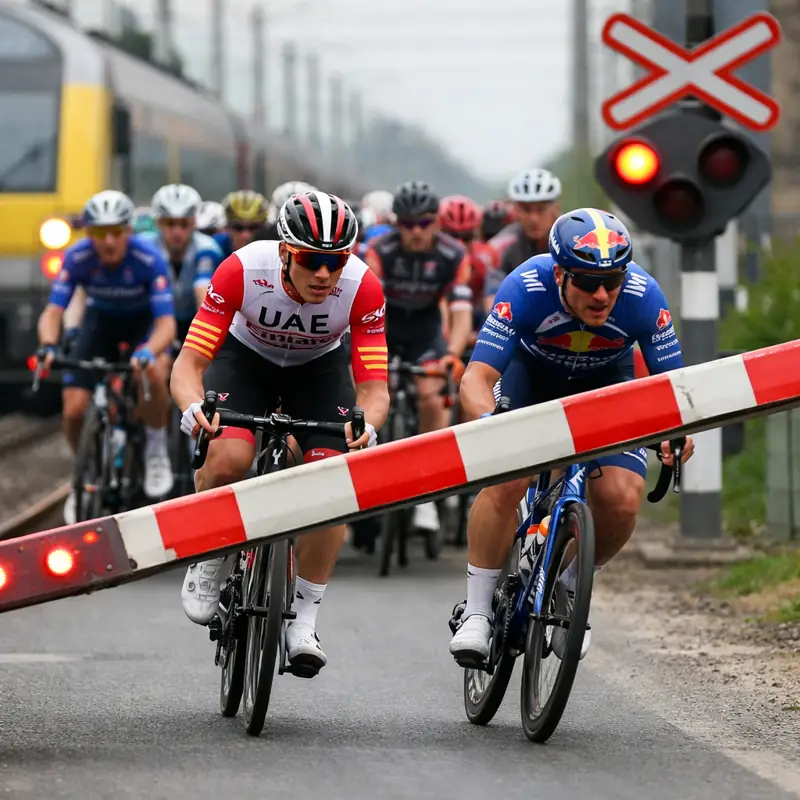

The 2026 Tour of Flanders was thrown into unexpected chaos on Sunday after a railway crossing incident involving some of cycling’s biggest names sparked fresh debate over UCI safety rules and race fairness. With more than 200 kilometres still to race, Tadej Pogacar and Remco Evenepoel found themselves at the centre of controversy after crossing the tracks just as barriers came down, splitting the peloton in a way that could have triggered disqualification under existing regulations.
The moment unfolded early in the race as the peloton approached a level crossing in Belgium. While a front group of around 30 riders managed to pass through before the barriers fully closed, a larger portion of the bunch — including Mathieu van der Poel — was forced to stop as a train passed. The sudden split created immediate confusion, both within the race and among viewers, as officials scrambled to assess whether rules had been breached.
Rather than applying sanctions, race commissaires quickly neutralised the situation. The leading riders were instructed to ease their pace, allowing those delayed at the crossing to regain contact once the barriers reopened. Within a few kilometres, the peloton was brought back together, but the incident had already left its mark on the race narrative.
Rulebook Meets Reality in Split-Second Decision
Under UCI regulations, riders are expected to stop at level crossings once warning signals are activated, with the rule designed primarily to ensure rider safety. In theory, any competitor who continues through a closed or closing crossing risks immediate removal from the race. However, as Sunday’s incident demonstrated, enforcing that rule in a fast-moving peloton is far from straightforward.
The key question is timing. Riders like Pogacar and Evenepoel appeared to pass the crossing just as the barriers were descending, placing them in a grey area between legal passage and potential violation. In a tightly packed bunch travelling at speed, riders at the front often have little time to react, while those behind are forced to brake suddenly — creating an uneven outcome that is difficult to regulate consistently.
This is not the first time cycling has faced such a dilemma. Similar incidents in past editions of Paris-Roubaix and other Classics have prompted debate over whether strict rule enforcement is practical when large groups of riders are involved. In many cases, officials have opted against disqualifications due to the difficulty of identifying exactly who crossed illegally.
The UCI has attempted to address these challenges through updated guidelines and safety initiatives, emphasising clearer procedures and improved coordination around race infrastructure. However, moments like the one seen in Flanders highlight the limits of those measures when real-world racing conditions intervene. More detail on these safety frameworks can be found on the UCI official website.
Impact on Race Dynamics and Competitive Fairness
While the peloton was ultimately regrouped, the breakaway ahead of the incident was allowed to continue uninterrupted. This decision had a measurable impact on the race, as the leading group gained additional time during the neutralisation, briefly extending its advantage over the main field.
For teams chasing from behind, the episode introduced an element of unpredictability into an already demanding race. Riders who had been positioned well suddenly found themselves delayed through no fault of their own, while others benefited from being in the right place at the right moment. Even with the regrouping, the energy expenditure required to restore order added another layer of complexity to race tactics.
Beyond immediate race dynamics, the incident has reignited broader questions about consistency and fairness in cycling. Should rules be applied rigidly, even if it means removing top contenders in chaotic circumstances? Or should officials prioritise the integrity of the competition by keeping riders in the race when intent is unclear?
For fans and analysts, the sight of leading contenders potentially facing disqualification over a split-second decision underscores the fragile balance between safety and spectacle in professional cycling. The sport relies on both, yet moments like this reveal how easily that balance can be disrupted.
As the Classics season continues, the Flanders railway incident is likely to remain a talking point. It serves as a reminder that even in one of cycling’s most established races, unpredictable variables — from infrastructure to human reaction — can still reshape the story in an instant.
You may like: Google Gemma 4 Open Models Under Apache 2.0 Deliver Fast AI Performance

Make Swikblog your go-to source on Google for reliable updates, smart insights, and daily trends.