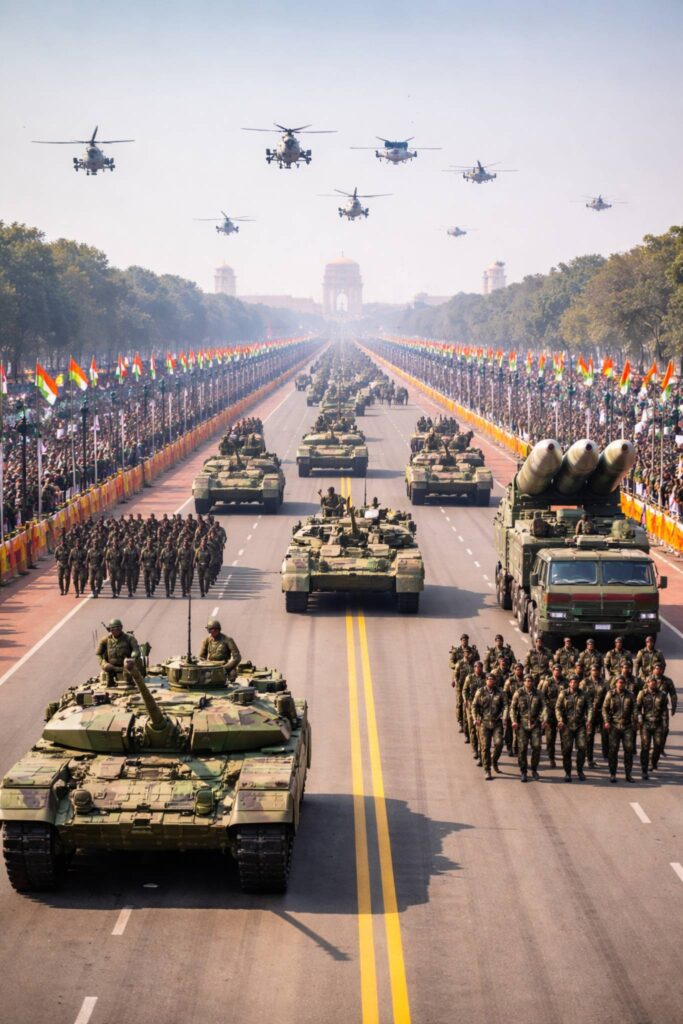
As India Republic Day 2026 is celebrated at Kartavya Path, the Republic Day Parade brings together military strength, cultural heritage and diplomatic symbolism.
India’s 77th Republic Day celebrations at Kartavya Path are being framed as more than a ceremonial march-past this year. The parade, expected to run for roughly 90 minutes, brings together close to 6,000 defence personnel, 18 marching contingents and 13 bands, alongside a sharper focus on how the Army fights in the field, not just how it looks on a boulevard.
One of the biggest talking points is the Indian Army’s first-time “phased battle array” presentation, described as Ranbhoomi Vyuh Rachna, where platforms and troops roll out in the sequence they would appear during a real operation. In simple terms, it starts with intelligence and reconnaissance, moves into mechanised and strike elements, and ends with support systems that sustain and protect a force under pressure.
This edition also carries a theme designed to blend culture and statecraft: “150 years of Vande Mataram.” The chief guests are two of Europe’s most senior leaders, European Commission President Ursula von der Leyen and European Council President António Costa, underlining the diplomatic weight attached to the event as well as the optics of India’s growing defence-industry confidence.
The phased battle array begins with the Recce element, led by the 61 Cavalry in active combatised uniform, a notable shift from its traditional ceremonial look. It is followed by a High Mobility Reconnaissance Vehicle, described as India’s first indigenously designed Armoured Light Specialist Vehicle. Overhead, the Dhruv Advanced Light Helicopter and its armed variant, Rudra, appear in a Prahar formation, signalling battlefield shaping and quick-response aerial cover.
Combat elements are then expected to push the story forward with a mix of armour and aviation. The lineup includes the T-90 Bhishma and the Main Battle Tank Arjun, with aerial support projected through the Apache AH-64E and the Prachand Light Combat Helicopter. Mechanised columns include the BMP-II Infantry Combat Vehicle and the Nag Missile System tracked variant, highlighting the Army’s effort to show manoeuvre, protection and strike in one continuous sequence.
A detachment of Special Forces follows, supported by mobility-focused platforms such as the Ajayketu all-terrain vehicle, the Randhwaj rugged terrain tactical transport system and Dhawansak light strike vehicles. A technology-forward segment is also being highlighted with robotic dogs, unmanned ground vehicles and four autonomous unmanned ground vehicles named Nigraha, Bhairav, Bhuviraksha and Krishna, mounted on vehicles as part of the display.
In the support element, the parade is set to spotlight what officials describe as a new generation of unmanned warhead capability, showcased through Shaktibaan and Divyastra mounted on specialised High Mobility Vehicles. These platforms are presented as carriers for a wide spectrum of aerial loitering munitions and drone systems, including Harop, Mini Harpy, Peacekeeper, ATS in extended and medium range variants, and Sky Striker. The emphasis, as described in official briefings, is on swarm-drone launches and longer-range “see and strike” missions, including systems described as exceeding 1,000 kilometres.
Artillery and deep-strike power then take centre stage. The Dhanush gun system and the Amogh advanced towed artillery gun system, also known as ATAGS, are positioned as symbols of defence manufacturing self-reliance. A heavier punch is signalled through the supersonic BrahMos weapon system alongside an indigenous universal rocket launcher capability described as Suryastra, which has been cited in briefings as having deep-strike reach up to 300 kilometres.
Air defence is also part of the battlefield narrative, with the Akash weapon system and a medium-range surface-to-air missile system referenced in the parade format. Another visual centrepiece described in releases is a glass-cased Integrated Operational Centre, designed to depict the conduct of “Operation Sindoor” in brief, combining heritage, diversity and development as a storyline for modern operational coordination.
Beyond weapons and formations, there are several first-time additions aimed at widening the parade’s appeal. The newly raised Bhairav light commando battalion is among the debutants, alongside a mixed scouts contingent described as wearing heavy thermal gear. The Remount and Veterinary Corps contingent is also expected to draw attention with animals and service dogs, including Zanskar ponies, Bactrian camels and raptors, offering a rare look at the Army’s working animal capability within a ceremonial setting.
The flypast is planned in two parts and is expected to feature 29 aircraft in multiple formations, including Rafale, Su-30, P8I, MiG-29, Apache, light combat helicopters, advanced light helicopters, Mi-17 helicopters, and transport aircraft such as the C-130 and C-295. Along the route, cultural visuals and tableaux add another layer to the national narrative, while the military segment is designed to read like a moving map of modern conflict.
For readers following the day’s coverage and explainers, you can also keep an eye on updates on Swikblog and our rolling homepage coverage at Swikblog’s latest. For the official overview of the theme, chief guests and the first-time battle array showcase, the Ministry of Defence release details how this year’s parade is being positioned as a blend of military readiness and cultural memory.