
By Chetan Sharma
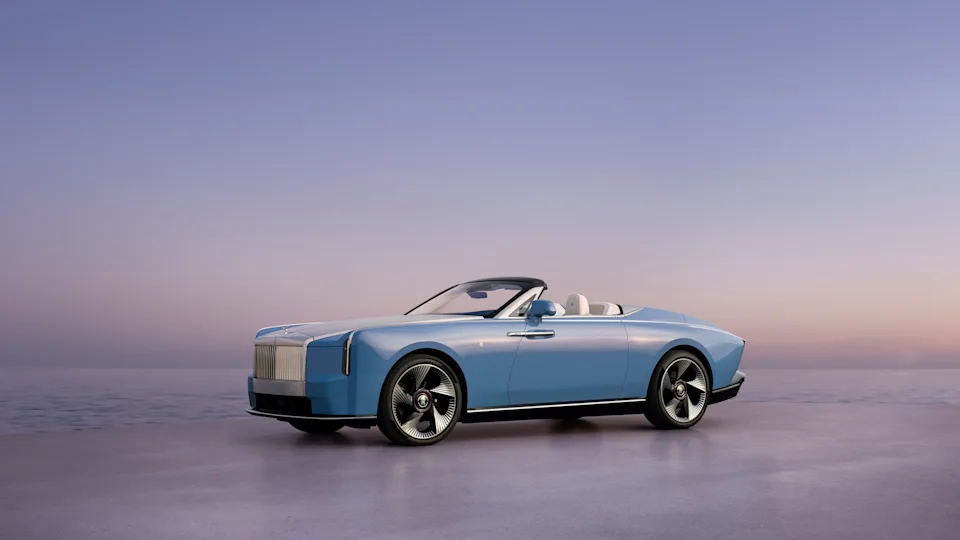
Rolls-Royce has never been in the business of chasing mass-market volume, and the Nightingale makes that point in spectacular fashion. The new electric grand tourer, priced at around $5 million and limited to just 100 units worldwide, has already sold out before a single customer car has reached the road. In a global auto market filled with louder launches, bigger production numbers, and constant competition for scale, Rolls-Royce has taken the opposite route. It has doubled down on rarity, craftsmanship, and long-term ownership experience, creating a car that is as much about access and prestige as it is about engineering.
The Nightingale is significant not only because of its extraordinary price or its immediate sellout, but because it signals a broader shift in the definition of luxury mobility. This is the first model in Rolls-Royce’s new Coachbuild Collection, a program designed to sit between the company’s standard production cars and its ultra-exclusive one-off commissions like the Boat Tail. That matters because it opens a new layer of exclusivity for buyers who want something rarer than a conventional Rolls-Royce, but not necessarily a single bespoke car built only once.
In many ways, Nightingale is Rolls-Royce refining the art of scarcity. Buyers were not invited into a normal dealership process. Instead, they entered the brand’s Private Office ecosystem, where the experience feels more like a private design consultation than a purchase. This is central to understanding why the car has generated such interest. For wealthy collectors, the final machine is only part of the appeal. The process of helping shape it, choosing details, materials, finishes, and atmosphere, is just as important. Rolls-Royce has understood that modern ultra-luxury is no longer just about ownership. It is about participation.
Why Rolls-Royce’s electric strategy looks different
What makes the Nightingale even more notable is its all-electric powertrain. Rolls-Royce has long been associated with smooth, near-silent V12 engines, so moving into fully electric territory could have felt like a departure from tradition. Instead, the company has positioned it as a natural evolution of everything the brand has always stood for. Quietness, effortless motion, and isolation from mechanical harshness have always been central to the Rolls-Royce identity. Electric propulsion simply pushes those qualities even further.
Chief Executive Chris Brownridge has described the open-top experience in terms that are unusually poetic for an industry often fixated on speed figures and horsepower. He compared the sensation to moving by sailing yacht, an image that captures the feeling Rolls-Royce wants this car to deliver. The Nightingale is not designed to shout. It is meant to glide. With the roof down and no engine noise interrupting the journey, occupants are left with a sense of calm that very few vehicles can offer. That silence becomes part of the luxury, not an absence of emotion.
The engineering also gives designers more freedom than a combustion platform would. Built on Rolls-Royce’s aluminum spaceframe, sometimes referred to as its “architecture of luxury,” the Nightingale uses a dual-motor electric setup that allows for cleaner proportions and smoother body surfacing. Without the same cooling demands of a large internal-combustion engine, designers have been able to reduce interruptions on the body and create a shape that feels more sculpted than assembled.
The proportions are striking. At nearly 20 feet long, the two-seat convertible has the commanding road presence of a classic land yacht, but with a cleaner and more contemporary finish. Rolls-Royce has said the design draws on the experimental EX models of the 1920s, especially the 16EX and 17EX prototypes, both of which explored elongated, dramatic forms. That historical reference gives Nightingale more design weight. It is not simply retro. It feels rooted in the brand’s own archive of bold ideas.
Among its standout details are the enormous 24-inch wheels, the largest ever fitted to a Rolls-Royce. They add to the car’s imposing stance and reinforce the sense that this is not a conventional luxury convertible. At the rear, the so-called Piano Boot serves as a luggage compartment and opens sideways on a cantilever, an intentional gesture designed to mimic the ceremonial reveal of a grand piano. That kind of theatrical flourish is not incidental. It is exactly what owners in this segment expect. At the very top of the luxury market, product design is inseparable from ritual and presentation.
Inside the ownership journey, personalization appears to be just as important as the hardware itself. Rolls-Royce has built a reputation on bespoke craftsmanship, but Nightingale takes that further by making the curation process central to the identity of the car. Buyers work through combinations of leather, paint, trim, and other design cues in highly tailored sessions. The result is that each Nightingale becomes more than a rare object. It becomes a personal statement shaped over years rather than ordered in hours.
That is also why the sellout carries such weight. Limited production alone does not guarantee demand, especially at such a high price point. But scarcity combined with heritage, design theatre, and deep personalization creates a powerful formula. Wealthy buyers are increasingly looking for assets and experiences that feel difficult to access and impossible to duplicate. Nightingale delivers both. It is exclusive by number, exclusive by invitation, and exclusive in the way each example is likely to reflect its owner.
There is a strong business case behind all of this. With 100 units sold at roughly $5 million each, the Nightingale implies around $500 million in revenue before the first delivery takes place in 2028. For a luxury automaker producing fewer than 6,000 cars annually, that is a major commercial achievement. It shows just how profitable low-volume, ultra-high-margin projects can be when a company has enough brand power to make exclusivity itself part of the product.
The Nightingale may also offer a preview of where the broader ultra-luxury segment is heading. Electrification is often framed around efficiency, regulation, or environmental positioning, but Rolls-Royce is approaching it differently. Here, electric power is not being sold as a technical obligation. It is being presented as an enhancement to serenity, refinement, and presence. That is an important distinction because it suggests that the future of premium EVs will not be defined by raw performance alone. For some buyers, it will be defined by how effortlessly a vehicle removes noise, friction, and intrusion from the experience.
That is what makes the Nightingale more than a headline-grabbing sellout story. It is a statement about how luxury is changing. The most desirable cars at the highest end of the market may no longer be the loudest or the most aggressive. They may be the quietest, the most personal, and the hardest to obtain. Rolls-Royce has taken that idea and turned it into a business model, blending heritage design cues with electric mobility and wrapping both in a client experience that feels closer to commissioning art than buying transportation.
For more official details on Rolls-Royce’s bespoke and Coachbuild philosophy, you can explore the company’s approach on its Coachbuild program page, which outlines how ultra-luxury cars like the Nightingale are curated.
By the time deliveries begin in 2028, the Nightingale will already have secured its place as one of the most talked-about luxury EVs of the decade. More importantly, it will stand as proof that in the rarefied world of top-tier motoring, silence can be just as powerful as sound, and exclusivity can still command extraordinary demand even in an industry that is rapidly changing. Rolls-Royce is not simply adapting to the electric age. With Nightingale, it is trying to define what the electric age looks like at the very highest level of luxury.
You may also like: Rolls-Royce stock jumps as nuclear deal boosts investor optimism.

Make Swikblog your go-to source on Google for reliable updates, smart insights, and daily trends.