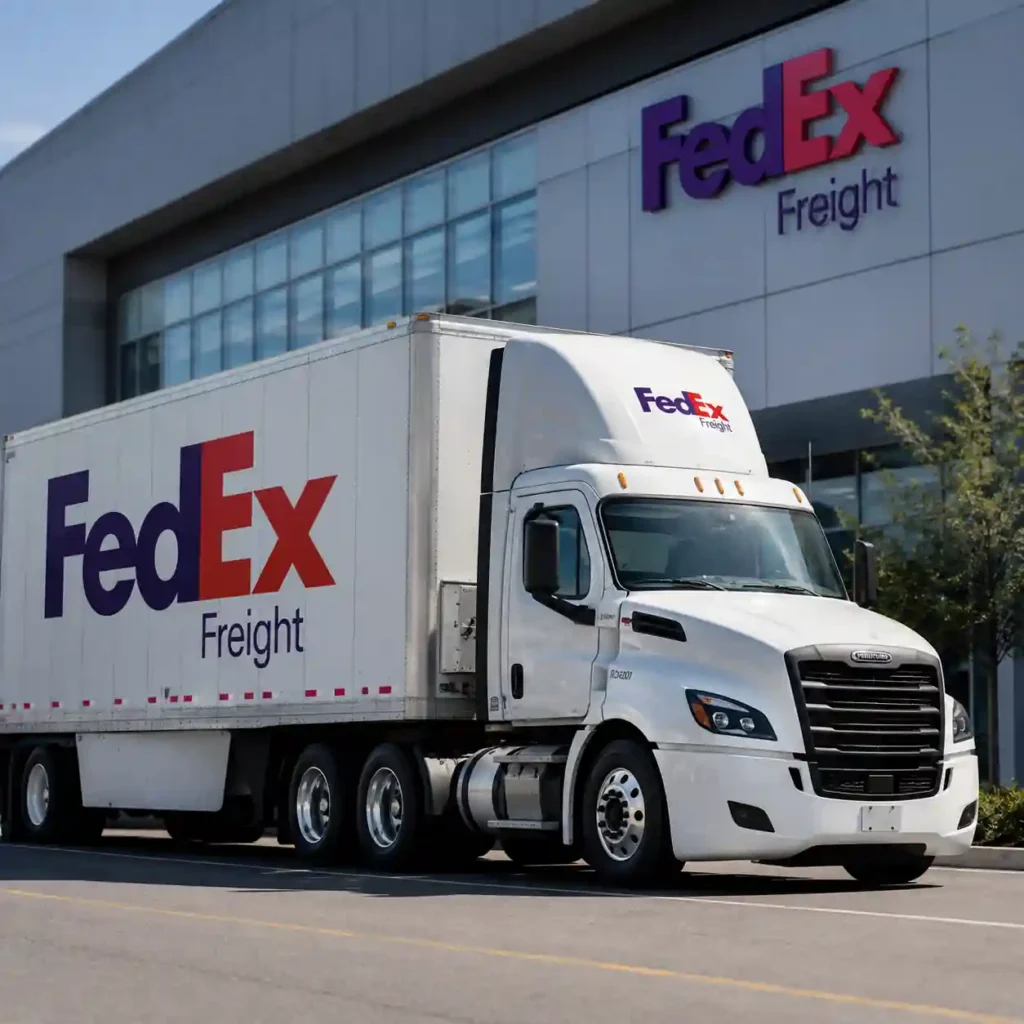

FedEx Freight has officially stepped out from under FedEx Corp and begun life as a separate publicly traded company, a move that gives investors a clearer view of one of the largest freight businesses in the United States.
The company is trading on the New York Stock Exchange under the symbol FDXF after completing its spinoff from FedEx. The separation places FedEx Freight in direct focus as a standalone less-than-truckload, or LTL, operator at a time when the U.S. freight market is showing early signs of improvement after a long and painful downturn.
FedEx Freight is not a small side business. It is the largest LTL provider in the U.S., a segment that handles shipments too large for parcel delivery but too small to fill an entire truck. That position gives the new company scale, network reach and pricing influence, but it also raises expectations. Investors will now be able to judge the business on its own operating performance rather than as one part of the broader FedEx group.
The timing of the spinoff is important. Freight rates have been under pressure for several years as weak demand and excess trucking capacity weighed on the industry. But that backdrop may be shifting. Some operators have exited the market after financial losses, while tighter industry capacity and changing regulatory pressure around commercial driver licenses could support stronger pricing conditions for remaining carriers.
FedEx Freight management has already laid out medium-term targets that will draw close attention. The company expects average revenue growth of 4% to 6%, while core profit is projected to grow at a faster 10% to 12% pace. That gap between sales growth and profit growth shows that margin expansion is central to the new company’s strategy.
Chief Financial Officer Marshall Witt previously said investments tied to modernizing the business and separating it from FedEx could weigh on profit in the short term. Over time, however, management expects cost controls, automation and a richer mix of higher-profit freight to support stronger margins.
That message gives investors both an opportunity and a warning. FedEx Freight has the advantage of size, brand recognition and a nationwide network, but the company must now prove it can operate with the consistency and efficiency expected from a focused public company.
Wall Street is already taking a measured view. BMO Capital Markets analyst Fadi Chamoun said the newly separated company offers a sizeable margin improvement opportunity, though that depends heavily on execution. He pointed to the need for better service quality, stronger revenue per shipment and sustained improvement in operating ratio.
J.P. Morgan analyst Brian Ossenbeck has taken a more cautious approach, valuing FedEx Freight at a lower multiple than rivals such as XPO, Saia and Old Dominion Freight Line. His concern centers on execution risk, transition costs related to the spinoff and weaker performance on service and volume metrics compared with leading competitors.
For FedEx Corp, the separation could also sharpen the parent company’s focus on parcel delivery, air cargo and broader logistics operations. Large corporate spinoffs are often designed to make businesses easier for investors to value, while giving each management team more freedom to set capital priorities and operating plans.
The freight sector has become increasingly important for investors watching the health of the U.S. economy. LTL demand is closely tied to manufacturing, retail inventory movement and business confidence. If shipping volumes improve while capacity remains disciplined, FedEx Freight could benefit from better pricing and improved network utilization.
Still, the early quarters as an independent company may be uneven. Separation costs, technology upgrades and modernization spending could limit near-term profit gains. The larger question is whether management can turn its scale advantage into better service, higher shipment revenue and a stronger operating ratio.
Recent changes across the logistics industry show how quickly transportation companies are being forced to adapt to regulatory, cost and trade-related pressures. Swikblog previously covered how major logistics firms responded to tariff-related refund developments in the U.S. supply chain sector: FedEx, UPS, DHL Move on $166 Billion Tariff Refund Push After Supreme Court Ruling.
FedEx Freight’s debut gives the market a new pure-play freight company to measure against established LTL rivals. Its growth targets are ambitious, but not unrealistic if the freight cycle improves and management executes on automation, cost discipline and service reliability.
Read More
For now, the spinoff marks a major reset. FedEx Freight has the scale to compete, the market position to attract investor attention and a clear profit-growth target. What it needs next is proof that independence can translate into stronger margins and better performance in a freight market that may finally be turning the corner.
Source: Reuters Business

Make Swikblog your go-to source on Google for reliable updates, smart insights, and daily trends.