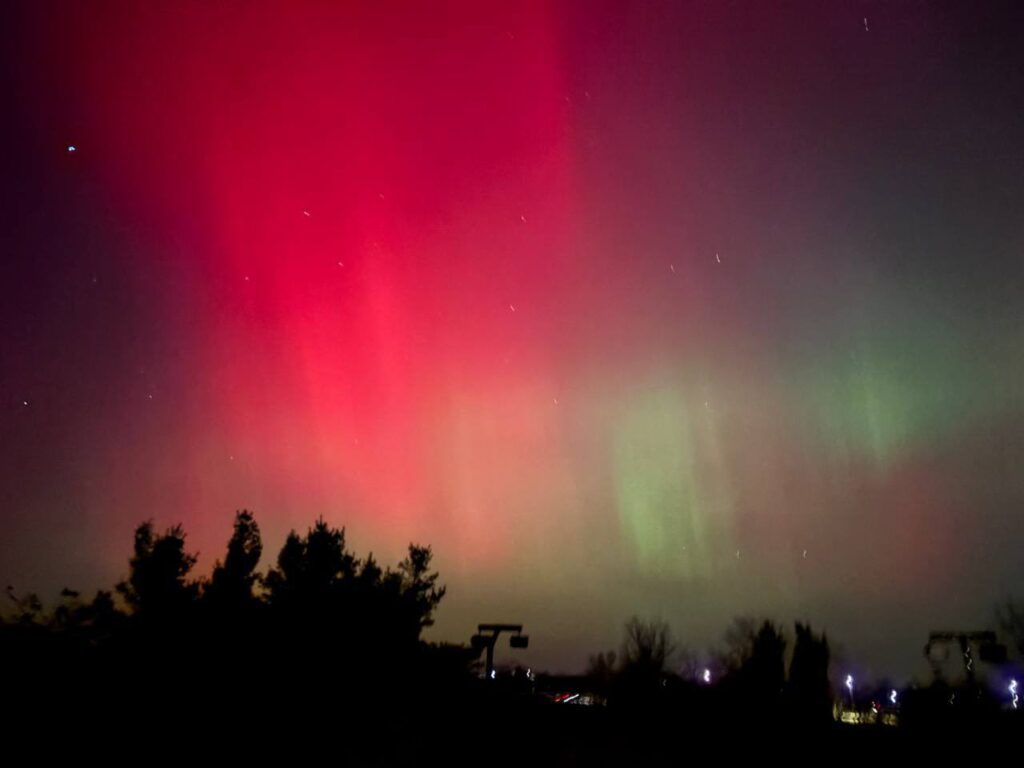
A strong-to-severe geomagnetic storm is expected to impact Earth from late Monday into early Tuesday, raising the chance that the aurora borealis (northern lights) could be visible far beyond their usual northern range — including across parts of the southern and central United States.
The warning follows an Earth-directed coronal mass ejection (CME) — a powerful eruption of solar material and magnetic energy from the sun. According to the NOAA Space Weather Prediction Center, storm conditions could reach G3 (Strong) or G4 (Severe) levels as the CME arrives. The U.K. Met Office has also issued a G4 geomagnetic storm watch for the same period.
States where the northern lights may be visible
If the storm intensifies into severe (G4) conditions, forecasters say auroras could be visible across a broad swath of the country. Potential viewing areas include:
- West: Northern California, Oregon, Washington, Idaho, Nevada, Utah
- Plains & Midwest: Colorado, Kansas, Nebraska, South Dakota, North Dakota, Missouri, Iowa, Illinois, Indiana
- Great Lakes: Michigan, Wisconsin, Minnesota, Ohio (cloud cover permitting)
- Mid-Atlantic & Appalachians: Pennsylvania, West Virginia, Virginia, Kentucky, Tennessee
- Southeast (rare but possible): Alabama, northern Georgia, northern Florida
- Northeast: New York, Vermont, New Hampshire, Maine, Massachusetts (especially northern areas)
Visibility will depend heavily on cloud cover, local light pollution, and how the CME’s magnetic field aligns when it reaches Earth. Even in southern states, auroras may appear low on the northern horizon or show up more clearly in long-exposure photos.
Best time and conditions to watch
NOAA says the best chance to see the northern lights in the U.S. is generally between 10 p.m. and 4 a.m. local time. Skywatchers are advised to head to dark, rural locations away from streetlights and to allow their eyes time to adjust to the darkness.
Why this storm is considered “severe”
Geomagnetic storms are ranked on a five-level scale. A G4 (Severe) storm is uncommon and can affect more than just the night sky. Possible impacts include voltage fluctuations on power grids, satellite navigation disruptions, radio communication issues, and increased risk of spacecraft charging and tracking problems.
Scientists note that heightened solar activity is expected during this phase of the sun’s 11-year solar cycle, which reached its peak in late 2024 and is forecast to remain active through 2026 — increasing the odds of auroras appearing at lower latitudes.
You may like
Weather conditions can matter just as much on the ground — see the latest Indiana vs Miami CFP national championship weather forecast.

Make Swikblog your go-to source on Google for reliable updates, smart insights, and daily trends.