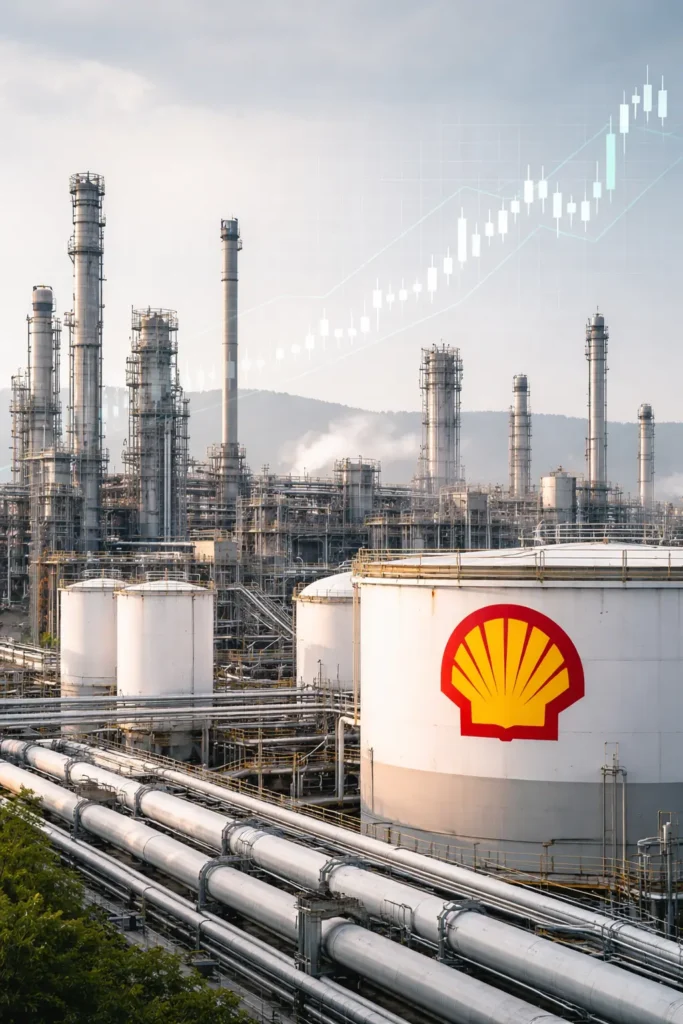

Shell (SHEL) shares gain today to £34.6, holding near recent highs as investors react to a mix of strong momentum and fresh risks following a disruption in Qatar’s LNG supply chain. The stock remains one of the top performers in the energy space, even as new developments raise questions about short-term earnings visibility and long-term strategy.
Shell shares gain today as stock holds near highs
Shell stock is trading close to its peak levels, supported by strong recent performance. The shares have surged 17.7% over the past 30 days and are up 25.4% year-to-date, while delivering a massive 72.5% return over the past three years. This rally reflects investor confidence in Shell’s cash flow strength, LNG leadership, and shareholder return strategy.
At the current price of £34.6, the stock is also trading slightly above the analyst target of £33.65, suggesting that much of the near-term optimism may already be priced in. However, valuation models still indicate the stock could be significantly undervalued on a long-term basis.
Qatar LNG disruption sparks fresh investor concern
The biggest risk currently facing Shell comes from a disruption at Ras Laffan Industrial City in Qatar, one of the world’s most critical LNG export hubs. The incident has forced Shell to assess supply impacts and reportedly consider declaring force majeure on certain LNG contracts with Asian buyers.
This development is significant because LNG is a core pillar of Shell’s business model. Any disruption in supply can affect not just production volumes, but also trading margins, contract reliability, and overall revenue visibility. Investors are particularly sensitive to LNG-related risks given Shell’s dominant position in the global gas market.
While the full financial impact remains unclear, the situation introduces short-term uncertainty. The possibility of force majeure signals that supply constraints could persist, potentially impacting earnings if the disruption is prolonged.
$3 billion North Sea deal supports long-term growth
Balancing the negative headlines, Shell recently secured a major strategic win through its joint venture with Equinor. The Adura Energy JV successfully raised a $3 billion reserve-based lending facility, marking a strong vote of confidence from global financial institutions.
The deal was oversubscribed and backed by 18 international banks, highlighting the strength of Shell’s asset portfolio and long-term production outlook. The JV includes key UK North Sea assets such as Mariner, Buzzard, Rosebank, and Clair, which are expected to deliver stable output and cash flow.
This financing provides Shell with greater financial flexibility, enabling continued investment in core hydrocarbon assets while maintaining resilience during market volatility.
Renewables sale signals strategic shift
Another major development is Shell’s reported plan to auction its European onshore renewables business. This move suggests a shift in strategy, with the company focusing more on high-return assets rather than expanding aggressively in lower-margin renewable segments.
Investors are increasingly interpreting this as a sign of capital discipline. By potentially exiting parts of its renewables portfolio, Shell could free up cash for share buybacks, dividends, or investment in more profitable energy segments like LNG and upstream operations.
This strategic repositioning aligns with Shell’s broader goal of balancing energy transition ambitions with strong financial returns.
Valuation and dividend outlook remain key focus
Despite the recent rally, Shell’s valuation remains a topic of debate. While the stock is trading near its highs, some models suggest it could still be undervalued by as much as 59.4% based on future cash flow projections.
At the same time, investors are keeping a close eye on dividend stability. Shell currently offers an attractive yield of around 3.25%, but any disruption to cash flow from LNG operations or asset sales could impact future payouts.
This creates a delicate balance for the stock. Strong earnings and capital returns support the bullish case, while operational risks introduce potential downside.
What investors should watch next
Looking ahead, several key factors will likely determine the direction of Shell shares. Updates on the Qatar LNG disruption, particularly around force majeure volumes, will be critical in assessing short-term risks.
Progress on the renewables sale process will also be closely monitored, as it could signal how aggressively Shell is reshaping its portfolio. Additionally, investors will watch whether the stock continues to trade above analyst targets or begins to consolidate after its recent gains.
For a deeper understanding of Shell’s strategy and financial positioning, investors can review the company’s official updates on its investor relations page and explore broader LNG market dynamics via the IEA gas market outlook.
In the near term, Shell shares are showing resilience, gaining today and holding near highs despite rising concerns. However, the LNG shock has introduced a new layer of uncertainty, making upcoming developments crucial for the stock’s next move.
You may like: Metformin’s surprising brain effect linked to RAP1 could mark a diabetes breakthrough

Make Swikblog your go-to source on Google for reliable updates, smart insights, and daily trends.