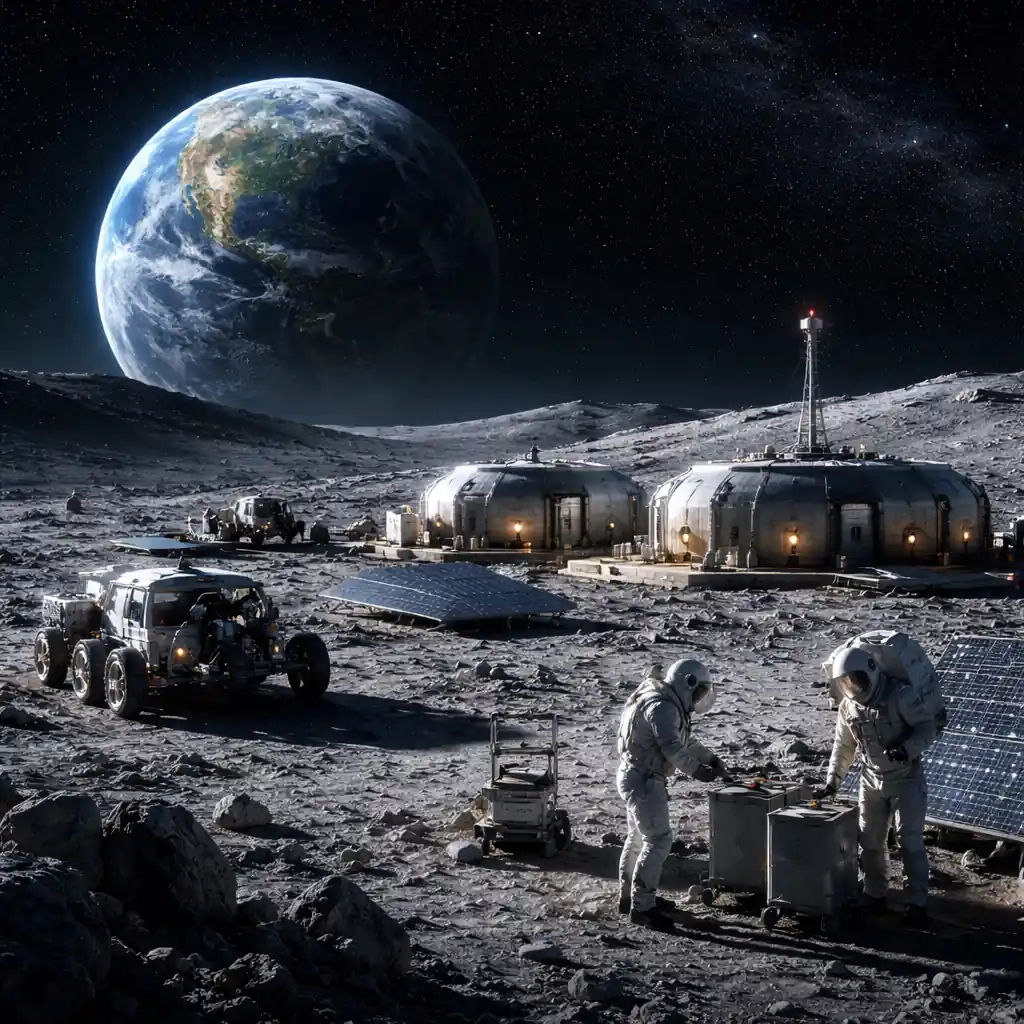

NASA has made a dramatic shift in its Moon strategy, scrapping plans for its long-promoted lunar space station and instead accelerating efforts to build a permanent base on the Moon’s surface. The move signals a major reset in the Artemis program and could reshape the global space race, especially as competition with China intensifies.
The agency is now targeting a more aggressive and practical roadmap, focusing on sustained lunar operations rather than complex orbital infrastructure. With a potential Moon base timeline emerging around 2028, NASA’s new direction is both ambitious and controversial.
Why NASA Dropped the Lunar Gateway Station
For years, NASA’s Gateway station was considered the backbone of its Artemis program. The small space station, planned to orbit the Moon, was meant to act as a staging hub for astronauts traveling to and from the lunar surface.
However, NASA has now decided to pause Gateway “in its current form” and shift priorities toward building infrastructure directly on the Moon. The reason is simple: speed and efficiency.
NASA leadership believes that maintaining an orbital station adds unnecessary complexity, cost, and delays to an already over-budget and late program. Instead, focusing on the lunar surface allows faster progress toward long-term human presence.
According to NASA’s official announcement, the agency wants to “concentrate resources on sustained surface operations” and simplify mission architecture to accelerate timelines. You can read more from NASA’s official update here.
NASA’s 3-Phase Moon Base Plan Explained
NASA has outlined a clear three-phase roadmap to build a permanent lunar base:
Phase 1: Build, Test, Learn
NASA will increase robotic missions, sending rovers, payloads, and experiments to the Moon. This phase focuses on testing technologies like power systems, communications, and mobility.
Phase 2: Early Infrastructure
The agency will begin deploying semi-habitable systems and support recurring astronaut missions. International partners will contribute hardware such as rovers and logistics systems.
Phase 3: Long-Term Human Presence
This phase aims to establish a continuous human base on the Moon, with heavy infrastructure, habitats, and regular crew rotations.
The goal is to transition from occasional missions to a sustained lunar presence — effectively turning the Moon into a long-term operational base.
Artemis Timeline: Can NASA Really Hit 2028?
NASA’s Artemis program has faced repeated delays, cost overruns, and technical challenges. While the agency still aims to land astronauts on the Moon by 2027–2028, many experts believe further delays are likely.
The program is already considered overly complex, and even with the new simplified approach, risks remain high. Some analysts warn that China’s more streamlined lunar program could beat the U.S. to the Moon.
This growing geopolitical pressure is a key reason behind NASA’s strategy shift. The race is no longer just about exploration — it’s about leadership in space.
Canada Hit Hard: $1B Canadarm3 in Limbo
One of the biggest immediate impacts of NASA’s decision is on Canada’s space program.
Canada had committed over $1 billion to develop Canadarm3, an advanced AI-powered robotic arm designed specifically for the Gateway station. With Gateway now paused, the project’s future has become uncertain.
The robotic arm was engineered for operation in zero-gravity space environments, not the harsh, dusty conditions of the lunar surface. This creates a major technical mismatch and raises questions about how — or if — it can be repurposed.
Despite the uncertainty, Canada continues discussions with NASA to redefine its role in the Artemis program.
Stock Market Reaction: MDA Falls 11%
The market reacted quickly to the news. MDA Space, the company building Canadarm3, saw its stock drop by around 11% immediately after the announcement before partially recovering.
Investors are concerned about potential contract changes, delays, or reduced scope. However, analysts suggest that the core technology could still be used in other applications, including private space stations or lunar robotics.
More details on the market reaction were reported by The Globe and Mail.
Impact on Global Partners
NASA’s decision doesn’t just affect the U.S. and Canada. Several international partners — including the European Space Agency (ESA), Japan, and the UAE — had committed hardware and funding to the Gateway station.
NASA has indicated that these contributions could be redirected toward lunar surface operations. However, this transition will require redesigns, renegotiations, and time.
While partnerships are expected to continue, the shift introduces uncertainty into previously agreed plans.
Bigger Picture: NASA vs China Moon Race
This strategic pivot highlights the growing urgency of the global Moon race.
China has been steadily advancing its lunar ambitions with a more streamlined approach. If NASA’s timeline slips further, there is a real possibility that China could land astronauts on the Moon first.
NASA’s new plan is clearly designed to counter that risk by simplifying operations and accelerating progress.
The message is clear: the Moon is no longer just about science — it is a strategic frontier.
What This Means for the Future
NASA’s decision marks a shift from complexity to practicality. Instead of building a layered system involving orbiting stations and transfer points, the agency is focusing directly on what matters most — staying on the Moon.
If successful, this approach could:
- Accelerate lunar missions
- Reduce costs and delays
- Enable long-term human presence
- Strengthen America’s position in the space race
However, the risks are equally significant. The transition disrupts existing plans, affects international partners, and depends heavily on execution.
The next few years will be critical. If NASA can deliver consistent lunar missions and begin building real infrastructure on the surface, the vision of a Moon base by 2028 could become reality.
But if delays continue, the U.S. risks falling behind in one of the most important technological and geopolitical competitions of the 21st century.

Make Swikblog your go-to source on Google for reliable updates, smart insights, and daily trends.