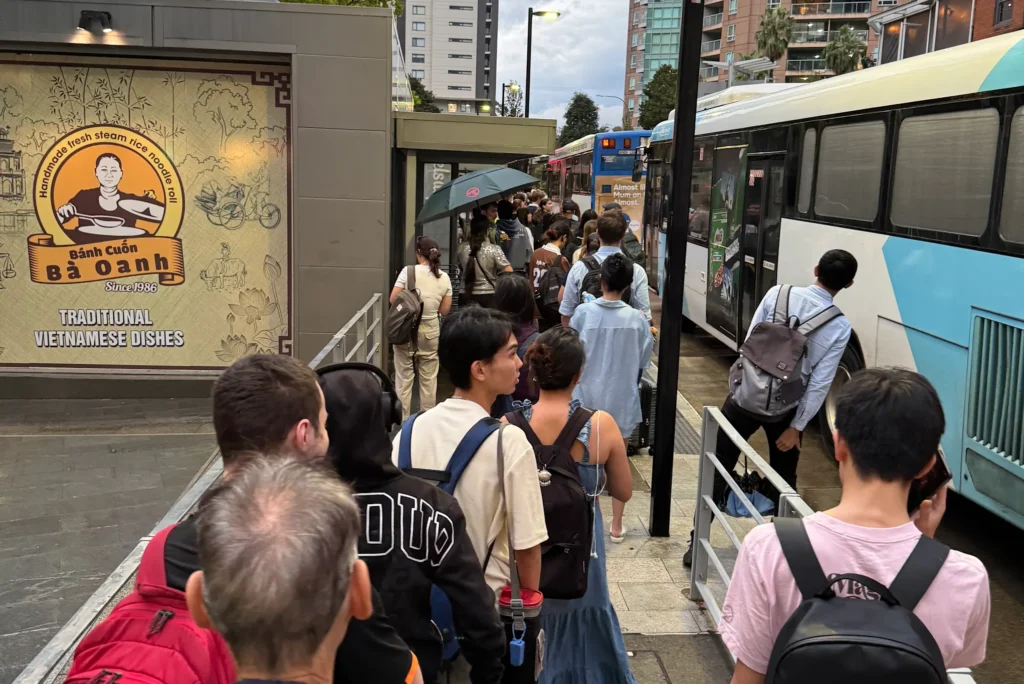

Sydney train services were thrown into chaos after a severe thunderstorm swept across the city, forcing a partial metro shutdown, damaging rail infrastructure and triggering major delays across the transport network. What began as a weather warning quickly turned into a difficult evening for commuters, with crowded platforms, split metro operations and suspended train services disrupting journeys across key parts of Sydney.
The most serious metro disruption hit the M1 line, where services stopped running between Chatswood and Barangaroo because of a power supply issue between Barangaroo and Victoria Cross. Earlier in the evening, the full line had been shut down before limited operations resumed. By later on Thursday, trains were running only between Tallawong and Chatswood and separately between Barangaroo and Sydenham, leaving one of the busiest central sections unavailable.
The closure quickly created congestion around stations, especially at Chatswood, where commuters were left waiting in long lines while trying to work out alternate routes home. At the same time, wider disruption across the Sydney train network added pressure to an already difficult evening peak, turning a weather-related setback into a broader city transport problem.
Storm disruption spread across metro and rail lines
Heavy rail services were also badly affected, with trains on the T1 North Shore line not running between Gordon and North Sydney in both directions. Transport authorities said severe weather had affected infrastructure, forcing the suspension and removing a major corridor through the city just as many passengers were trying to head home.
There was little immediate relief for travellers. Authorities said replacement buses were not available at that stage, a detail that made the disruption even more difficult for people already dealing with the metro outage. Transport for NSW also warned that some trains might remain stopped on platforms or even between stations for longer than usual, and advised passengers to delay travel if possible or consider alternative options.
The problem extended beyond the North Shore. Delays were also reported on the T1 Western Line, T2 Leppington & Inner West Line, T3 Liverpool & Inner West Line and T5 Cumberland Line. For commuters relying on Sydney train services, that meant the disruption was not limited to one route but spread across several major lines serving different parts of the city.
Damaging winds, heavy rain and hail hit Sydney
The travel chaos came after a strong thunderstorm moved across Sydney and surrounding suburbs, bringing damaging winds, heavy rain and hail. Weather alerts issued in the early evening warned that the system was tracking east and was expected to affect a wide area including Sutherland, Richmond, Liverpool, Hornsby, Parramatta, Sydney City, Sydney Airport, Mona Vale, Sydney Olympic Park, the Harbour Bridge and waters off Bondi Beach.
Some of the most severe impacts were recorded before the worst commuter delays fully unfolded. Parts of Bradbury and Rosemeadow were hit by hail, while wind gusts of 76km/h were recorded in Richmond after 5pm. The system was then expected to move toward Gosford, Calga and Woy Woy by about 7pm, showing how quickly the storm was moving through the wider region.
The Bureau of Meteorology had issued a severe thunderstorm warning as conditions intensified, highlighting the risk of damaging winds and intense rainfall. Those weather conditions appear to have fed directly into the breakdown across metro and rail services, especially where infrastructure was affected. As commuters searched for updates, the disruption quickly became one of the most talked-about Sydney train delays today.
Commuters faced long waits and few alternatives
For passengers, the practical impact was immediate. Crowds built up at stations, travel times stretched out and many people were left deciding whether to wait, reroute or abandon their usual journey. Without replacement buses on some suspended routes, the choices became even more limited, especially during the busiest part of the evening.
The disruption also showed how vulnerable Sydney’s transport system can become when several parts of it fail at once. A metro outage through the inner city is disruptive enough on its own. Add suspension on a major rail corridor, broader Sydney train delays on multiple lines and severe weather moving across the region, and the effect quickly spreads well beyond a single station or service.
Even after some metro operations resumed in limited sections, the network was still far from normal. Split service patterns, suspended rail segments and ongoing delays meant many commuters were still facing longer and more uncertain journeys late into the night. Sydney’s transport system did not come to a complete halt, but for a large number of passengers caught in the storm, the evening felt close to it.
You May Also Like
- Immigration to France from the United States explained through real-world systems and processes
- Latest global news and trending updates across travel, policy and real-world systems

Make Swikblog your go-to source on Google for reliable updates, smart insights, and daily trends.