
Shopify shares are trying to find their footing again after one of those modern earnings reactions that feels less like a verdict and more like a tug-of-war. The company delivered headline growth that most large-cap tech firms would happily frame and hang on the wall, yet the market answered with a sharp reset, and then a quiet bounce. On the tape, it has looked like this: strong quarter, sudden sell-off, bargain hunters stepping in, and a wider debate over what growth is worth in a market that is increasingly allergic to surprises.
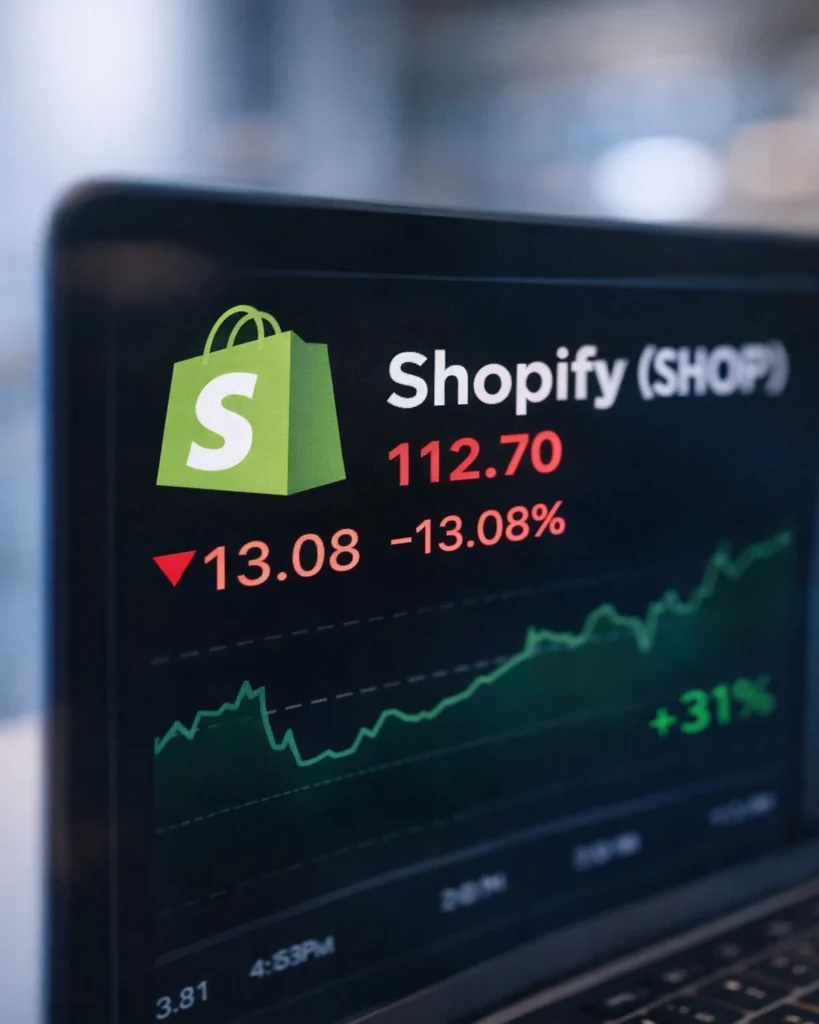
The latest print has Shopify trading around $112.70, up roughly 1.84% on the session, with after-hours hovering near $112.60. That calm number masks the drama beneath it. Not long ago, the stock sank about 13% after earnings, a move that carried the unmistakable message: growth is welcome, but expectations still demand precision.
Start with the headline that matters. Shopify posted 31% revenue growth in the quarter, bringing revenue to about $3.67 billion. That is not a soft landing. It is the kind of number that keeps Shopify in the conversation as a defining platform for online commerce and merchant tools, especially as retail and services continue to modernize their checkout flows, marketing stacks, and inventory systems.
And yet, the market’s first reaction was to hit the sell button. The simplest explanation is usually the right one: results can be strong in absolute terms but still miss what investors had already priced in. A quarter can be impressive and still disappoint. Add in a broader sell-off mood across risk assets and the reflex becomes sharper. When sentiment turns cautious, it does not take a crisis for the market to re-rate a stock; it takes an excuse.
Then came the $2 billion signal. Shopify announced a $2 billion share buyback, and that detail matters because buybacks do not simply return cash. They tell a story. They hint at management confidence in cash generation and durability. They can also act like a stabilizer when a stock is swinging, because the company itself becomes a potential buyer when the market gets jumpy. If you want the clean, official phrasing, it’s laid out in Shopify’s own investor relations updates.
Wall Street’s tone has not flipped bearish. Price targets remain supportive even after the stumble. Benchmark has pointed to $145, while Citizens has talked about $160. Targets vary widely, but the common thread is that many analysts still see Shopify as a premium compounder that can keep expanding its ecosystem without losing its grip on product velocity. What has changed is not belief in the platform. It is the market’s patience for paying up.
This is where valuation becomes the battleground. Shopify’s multiple has remained elevated compared with slower-growing peers, and one widely cited yardstick is its price-to-sales ratio, around 10.8x. That kind of premium does not require perfection, but it does require consistency. When earnings miss expectations, even slightly, the premium can become the headline. In other words: the market is not necessarily questioning Shopify’s story. It is questioning the price it has been paying for that story.
The second half of the debate is AI, and Shopify is pushing hard here. The company has been investing in AI-driven tools designed to help merchants sell more efficiently, automate the tedious parts of running a storefront, and sharpen the customer experience. If AI features lift conversion, reduce support friction, and improve marketing outcomes, that can show up in retention, take rate resilience, and higher subscription value over time. The market loves AI narratives, but it rewards proof even more. Shopify’s next chapters will be about turning clever tools into measurable outcomes.
The chart read is simple. After the earnings jolt, traders have been watching a few obvious zones. Around $110 has acted like a psychological and technical shelf, the kind of level where buyers tend to show up if the tape feels oversold. Above, the $120 area looks like a near-term hurdle, where the stock needs conviction to climb. This is not prophecy. It is market behavior: sell-offs create scars, and the first rebound often meets resistance where confidence broke.
So what is the real question for readers watching SHOP now. It is not whether Shopify can grow. The quarter suggests it can. It is whether Shopify can grow in a way that gradually makes the valuation feel less like a leap of faith and more like a calculation. If growth stays near the current pace while profitability levers strengthen and buybacks continue, the premium can look justified again. If growth cools or the macro mood darkens, the market may keep forcing the multiple lower even as the business executes.
For now, the tape tells you investors are still engaged. A stock that collapses on earnings and then continues collapsing is a different story. Shopify, instead, is hovering, absorbing the shock, and drawing buyers who see value in the pullback, especially with a buyback in the background. That is not a guarantee of upside. It is a sign the argument is still alive.
What to watch next is clarity, not slogans. Watch how guidance shapes expectations, how merchants respond to new AI tools, and whether the company can keep growth strong without reigniting valuation anxiety. In a market that is quick to punish surprises, Shopify’s best catalyst may be something less dramatic: steady execution that makes the price feel reasonable again.
You may also like
Shopify stock today: Q4 earnings, revenue growth, and what traders are watching next

Make Swikblog your go-to source on Google for reliable updates, smart insights, and daily trends.