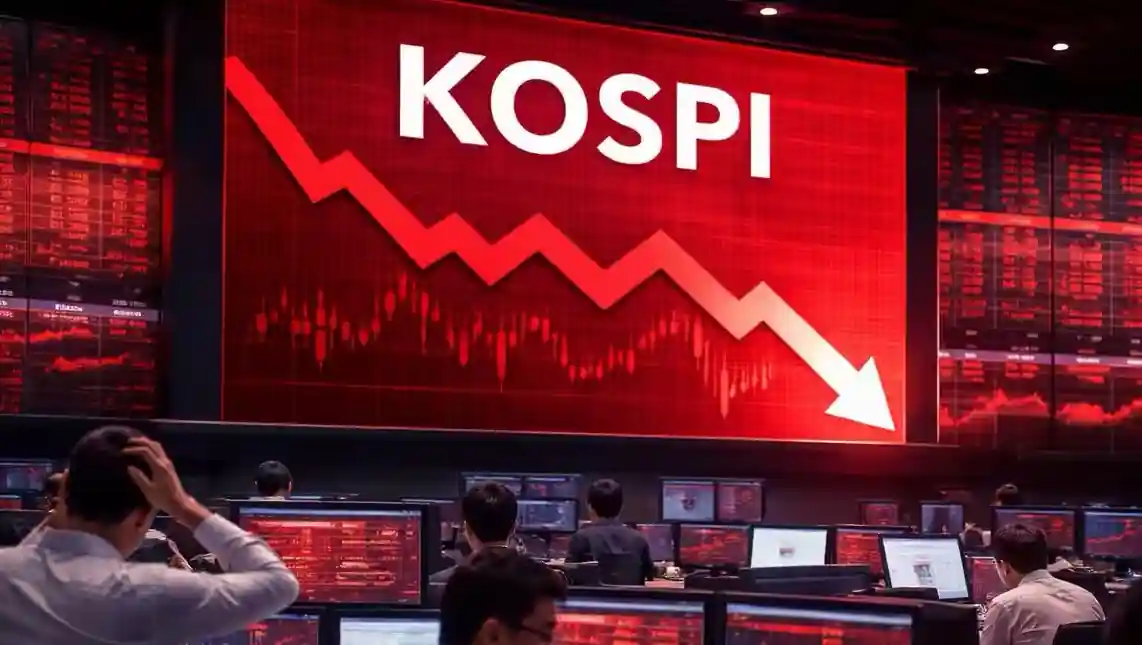

SK Hynix (000660.KS) held near ₩948,000 in Seoul trading as investors weighed a fresh surge of optimism around high-bandwidth memory against an unusually blunt warning from the top of its parent group. The chipmaker, now widely viewed as a key supplier in the global AI hardware stack, is heading into 2026 with demand running so hot that its flagship AI memory output is effectively spoken for — even as leadership cautions that today’s boom conditions can flip fast in a market shaped by rapid technology shifts.
The stock was last indicated around ₩948,000, slightly lower on the session (about -0.11%) after an early push toward the top of the day’s range. Trading action showed a wide band, with a day range of ₩948,000 to ₩980,000, and the prior close near ₩949,000. The day’s open printed around ₩980,000, underscoring how quickly sentiment can swing around AI-linked names. Over a longer view, the shares have approached the upper end of a 52-week range of ₩162,700 to ₩980,000 as AI spending and memory tightness reshaped investor expectations.
HBM moves from niche to profit engine
At a conference in Washington on Feb. 20, SK Group Chairman Chey Tae-won described high-bandwidth memory as a “monster chip” that is generating enormous profits for SK Hynix. HBM has become essential for the latest AI accelerators used to train and run large-scale models, and the market has increasingly treated SK Hynix as a prime beneficiary of that hardware cycle. The company sits in a concentrated global supply landscape alongside South Korea’s Samsung Electronics and U.S.-based Micron.
What’s new is the intensity of the forward demand picture. SK Hynix has indicated that it has effectively sold out its 2026 memory chip slate, with Micron also signaling that its HBM capacity is similarly committed. For investors, “sold out” is the kind of phrase that turns a sector story into a scarcity story — and scarcity stories tend to travel fast, especially when they are tied to the world’s most crowded trade: AI infrastructure.
$650B in AI infrastructure sets the tone
The backdrop is the extraordinary level of spending being funneled into data centers and AI computing. Major U.S. technology firms, including Microsoft and Meta, are allocating roughly $650 billion this year toward infrastructure designed to maintain an edge in AI. That buildout is pushing the memory market into a tight squeeze, particularly for advanced products like HBM that are required for many high-end accelerators.
In practical terms, the AI arms race is pulling memory into the center of the performance equation. As GPU and accelerator clusters expand, memory bandwidth and capacity become gating factors — and suppliers that can deliver at scale gain pricing power. That dynamic has helped drive investor enthusiasm, especially after a period when the memory cycle punished even the strongest operators.
Capex set to rise as supply stays tight
Chey did not put a number on how large the expansion will be, but SK Hynix has already signaled that 2026 capital expenditure will rise significantly from the prior year to meet HBM demand. For a capital-intensive industry, this is a pivotal balancing act: spending must move fast enough to capture demand, but not so aggressively that it creates the next oversupply hangover once the cycle turns.
Investors are also watching whether capacity adds remain constrained by equipment lead times, packaging bottlenecks, and the difficulty of ramping advanced memory yields. Those frictions matter because they keep the “tightness premium” alive longer than a typical upcycle.
$70B profit expectations — and a rare $100B warning
Chey said the average of analyst projections for SK Hynix’s 2026 operating profit had climbed to roughly $70 billion in January from about $50 billion late last year, with some estimates revised again to more than $100 billion. That kind of step-change is a headline by itself — and it helps explain why the shares have been treated as a bellwether for “AI supply chain winners.”
But the most market-moving moment wasn’t the upside figure. It was the caution. Chey argued that the same conditions driving blockbuster expectations could just as easily flip the other way, remarking that the story could turn into a $100 billion loss scenario if the competitive landscape shifts quickly. That warning lands differently coming from a leader who is simultaneously promising to grow production — and it captures the central tension in semiconductors: cycles, technology transitions, and competition rarely stay stable for long.
Energy becomes the next bottleneck
Another part of the message was less about chips and more about electricity. Chey highlighted infrastructure constraints and said SK Group is exploring building power plants alongside AI data centers. The logic is straightforward: if energy supply cannot keep up with AI compute demand, the downstream impact could be “disastrous” for deployments, utilization, and expansion plans.
For markets, this is a reminder that the AI boom is not only a semiconductor story — it is also a grid, generation, and permitting story. Any friction there can affect the pace of data center buildouts, which in turn can affect near-term demand curves for memory and accelerators.
Key trading markers investors are watching
With the stock near ₩948,000, traders are watching whether momentum can reclaim the upper band near ₩980,000 — the top end of the recent range. The session snapshot also underscored how active positioning has been, with volume around 2,496,778 versus an average volume near 4,067,407. The company’s market value was indicated around ₩654.552 trillion on an intra-day basis, with a 5-year monthly beta of 1.70, reflecting the stock’s tendency to swing harder than the broader market during tech-driven moves.
Income is not the core thesis for most investors here, but dividend details remain on the radar: a forward dividend around ₩3,000 (roughly 0.32%) and an ex-dividend date noted as 26 Feb 2026. The next major calendar checkpoint is the estimated earnings date around 29 Apr 2026, where investors will look for updated pricing signals, HBM shipment commentary, and capex discipline.
For company updates and filings, investors often monitor SK hynix investor relations.
You May Also Like

Make Swikblog your go-to source on Google for reliable updates, smart insights, and daily trends.