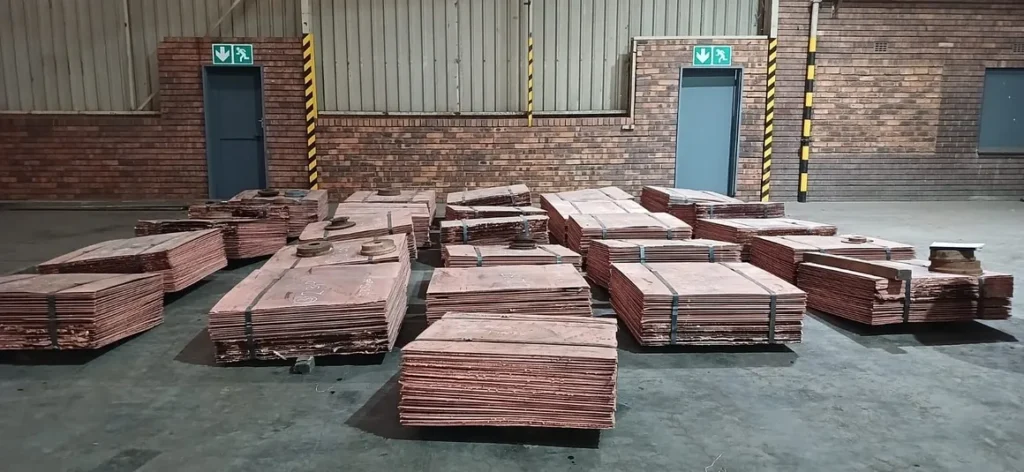

A recovery operation in Johannesburg has uncovered what investigators believe is one of the largest suspected stolen-copper shipments traced through Southern Africa in recent months. South African authorities seized 121 tonnes of copper valued at approximately R12.68 million after intelligence linked the consignment to hijacked trucks originating in Zambia.
The discovery was made during a coordinated operation in City Deep involving Gauteng Crime Intelligence, Interpol, Border Police, local law enforcement and private security partners. While no arrests have been announced, investigators are examining a chain of events that allegedly involved hijacked cargo, false vehicle identities, suspected customs fraud and cross-border transportation.
Zambia tip-off triggered multinational investigation
The case began when Zambian authorities shared intelligence regarding three trucks that had been hijacked while transporting copper blocks. Information gathered during the investigation suggested that vehicles displaying false Tanzanian registration plates were allegedly used as part of the operation.
One of the trucks was later recovered in Zambia. Investigators reportedly discovered that the registration numbers displayed on the vehicle belonged to a South African logistics company, raising fresh concerns about the use of cloned vehicle identities in regional cargo crime.
The information exchange between Zambian and South African authorities ultimately helped investigators trace the movement of the shipment across borders and into South Africa.
How the copper entered South Africa
According to investigators, two trucks carrying approximately 121 tonnes of copper slabs crossed into South Africa through the Beitbridge Border Post on June 10, 2026.
Authorities believe the cargo may have entered the country using fraudulent customs documentation. While investigators have not publicly disclosed the exact paperwork involved, the allegation has placed additional attention on border-security processes at one of Southern Africa’s busiest trade crossings.
Beitbridge serves as a critical gateway for commercial transport between South Africa and neighbouring countries, handling thousands of freight movements each month. Cases involving suspected customs fraud are often closely scrutinised because of their potential impact on legitimate trade operations.
City Deep operation uncovers 26 bundles of copper
Following further intelligence gathering, law enforcement teams conducted a targeted operation in City Deep on June 18. The industrial logistics hub is one of Johannesburg’s most active freight districts, making it a strategic location for investigators tracking commercial cargo movements.
During the operation, officers seized 26 bundles of copper with an estimated value of R12,680,000.
Investigators also found that the original serial numbers on the copper had been deliberately removed. Such markings are commonly used to identify ownership and trace industrial commodities through supply chains.
By removing serial numbers, criminal networks can potentially make stolen material more difficult to identify, recover and connect to its original source.
Why copper theft remains a major concern
Copper is among the world’s most valuable industrial metals because of its extensive use in power transmission, construction, telecommunications, manufacturing and renewable-energy projects. Strong demand has continued to support global prices, with investors closely monitoring copper price trends and market momentum across international markets.
That value has also made copper an attractive target for organised criminal groups. Across Southern Africa, theft involving copper cables, industrial stockpiles and transport shipments has created significant financial losses for businesses and infrastructure operators.
Unlike smaller theft cases, the Johannesburg seizure involved a large commercial shipment, suggesting a level of planning and coordination that investigators believe may extend beyond a local criminal operation.
Read More
What authorities are investigating next
Police are now focused on identifying those responsible for the hijacking, tracing the ownership history of the recovered copper and determining the intended destination of the shipment.
Investigators are also expected to examine whether similar methods involving false registration plates, cloned vehicle identities and suspected fraudulent customs documents may have been used in previous cross-border shipments.
The involvement of Interpol highlights the international dimension of the case and reflects growing cooperation between law-enforcement agencies seeking to disrupt organised commodity-smuggling networks operating across national borders.
For now, the seizure represents a significant recovery of suspected stolen goods. The next phase of the investigation will determine whether authorities can connect the copper shipment to the individuals and networks believed to be behind its movement.
Additional information on international efforts to combat organised cross-border crime can be found through Interpol.

Make Swikblog your go-to source on Google for reliable updates, smart insights, and daily trends.