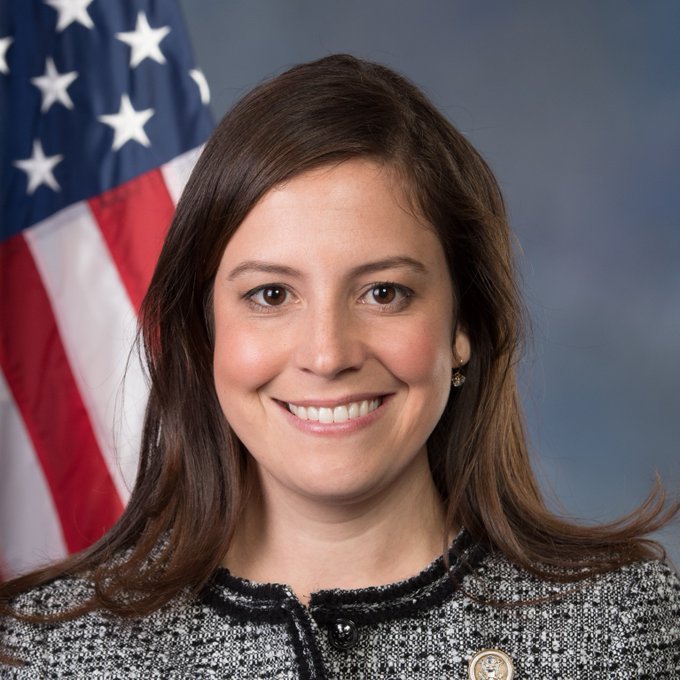
Republican congresswoman Elise Stefanik has withdrawn from the New York governor’s race and announced she will not seek re-election to the U.S. House of Representatives, bringing an abrupt halt to a political career that has spanned more than a decade in Congress.
The decision comes just weeks after Stefanik launched her campaign to challenge Governor Kathy Hochul, a bid that briefly positioned her as one of the Republican Party’s most prominent statewide contenders in a heavily Democratic state.
In a statement released on Friday, Stefanik said the move followed a period of personal reflection and was driven by family priorities and the demands of public life. She described the choice as difficult but necessary, signaling that she plans to step away from electoral politics once her current term concludes.
Stefanik entered the governor’s race earlier this winter with the aim of energising Republicans and presenting a conservative alternative to Hochul. But the challenge was always steep. New York has not elected a Republican governor in more than two decades, and recent statewide races have underscored the party’s structural disadvantages.
Her campaign also faced an increasingly complex internal landscape. The entry of Nassau County executive Bruce Blakeman raised the prospect of a contested Republican primary, potentially diluting support at a time when party unity was already fragile.
More consequential than her withdrawal from the governor’s race is Stefanik’s decision not to seek another term in Congress. She has represented New York’s 21st Congressional District since 2015, steadily rising through the Republican ranks and becoming one of the party’s most recognisable national figures.
Her departure will leave the upstate district open in 2026, creating a competitive contest that is expected to draw significant attention from both parties. While the seat has leaned Republican in recent cycles, demographic shifts and national political trends have made it increasingly competitive.
During her time in Washington, Stefanik built a reputation as a disciplined and media-savvy lawmaker, serving in senior Republican leadership and playing a prominent role during high-profile congressional investigations and impeachment proceedings.
Earlier this year, she was briefly nominated for a senior diplomatic role as U.S. ambassador to the United Nations, a move widely seen as a reflection of her standing within Republican leadership circles. The nomination was later withdrawn, but it reinforced perceptions of Stefanik as a national political figure.
Her exit from both the governor’s race and Congress reshapes the political calculus in New York. For Republicans, it removes a high-profile standard-bearer while opening space for new candidates to emerge. For Democrats, it eases pressure in a governor’s race that already favours the incumbent.
Political analysts say Stefanik’s decision reflects the broader challenges facing Republicans in New York, where statewide victories have proven elusive despite strong pockets of support. It also highlights the personal toll of high-level politics and the difficulty of sustaining national ambitions from a state dominated by the opposing party.
Stefanik has not outlined her plans beyond leaving elective office, though allies say she intends to remain engaged in public life in some capacity. For now, her announcement closes a significant chapter in New York politics, marking a rare voluntary step back by one of the Republican Party’s most prominent figures.
Further reporting and national political context can be followed through coverage by Reuters.

Make Swikblog your go-to source on Google for reliable updates, smart insights, and daily trends.