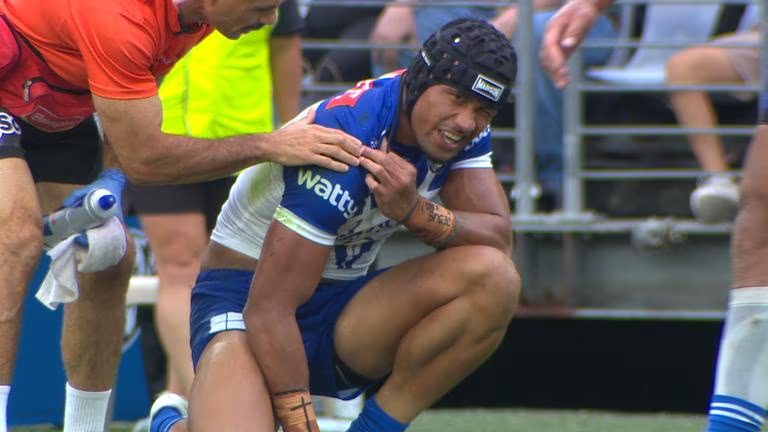

A shoulder injury to captain Stephen Crichton has exposed deeper issues at the Canterbury Bulldogs, with a puzzling tactical call and a second-half collapse compounding a damaging 32-24 Good Friday loss to South Sydney.
What began as a competitive clash quickly turned into a turning point for the Bulldogs’ season — not just because of the result, but due to the fallout that followed.
Crichton injury casts long shadow
The defining moment came early in the second half. In the 43rd minute, Crichton struggled to his feet after an awkward tackle involving Jack Wighton and Campbell Graham, clearly in pain as he attempted to play the ball.
Sideline reports later confirmed the Bulldogs skipper had suffered an AC joint injury. He was ruled out shortly after and will undergo scans, but early assessments suggest a high-grade two or even grade three issue.
“It doesn’t look great,” coach Cameron Ciraldo admitted post-match, adding that Crichton could be sidelined “for a while,” with no clear timeline between weeks or potentially months.
The loss of Crichton — both a strike weapon and the team’s primary defensive organiser — immediately destabilised Canterbury’s structure.
Game slips away amid errors and discipline issues
At halftime, the Bulldogs were in control, having built a lead through tries from Lachlan Galvin and Sitili Tupouniua after responding to early South Sydney pressure.
But the second half told a different story.
Canterbury completed just 61 percent of their sets and committed 16 errors, while conceding an 8-2 penalty count that handed South Sydney sustained possession.
The Rabbitohs capitalised ruthlessly, with Tallis Duncan, Cameron Murray and Latrell Mitchell all crossing as the Bulldogs’ defence and composure unravelled.
Despite a late consolation try to Connor Tracey, the damage had already been done.
Ciraldo pointed to the penalty count as a major factor but conceded the team’s execution also fell short, particularly under fatigue.
‘Baffling’ selection call raises bigger concerns
Beyond the injury, the most debated moment came with Ciraldo’s substitution call.
Instead of bringing on specialist centre Bronson Xerri to replace Crichton, the coach introduced halfback Sean O’Sullivan, shifting Matt Burton out to the centres.
The decision drew immediate criticism.
“Are you not baffled by that?” commentator Andrew Voss said during the broadcast, while Greg Alexander questioned why Xerri was even on the bench if not used in that situation.
The confusion was amplified by Ciraldo’s own pre-game comments, where he had stated Xerri would “cover outside backs.”
Post-match, the coach defended his call, saying the team needed a “communicator” after losing Crichton — a role he believed O’Sullivan fulfilled better.
“When you lose your best communicator, I needed to get another communicator out there,” Ciraldo explained.
The explanation, however, has only intensified scrutiny around Canterbury’s spine, with critics pointing to a lack of a dominant organiser in the halves.
Burton role shift backfires again
The reshuffle also revived concerns around Matt Burton’s usage.
With Burton pushed to centre, the Bulldogs lost one of their key playmakers from the middle of the field — a move that has now been trialled multiple times, including the previous week against Newcastle.
Ciraldo had earlier suggested the experiment could unlock attacking potential by bringing Crichton closer to the ball, but in this instance, the absence of Crichton exposed the fragility of the system.
Without structure, the Bulldogs attack stalled, errors mounted, and defensive gaps widened.
The situation also casts further doubt over Xerri’s future at the club. After being dropped earlier this season and reportedly seeking a release, his non-selection in a moment tailor-made for his role only deepens the uncertainty.
For Canterbury, the implications stretch beyond one loss.
They now face the prospect of playing without their captain, while also confronting unresolved questions about leadership, combinations, and tactical clarity.
As the season unfolds, those questions may prove even more damaging than the scoreboard.
You may like: Tesco UK Easter Opening Times 2026: What to Know About Sunday Closures and Holiday Store Hours

Make Swikblog your go-to source on Google for reliable updates, smart insights, and daily trends.