
Sydney’s afternoon commute was thrown into chaos after a freight train caught fire near Warwick Farm, forcing major shutdowns across the T2, T3 and T5 lines and leaving thousands of passengers stranded during peak hour. What began as a sudden rail incident in the city’s southwest quickly turned into a wider transport headache, with trains suspended across key stretches of the network, replacement buses not yet in operation in the early stages, and commuters told to delay travel or find another way home.
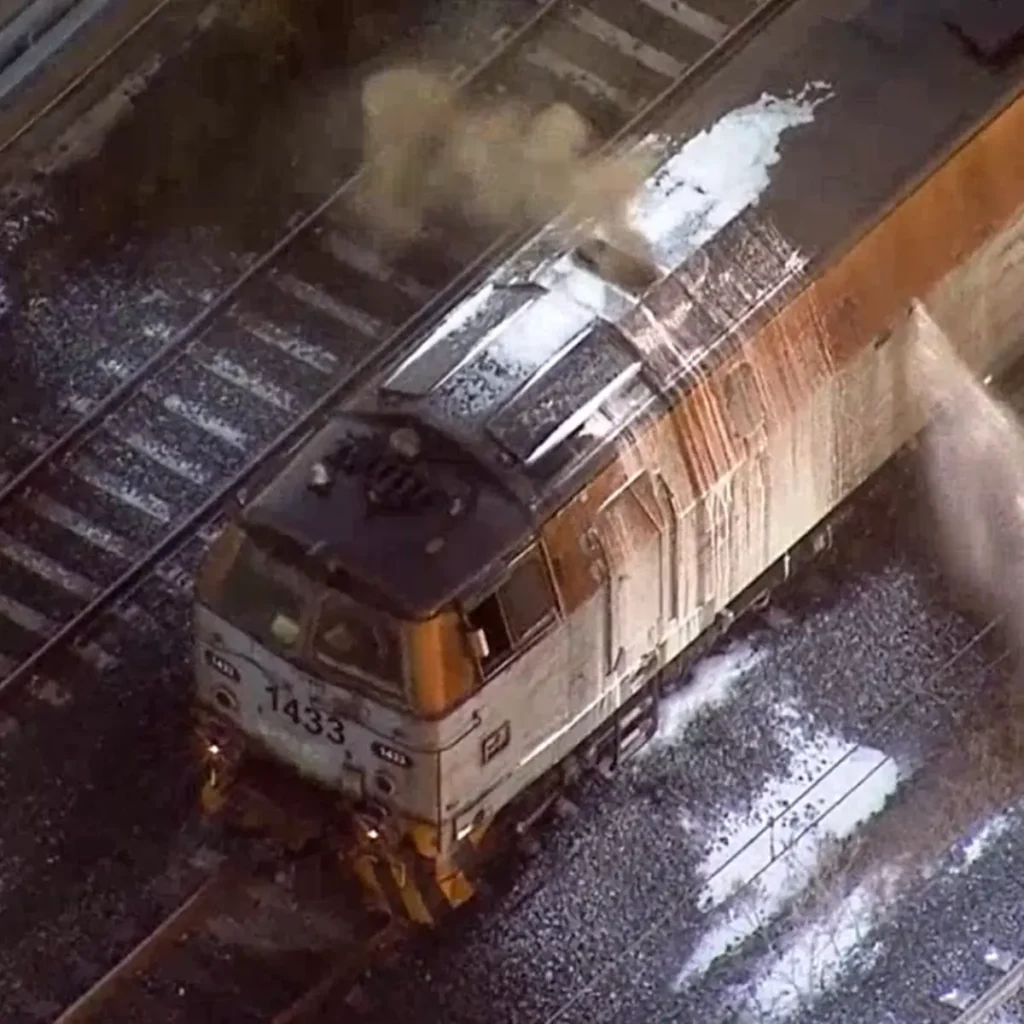
The disruption centred on Warwick Farm, about 30km west of Sydney’s CBD, where flames were seen on a freight train carriage and emergency crews moved in to contain the fire. Images and television footage from the scene showed smoke rising from the train as firefighters worked around the locomotive area. For passengers already on platforms or trying to reach home after work, the visuals confirmed what station announcements were already making clear: this was not a short delay, and it was not confined to one line.
Peak-hour shutdown spreads across multiple Sydney train lines
Transport authorities said trains stopped running between Fairfield and Liverpool on the T2 Leppington and Inner West Line and on the T5 Cumberland Line. Services were also suspended between Villawood and Liverpool on the T3 Liverpool and Inner West Line. That combination hit one of Sydney’s busiest commuter corridors, cutting across routes used daily by office workers, students, shift staff and families moving between the southwest and the inner city.
The impact was immediate. Crowds began building at affected stations as normal services dropped away and travel times became impossible to predict. Some passengers waited for updates in the hope trains would resume quickly. Others abandoned the rail network altogether and began searching for buses, rideshares or lifts from family and friends. The advice from transport officials was blunt: delay travel, consider alternative transport and allow plenty of extra travel time.
What made the disruption more frustrating for commuters was the gap between the suspension notice and any practical fallback. Replacement buses were requested, but they were not yet running in the initial phase of the incident. In a city where peak-hour congestion already stretches roads and public transport connections, that meant many stranded passengers were left without an immediate substitute just as demand surged.
The fire itself appears to have broken out on the freight train near the locomotive area, with reports describing flames near the roof line close to the driver’s cabin. Emergency services moved to extinguish the blaze while rail teams managed the operational fallout. Even when a fire is quickly brought under control, rail disruptions of this kind can continue well beyond the flames. Tracks may need to be inspected, surrounding infrastructure assessed, and trains re-sequenced before any line can return to a safe and reliable timetable.
That is why incidents like this tend to ripple far beyond the exact point of failure. A freight train fire near Warwick Farm does not only affect one carriage or one station. It disrupts signalling, platform operations, service spacing and passenger movement across a wider section of the Sydney network. Once the rail corridor is interrupted, the effects spread fast, especially when the timing lands in the busiest part of the day.
For commuters on the ground, the experience was more personal than any network map could show. Some were caught midway through their trip and had to improvise in real time. Others were heading toward Liverpool, Fairfield or Villawood and suddenly found themselves stuck with no clear estimate for recovery. Parents trying to reach children after school, workers leaving offices, and people travelling to evening shifts all faced the same uncertainty. Sydney’s train system is built around rhythm and frequency, and when that rhythm breaks, the disruption is felt almost instantly.
There is also a wider reason stories like this travel quickly. Rail interruptions in Sydney do not stay local for long because so many daily routines depend on smooth movement through a few critical corridors. When a freight incident knocks out sections of the T2, T3 and T5 lines, the story is no longer just about a fire. It becomes a citywide commuting problem, a traffic problem, and for many people, a time-and-cost problem as they scramble for other transport options during one of the most expensive and congested parts of the day.
Authorities were still working through the response as updates continued to come in, and the focus remained on extinguishing the fire, securing the train and restoring movement safely. That safety-first approach is essential, but it also means passengers often have to wait while essential checks are completed. In practical terms, Sydney commuters were left balancing caution against frustration, watching an already difficult trip home become even longer.
The incident is another reminder of how quickly one operational failure can upend travel for thousands across a major city. A single freight train fire near Warwick Farm was enough to stop services across multiple lines, stretch patience on station platforms and push more pressure onto roads already under strain. For travellers trying to get home, the advice remained to keep checking official updates and rethink the journey where possible through the Transport for NSW travel alerts page.
By the end of the afternoon, the story was no longer just about a train on fire. It had become the defining commute disruption of the day in Sydney, with stranded passengers, halted services and a familiar sense of citywide gridlock returning the moment the rail network lost one of its key links.
You may like: Japan’s 1,200-Year Cherry Blossom Record Shows Climate Change Impact

Make Swikblog your go-to source on Google for reliable updates, smart insights, and daily trends.