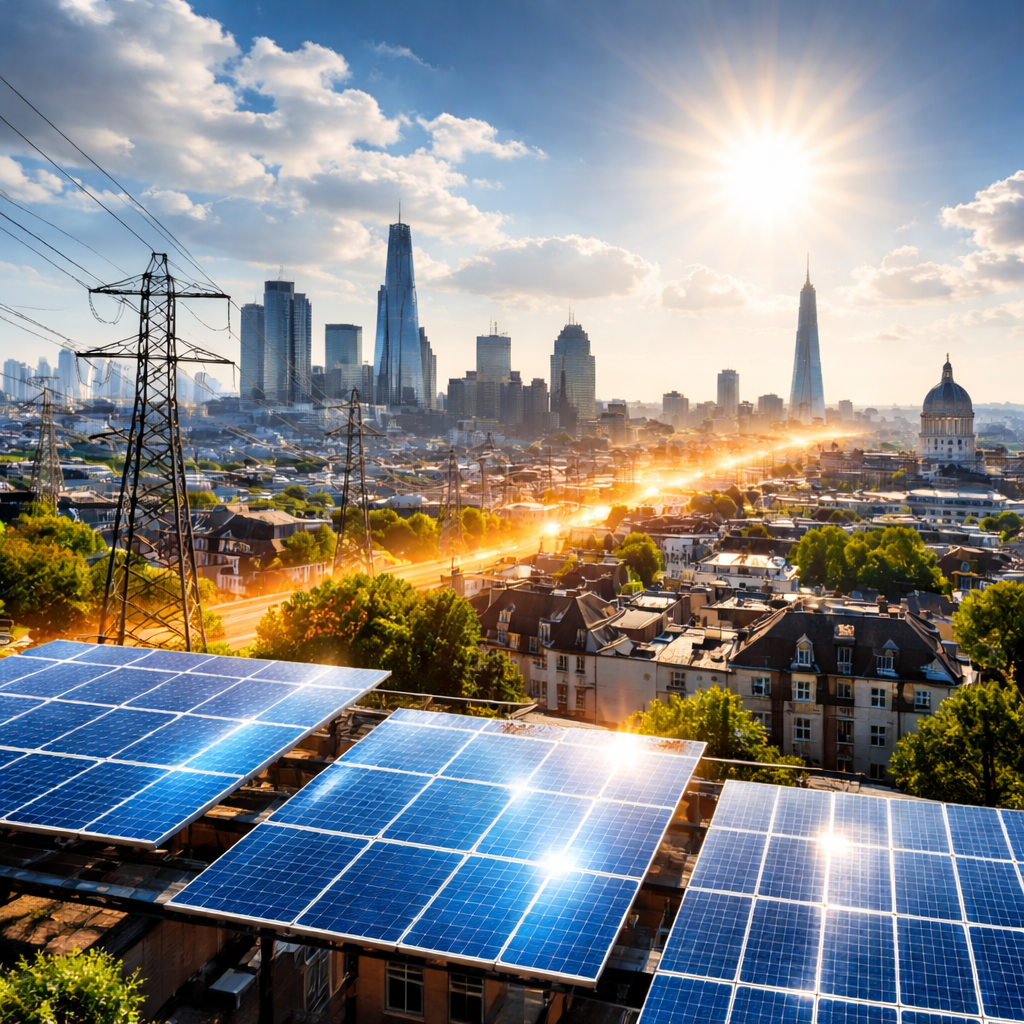

Britain’s electricity system is facing a new kind of pressure, and it’s not the one most people would expect. The traditional fear of blackouts during freezing winter nights is being replaced by a very different risk — one that could emerge on a bright, sunny summer afternoon when solar panels are generating more power than the country actually needs.
Energy experts are increasingly warning that the UK grid is struggling to keep pace with the rapid rise of renewable energy, particularly solar. On some days, solar output can surge to nearly 19GW, while national demand drops to as low as 11GW to 15GW. That imbalance — too much supply and too little demand — is becoming one of the biggest technical challenges for the country’s power system. :contentReference[oaicite:0]{index=0}
The National Energy System Operator (Neso), which is responsible for balancing the grid, has acknowledged that these conditions are becoming more frequent. While it insists the system remains reliable, it has also warned that operators may need to use their full range of tools to maintain stability during periods of low demand and high renewable generation. :contentReference[oaicite:1]{index=1}
Why too much solar power can become a problem
The issue lies in how Britain’s electricity grid was originally designed. For decades, power flowed in one direction — from large, controllable power stations into homes and businesses. These stations, typically powered by gas, coal or nuclear energy, could be adjusted in real time to match demand.
Today’s system looks very different. A growing share of electricity is being generated by solar panels and wind farms, many of which are connected to the distribution network rather than the main transmission grid. This lower-level network was never built to handle large volumes of generation, nor was it equipped with the same level of monitoring and control.
As a result, a significant portion of solar output is effectively invisible to central grid operators. They cannot always see how much electricity is being generated in real time, nor can they easily switch it off when supply exceeds demand. That lack of visibility and control is now a critical weakness in the system. :contentReference[oaicite:2]{index=2}
On a sunny Sunday or bank holiday — when factories are closed and household demand is low — solar panels can continue generating at full capacity. In the past, operators could simply dial down large power stations. Now, they are dealing with thousands of decentralised generators that behave very differently.
Lessons from Spain’s massive blackout
The risks are not just theoretical. A major blackout in Spain and Portugal last year offered a stark warning of what can happen when renewable-heavy grids lose stability. More than 50 million people were left without power after a chain reaction triggered by disruptions in solar generation. :contentReference[oaicite:3]{index=3}
At the time, around 80% of electricity in the Iberian Peninsula was coming from wind and solar. While that marked a significant milestone for clean energy, it also exposed a structural weakness. Traditional power stations, with their heavy spinning turbines, provide what engineers call “inertia” — a stabilising force that helps keep the system’s frequency steady.
Solar and wind do not provide that same level of inertia. When parts of the system suddenly disconnected, there was not enough stabilising force to absorb the shock, leading to a cascading failure.
Britain’s grid is structured differently, and operators are confident a similar nationwide collapse is unlikely. However, experts warn that the underlying challenge — managing a system with high renewable penetration and lower inertia — is becoming increasingly relevant in the UK as well.
Rising costs and growing political tension
Even when blackouts are avoided, the financial cost of managing the grid is rising sharply. Last year alone, the UK spent more than £1 billion paying wind farms to switch off when there was too much power in the system. These so-called curtailment costs are expected to grow as more renewable capacity comes online. :contentReference[oaicite:4]{index=4}
The issue has quickly turned political. Critics argue that too many renewable projects have been connected without fully upgrading the grid infrastructure needed to support them. Some have questioned whether the true cost of renewable energy — including balancing and curtailment — has been underestimated.
Supporters of the government’s net zero strategy counter that these challenges are part of a necessary transition. They argue that investing in grid upgrades, storage technologies and smarter systems will ultimately reduce costs and deliver cleaner, more affordable energy in the long term.
Meanwhile, the debate is becoming more heated, with some political voices even calling for limits on new solar developments, while others push for faster expansion backed by stronger infrastructure.
For now, Britain’s energy system remains stable, but the pressure points are becoming clearer. The combination of rising solar output, limited grid visibility and lower system inertia is creating a new balancing act — one that will define the next phase of the country’s energy transition.
As summer approaches, the real test may come on those quiet, sunny days when demand dips and solar generation peaks. Keeping the lights on is no longer just about having enough power. It is about managing when, where and how that power enters the system — and whether the grid is ready for a future shaped by renewable energy.
You may also like: UK bans Lidl and Iceland ads in junk food crackdown

Make Swikblog your go-to source on Google for reliable updates, smart insights, and daily trends.