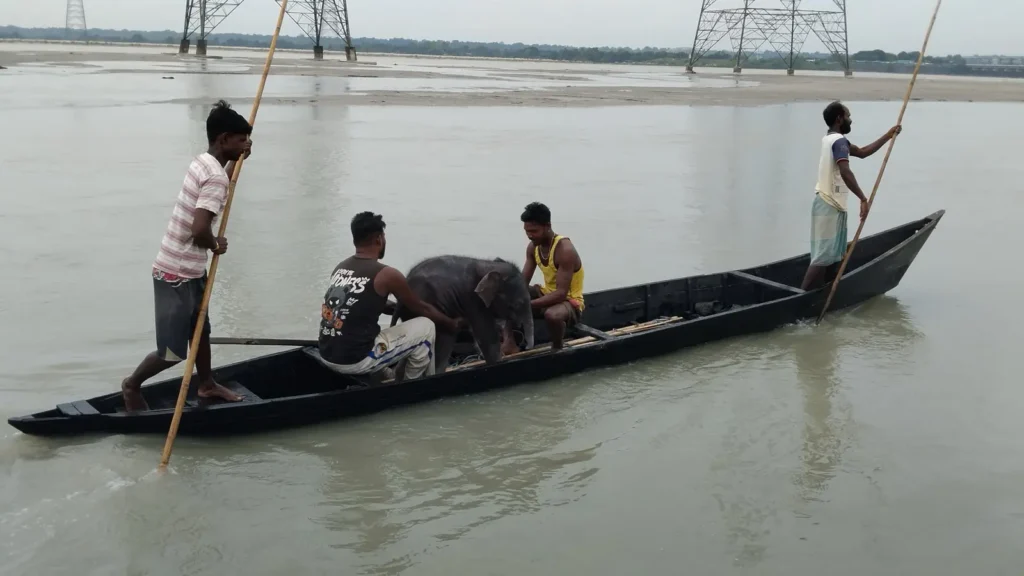

JALPAIGURI, India — Five fishermen risked their lives in the powerful current of West Bengal’s Teesta River to save a two-week-old elephant calf that had been separated from its herd and carried several kilometres downstream.
The rescue unfolded near Gajoldoba in Jalpaiguri district on Monday morning, September 21, after the calf was swept away while a herd of five elephants attempted to cross the swollen river near the Kathambari range of Apalchand Forest.
Witnesses initially noticed an unidentified object moving rapidly with the current. As the fishermen approached, they reportedly heard the calf’s faint cries and saw its trunk raised above the water as it struggled to breathe.
Divisional Forest Officer Mudit Kumar Verma said the newborn calf was swept nearly five kilometres downstream before the fishermen and Forest Department personnel intervened.
“Our Forest team, with help of local fishermen, rescued the drowning calf and reunited it with its mother,” Verma said.
Fishermen entered the Teesta to reach the drowning calf
The fishermen involved in the rescue were identified as Bablu Das, Mithun Das, Kader Das, Biswanath and Gopal. They spotted the calf at around 8:30 a.m. near the Teesta’s 12th spur, close to the Punjab embankment.
According to The Times of India, the men rowed towards the exhausted animal in a small boat while waves continued to carry it downstream.
Three fishermen then entered the river and helped lift the calf into the narrow boat. With the additional weight making it difficult to navigate against the current, some of the men reportedly swam alongside and pushed the boat towards the riverbank.
Local resident Rajkumar Roy said the current was extremely strong and the calf appeared helpless. He told The Statesman that the fishermen followed the animal for several kilometres before bringing it under control.
Published estimates of the distance differ. Verma’s account placed it at nearly five kilometres, while other reports estimated that the calf travelled approximately three to four kilometres. What is clear is that it had been carried a considerable distance from its herd.
After reaching the bank, the fishermen handed the calf to personnel from the Baikunthapur Forest Division. It was taken for an immediate veterinary examination before officials began trying to locate its mother.
Officials faced a second challenge after the rescue
Saving the calf from the river was only the first part of the operation. Forest workers also needed to reunite it quickly with its mother while limiting unnecessary human contact.
Young elephant calves depend heavily on their mothers, but prolonged separation and extensive handling can complicate their return to a herd. Officials therefore kept the calf under observation near the Teesta while listening for calls from nearby elephants.
The calf was moved across the Gajoldoba Barrage towards a dry section of the riverbed near Saraswati Tea Garden and the adjoining Saraswati Forest, where the herd was believed to have taken shelter.
Forest personnel soon heard the mother elephant calling from the forest. They placed the calf in a suitable location and moved back, allowing the mother to approach without being disturbed.
After nearly two hours of coordinated work involving forest officers, local residents and the fishermen, the mother reached the calf and accepted it. Reports said she was seen nursing the newborn before taking it into the water, bathing it and moving back towards the forest.
The successful reunion was particularly significant because separated calves are not always immediately accepted after rescue. During earlier flooding in North Bengal, another calf rescued from the Mechi River was reportedly rejected by its herd following prolonged human exposure.
Verma praised the fishermen for reacting quickly and supporting the Forest Department throughout the operation. Their decision to pursue the calf through the strong current ultimately turned a potentially fatal separation into a rare rescue and reunion.
Source information: The Times of India, The Statesman and NDTV India.

Make Swikblog your go-to source on Google for reliable updates, smart insights, and daily trends.