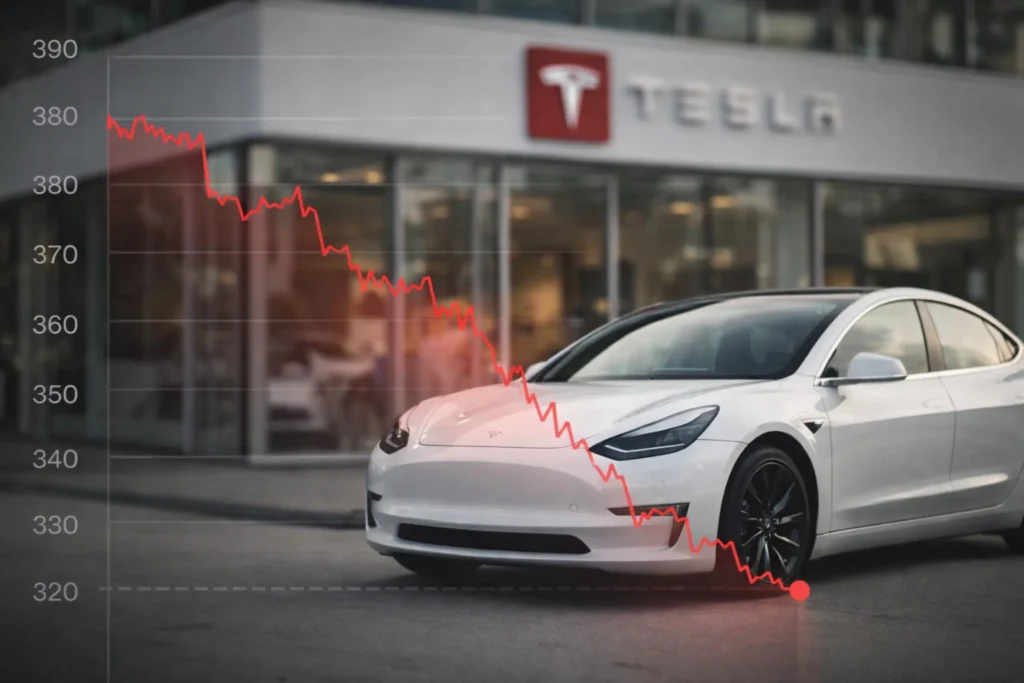

Tesla shares were under pressure in early trading after the company’s first-quarter delivery report came in below Wall Street expectations, giving investors another reminder that the electric-vehicle giant is still navigating a much tougher market than it enjoyed a few years ago. TSLA fell 3.6% to $367.46, down $13.80 on the day, after touching an intraday range of $363.65 to $368.05. The move left the stock well below its previous close of $381.26, even as traders continued to weigh Tesla’s longer-term story around autonomy, robotics, and energy.
The immediate trigger was the delivery number. Tesla reported 358,023 vehicles delivered in Q1 2026, missing the market consensus of 364,645. That shortfall may not look huge at first glance, but for a company that still commands one of the market’s richest valuations, even a modest miss can hit sentiment quickly. Investors have become used to judging Tesla not just on whether it grows, but on whether it grows fast enough to justify the premium attached to the stock.
The quarter was not weak across every line. Tesla said it produced 408,386 vehicles globally during the period, showing that manufacturing capacity remains solid. But that gap between production and deliveries also matters. When output runs ahead of sales, the market starts asking harder questions about demand, discounting, and how much pricing pressure may be needed to keep volume moving.
Delivery miss lands at a sensitive moment for Tesla stock
This is landing at a delicate time for Tesla because the company is no longer being judged purely as a fast-growing carmaker. It is being judged as a future-facing technology business with a current market cap of roughly $1.379 trillion. That is a massive figure for a company whose latest quarterly delivery report missed expectations and whose core auto business is facing stiffer competition in nearly every major region.
The valuation debate remains central. Tesla is trading with a reported trailing P/E ratio of 343.35, alongside EPS of $1.07. The stock also carries a beta of 1.93, which helps explain why reactions can be sharp when expectations are not met. Even after the latest pullback, the stock is still far above its 52-week low of $214.25, though well below its 52-week high of $498.83. That range tells the story clearly: Tesla remains one of the market’s most closely watched momentum names, but it is also one of the most debated.
Analysts’ average 1-year target estimate of $418.83 suggests there is still optimism around upside, yet the market is clearly asking what will drive the next sustained leg higher. A delivery miss by itself does not break the story, but it adds to the sense that Tesla’s growth path is becoming more uneven and less predictable than before.
There is also a broader backdrop here. Competition in electric vehicles has intensified across Europe and Asia, with established automakers and aggressive Chinese rivals pushing hard on both price and features. That has made Tesla’s position more complicated than it was when the brand had a cleaner first-mover advantage. A recent Reuters report also highlighted the pressure around Tesla’s first-quarter delivery miss as investors reassess the company’s near-term momentum.
Investors are still balancing weak near-term numbers against Tesla’s bigger story
Beyond vehicles, Tesla’s energy business also drew some attention. The company deployed 8.8 GWh of energy storage products in the quarter, down from 14.2 GWh in the previous quarter. That sequential decline does not erase the importance of the energy segment, but it does remove one possible cushion at a time when investors are looking for stronger support outside the car business.
Trading activity showed the stock was firmly in focus. Early session volume reached 7,755,206 shares, though that was still below the average daily volume of 61,215,768. The bid was around $367.39 x 200, with the ask near $367.81 x 200, showing a market that was active but not disorderly. This was not a panic sell-off. It looked more like a recalibration after a headline that failed to give bulls the clean beat they wanted.
That matters because Tesla is one of those stocks where the story often trades ahead of the numbers. Supporters continue to argue that the real prize is not just car sales, but autonomous driving, robotaxis, Optimus, and software-led expansion. Skeptics counter that those ambitions have been in the narrative for years, while the auto business still does most of the heavy lifting today. When deliveries miss and the valuation is still this elevated, the market tends to lean back toward caution.
For now, Tesla remains a stock split between two powerful forces. On one side is the pressure from softer delivery momentum, pricing competition, and a more demanding EV market. On the other is the belief that the company still has the brand, scale, and innovation pipeline to reopen a stronger growth chapter. With Q1 earnings expected on April 21, 2026, the next major update may matter even more than this delivery report. Investors will want to see not only margins and guidance, but also a clearer sense of whether demand is stabilizing enough to support the kind of growth story Tesla still trades on.

Make Swikblog your go-to source on Google for reliable updates, smart insights, and daily trends.