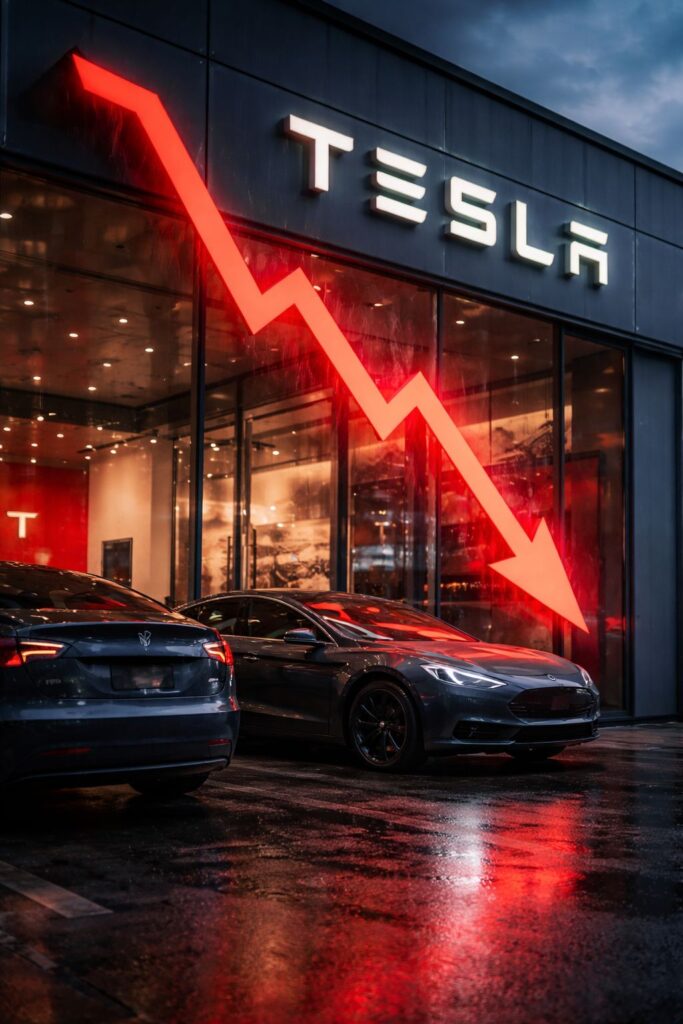

Tesla stock fell today to $380.81, down 1.33%, as investors reacted to a mix of bullish expansion plans and rising concerns around its AI-driven future. While Elon Musk is doubling down on solar energy with a reported $2.9 billion sourcing deal in China, growing regulatory scrutiny and valuation worries are keeping sentiment under pressure.
The decline reflects a broader shift in how the market is viewing Tesla. The company is no longer just an electric vehicle maker. It is now being priced as a high-stakes bet on artificial intelligence, robotics, and energy infrastructure — and that makes every development far more impactful.
$2.9 billion solar push signals Tesla’s AI energy strategy
According to a Reuters report, Tesla is in talks with Chinese firms to source up to $2.9 billion worth of solar manufacturing equipment. The company has reportedly engaged with suppliers such as Suzhou Maxwell Technologies, a major producer of solar cell equipment.
The move is part of Musk’s broader vision to scale solar energy in the United States, with a target of 100 gigawatts of solar capacity. This push is not just about clean energy — it directly ties into the rising power demands of artificial intelligence.
As AI data centers expand rapidly, energy consumption is becoming a major bottleneck. Tesla appears to be positioning itself to supply that energy, potentially turning its solar and storage business into a key growth driver. If successful, this strategy could significantly diversify Tesla’s revenue beyond vehicles.
Cathie Wood trims Tesla stake despite long-term optimism
Adding to investor caution, ARK Investment Management — led by longtime Tesla bull Cathie Wood — reduced its position in the company. The firm cut its Tesla holdings by about 19% between Q3 and Q4 2025, lowering its stake from 3.59 million shares to 2.91 million shares.
While ARK still holds a substantial position, the reduction signals a degree of risk management at current valuation levels. For many investors, this move reinforces the idea that even strong supporters of Tesla are becoming more selective as uncertainties increase.
NHTSA probe raises serious questions on Tesla’s AI strategy
The biggest overhang on Tesla stock right now is regulatory risk tied to its Full Self-Driving (FSD) technology. A recent Barron’s analysis highlights an ongoing National Highway Traffic Safety Administration (NHTSA) probe into Tesla’s camera-only autonomous system.
The investigation has identified multiple crashes, including one fatal incident, where Tesla’s system reportedly failed in low-visibility conditions such as fog, glare, and dust. The concern is not just software performance but whether Tesla’s hardware approach — relying solely on cameras — is fundamentally sufficient.
If regulators mandate changes, Tesla could be forced to adopt additional sensors such as LiDAR or radar. That would have major implications, potentially requiring costly redesigns across millions of vehicles.
Ripple effects could hit Cybercab and Optimus
The implications extend far beyond current vehicles. Tesla’s entire “physical AI” ecosystem — including its upcoming Cybercab robotaxi and Optimus humanoid robots — relies on the same vision-based system.
If the NHTSA determines that Tesla’s approach is unreliable in certain conditions, it could delay the Cybercab rollout, which is expected to begin production ramping in 2026. A hardware redesign would not only increase costs but also push timelines further out.
For Optimus, the risks are more nuanced but still significant. While factory environments are more controlled, regulatory skepticism could slow adoption, especially in broader use cases beyond industrial settings.
Valuation pressure adds to downside risk
Tesla’s valuation remains one of the biggest concerns for investors. The stock is currently trading at around 180x forward earnings, a level that assumes near-perfect execution of its AI, robotics, and energy strategies.
At the same time, Tesla’s core automotive business is showing signs of slowing growth, with margins under pressure. The company has even begun scaling back parts of its legacy lineup, including discontinuing the Model S and Model X, as it reallocates resources toward future-focused projects.
This creates a challenging dynamic. Tesla is sacrificing near-term stability for long-term potential, but that potential is still uncertain and heavily dependent on regulatory outcomes and technological breakthroughs.
Market caught between vision and reality
Today’s 1.33% drop highlights the tension between Tesla’s ambitious vision and the risks surrounding its execution. On one hand, the $2.9 billion solar push strengthens the company’s positioning in a rapidly growing AI-driven energy market. On the other, regulatory scrutiny and valuation concerns are limiting investor enthusiasm.
For now, Tesla remains one of the most polarizing stocks in the market. It offers exposure to multiple transformative industries, but it also carries significant downside risk if even one part of its strategy faces setbacks.
The coming months will be critical. Investors will be watching closely for updates on the NHTSA investigation, progress in solar expansion, and early signals from Tesla’s next-generation AI products. Until then, the stock is likely to remain volatile, driven as much by headlines and expectations as by fundamentals.
You may like: Why AMD Stock Is Falling Today Despite Price Hike Buzz and Strong AI Demand Signals

Make Swikblog your go-to source on Google for reliable updates, smart insights, and daily trends.