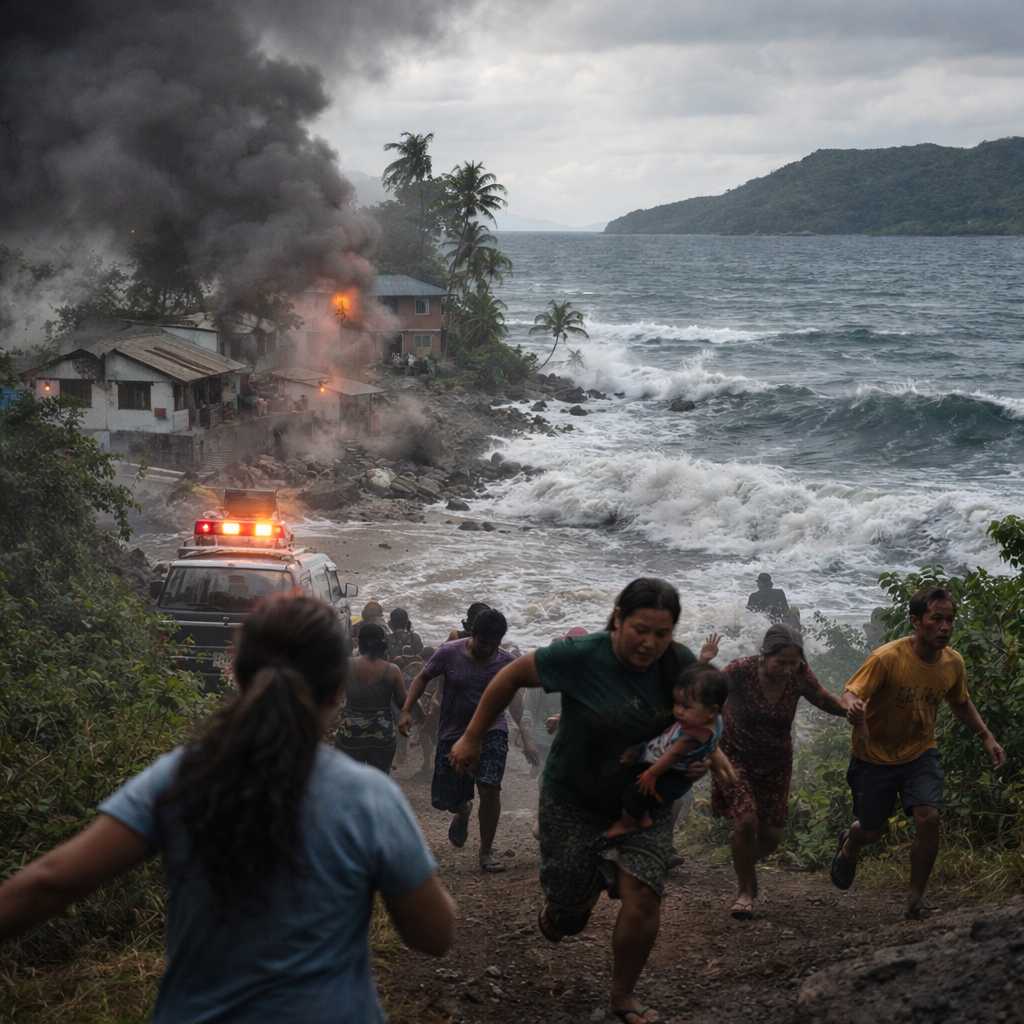

A powerful 7.6 magnitude earthquake struck near Tonga, shaking the Pacific region and triggering immediate tsunami alerts, emergency sirens, and evacuations across multiple islands. The quake, which hit west of Neiafu in the Vavaʻu group, caused widespread panic in the first few minutes as authorities rushed to assess the tsunami risk.
The strong tremor was recorded at a depth of approximately 237 km, which later played a crucial role in reducing the chances of a destructive tsunami. However, initial warnings forced residents to move quickly to higher ground as a precaution.
7.6 magnitude quake strikes near Tonga
According to seismic data, the earthquake occurred around 5:38 PM NZ time, about 150 km west of Neiafu. Despite being deep, the quake was widely felt across Tonga, with residents describing it as one of the longest and strongest tremors in recent memory.
Eyewitness Lucy Faanunu, a government official in Vavaʻu, said the shaking was intense even while driving.
“The steering wheel was shaking left and right. When I got home, my son said it was a long quake,” she said.
Another local journalist noted that the tremor felt different from typical earthquakes, highlighting the unusual duration of the shaking.
Tsunami alert triggers evacuations and sirens
Immediately after the earthquake, Tonga’s National Disaster Risk Management Office issued a tsunami warning for all coastal areas. Sirens began blaring across the capital Nuku’alofa and other regions, prompting urgent evacuations.
Authorities instructed residents to:
- Move immediately to higher ground
- Avoid beaches and shorelines
- Follow official evacuation routes
- Stay away from low-lying coastal areas
Schools reassured parents that children were safe, with students gathered in secure locations under supervision. Emergency broadcasts urged people to stay calm but act quickly.
Live updates: warnings lifted in some areas
As assessments continued, authorities began updating the situation in real time:
- Tsunami warnings lifted for Tongatapu, ʻEua, Haʻapai, and the Niuas
- Warning remained active for Vavaʻu due to proximity to the epicenter
- Emergency services continued monitoring wave activity
The staggered lifting of warnings created uncertainty, keeping residents alert even after initial panic began to ease.
No tsunami threat due to deep earthquake
The Pacific Tsunami Warning Center (PTWC) confirmed that no major tsunami threat was expected.
The reason: the earthquake occurred too deep beneath the Earth’s surface to significantly displace ocean water.
Officials stated:
“There is no tsunami threat because the earthquake is located too deep inside the Earth.”
This scientific assessment helped calm fears across the wider Pacific region.
No threat to New Zealand confirmed
New Zealand’s National Emergency Management Agency (NEMA) and GNS Science quickly evaluated the situation and confirmed there was no tsunami threat to New Zealand.
Authorities noted that even if a wave had formed, it would take at least two hours to reach New Zealand, giving enough time for further analysis.
After reviewing all data, officials concluded the earthquake was unlikely to generate a dangerous ocean event for the country.
For official updates, readers can refer to the Pacific Tsunami Warning Center and US Geological Survey.
What residents experienced on the ground
Residents across Tonga reported strong shaking that caused items to fall from shelves and buildings to sway. A shop owner in Neiafu captured the moment the tremor hit, showing products rattling and dropping.
Some described feeling physically shaken and disoriented, while others rushed to check on family members. Sirens and emergency announcements added to the urgency of the situation.
Tonga Police urged the public to:
- Stay calm and avoid panic
- Follow official instructions only
- Avoid spreading unverified information
Evacuees were also advised to carry essential emergency supplies, including water, food, medicines, flashlights, and important documents.
Damage update: no major destruction reported
Despite the strong magnitude, early reports from officials indicated no significant damage in major populated areas such as Neiafu.
This outcome is largely attributed to the depth of the earthquake, which reduces surface impact compared to shallow quakes.
Authorities continue to monitor aftershocks and assess infrastructure, but initial signs suggest the situation is under control.
Why this 7.6 earthquake caused panic
The earthquake quickly became a major global news event due to its combination of size, location, and immediate tsunami alerts.
In the Pacific region, strong earthquakes are closely linked to tsunami risks, making rapid evacuations a standard safety response. The memory of past disasters means authorities act quickly even when the risk is uncertain.
The Tonga earthquake also unfolded in real time, with updates, warnings, and eyewitness reports spreading rapidly across media platforms.
Outlook: situation stabilising but monitored
As of now, the situation is stabilising, with most tsunami warnings lifted and no major damage reported. However, authorities remain on alert, particularly in Vavaʻu, where warnings persisted longer.
The Tonga earthquake 7.6 magnitude event highlights the importance of preparedness in earthquake-prone regions. While the worst-case scenario was avoided, the rapid response and evacuations likely played a key role in ensuring public safety.
For residents, the experience serves as a reminder of how quickly natural disasters can unfold — and why staying informed and prepared is critical in the Pacific.

Make Swikblog your go-to source on Google for reliable updates, smart insights, and daily trends.