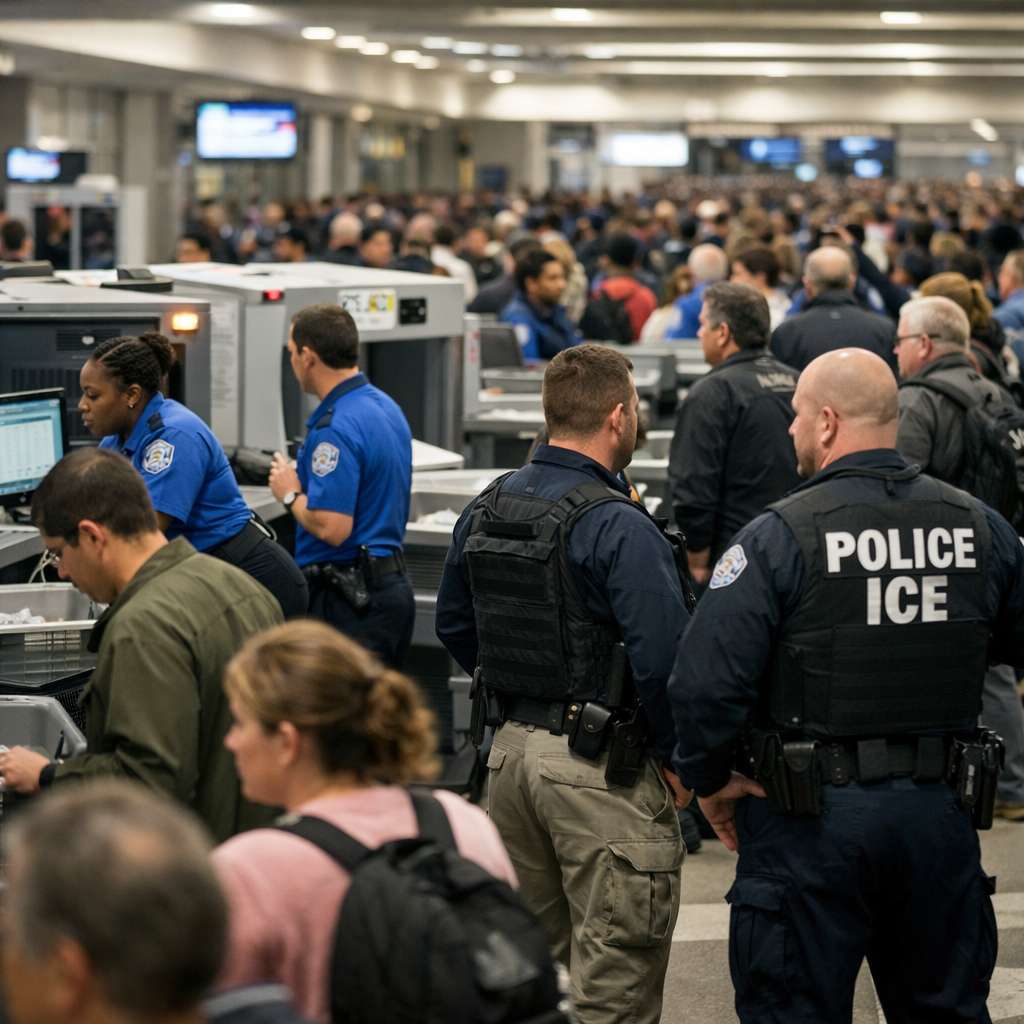

The U.S. aviation system is under mounting pressure as a severe TSA staffing shortage forces emergency measures across the country. In a dramatic move, the government has deployed Immigration and Customs Enforcement (ICE) agents to 13 major airports after more than 400 TSA workers quit and absentee levels hit their highest point since the shutdown began.
With long security lines, delayed flights, and growing traveler frustration, this situation is quickly turning into one of the biggest travel disruptions in recent months.
Why TSA Staffing Is Plunging
The crisis stems from the ongoing partial government shutdown, which has left Transportation Security Administration (TSA) officers working without regular pay since mid-February. Although classified as essential workers, TSA agents are required to continue working even as their salaries are delayed.
This financial strain has triggered a sharp rise in absenteeism, with many officers calling out sick or leaving their jobs entirely. According to official updates, more than 400 TSA workers have already quit, while many others are struggling to continue under the current conditions.
This staffing collapse has directly impacted airport operations, leading to long queues, slower security processing, and widespread travel delays.
ICE Deployed to 13 Major Airports
To manage the growing chaos, ICE agents were sent to 13 major U.S. airports on March 23. These include:
- Chicago O’Hare International Airport (ORD)
- Cleveland Hopkins International Airport (CLE)
- Hartsfield-Jackson Atlanta International Airport (ATL)
- Houston William P. Hobby Airport (HOU)
- John F. Kennedy International Airport (JFK)
- LaGuardia Airport (LGA)
- Louis Armstrong New Orleans International Airport (MSY)
- Luis Muñoz Marín International Airport (SJU)
- Newark Liberty International Airport (EWR)
- Philadelphia International Airport (PHL)
- Phoenix Sky Harbor International Airport (PHX)
- Pittsburgh International Airport (PIT)
- Southwest Florida International Airport (RSW)
Some reports suggest deployments could extend to 14 airports, though officials have not confirmed all locations, citing operational security reasons.
What ICE Agents Are Actually Doing at Airports
Despite widespread concern, ICE agents are not replacing TSA officers or performing passenger screening duties. They are not trained to operate X-ray machines or conduct full security checks.
Instead, their role is limited to support functions such as:
- Guarding exits and secure areas
- Managing passenger flow and crowd control
- Handling administrative or logistical tasks
According to officials, this allows TSA officers to focus on specialized screening roles, improving efficiency at checkpoints.
You can read more details from The Guardian’s full report and Business Insider’s breakdown.
Will ICE Agents Arrest Travelers?
Officials have clarified that ICE agents are not deployed to conduct broad immigration enforcement or randomly check passengers.
Their mission is focused on operational support, not immigration screening at TSA checkpoints.
However, ICE remains a law enforcement agency with the authority to act if necessary. This means that individuals already flagged in their system, such as those with active warrants or deportation orders, could still face targeted enforcement.
For the average traveler, there is no change in the standard airport security process.
Mixed Impact: Are Wait Times Improving?
While the deployment aims to ease congestion, early reports from airports suggest mixed results.
Some travelers report little to no improvement in wait times, especially at high-traffic hubs like Atlanta (ATL) and New York (JFK). Security lines continue to stretch for hours in certain locations, particularly during peak travel periods.
Spring travel demand has further intensified the situation, making it difficult for limited staff to handle passenger volume efficiently.
Mask Controversy Around ICE Agents
The presence of ICE agents has also sparked debate over whether they should wear masks while on duty. President Donald Trump stated he supports agents wearing masks during enforcement operations but prefers they do not wear them at airports.
However, on-the-ground observations show both masked and unmasked ICE agents operating at major airports, adding to public attention and concern.
Why ICE Is Paid While TSA Workers Are Not
One of the most controversial aspects of this situation is the difference in pay between ICE agents and TSA officers.
ICE agents continue to receive full pay because their funding comes from long-term federal allocations. In contrast, TSA funding relies heavily on annual congressional appropriations, which have been disrupted by the shutdown.
This funding imbalance has fueled frustration among TSA workers, many of whom are struggling financially while continuing essential duties.
Safety Concerns and Criticism
The deployment of ICE agents has drawn criticism from labor unions and aviation experts. Critics argue that ICE personnel lack the specialized training required for aviation security roles.
While their support may help operationally, experts warn that it does not address the root issue of staffing shortages and could raise concerns about overall airport security efficiency.
What Travelers Should Do Now
With disruptions expected to continue, travelers should take extra precautions when planning trips:
- Arrive at least 2–3 hours before departure
- Prepare for extended security wait times
- Monitor airline updates and airport alerts
Flexibility and early planning will be key to avoiding missed flights and travel stress.
Outlook: Temporary Fix or Escalating Crisis?
The deployment of ICE agents highlights the seriousness of the TSA staffing crisis but also underscores the limitations of short-term solutions.
Without a resolution to the government shutdown and restoration of TSA funding, the situation could worsen further, potentially leading to more delays, cancellations, and operational strain across U.S. airports.
For now, the U.S. travel system remains under pressure, with millions of passengers facing uncertainty in the weeks ahead.

Make Swikblog your go-to source on Google for reliable updates, smart insights, and daily trends.