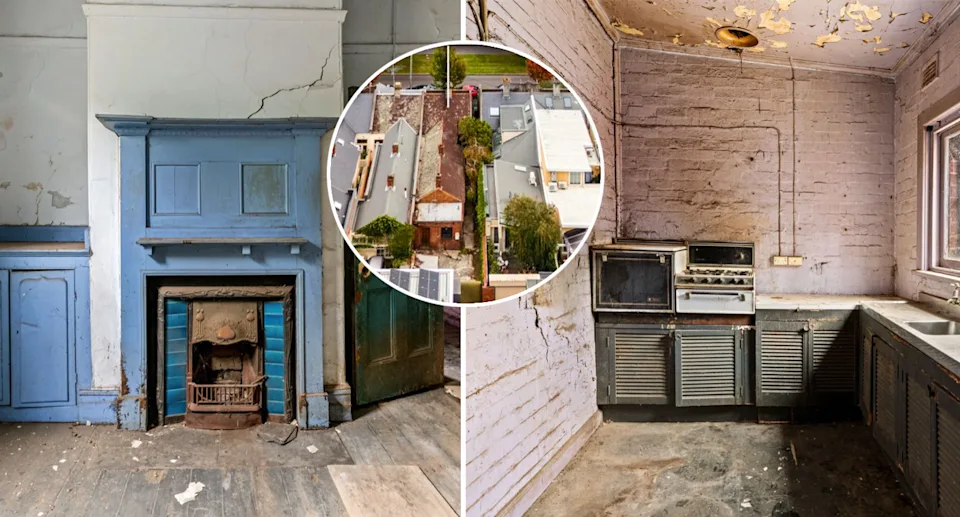

A derelict and reportedly unliveable house in East Melbourne has sold for approximately $2 million, despite occupying a block of only about 250 square metres.
Multiple buyers competed for the property, pushing its auction price more than $400,000 above the reserve. The result challenges a common investment assumption that a bigger block automatically delivers stronger capital growth.
Why did buyers pay $2 million?
The deteriorated property is located one suburb from Melbourne’s central business district. Although the house offered little immediate value as a residence, its land provides access to employment, public transport, hospitals, universities, parks and established amenities.
Buyers were effectively paying for the location and its future potential. A building can be repaired or replaced where planning rules permit, but a parcel of land beside the CBD cannot be reproduced.
The same property reportedly sold for approximately $400,000 three decades ago. Its latest price is about five times that figure in nominal terms, although the comparison does not account for inflation, interest, taxes, maintenance or transaction expenses.
Small block, strong competition
The 250-square-metre site demonstrates the difference between land size and land quality. A 2,500-square-metre block is not necessarily a better investment if it is located far from jobs, infrastructure and growing buyer demand.
A large site in an area with abundant undeveloped land may face competition from future supply. A smaller block in a tightly held inner-city neighbourhood can be harder to replace and may attract more buyers.
Investors should therefore consider zoning, frontage, access, nearby infrastructure and population growth—not simply the number of square metres advertised in the listing.
Is Melbourne property undervalued?
James Fitzgerald, managing director of property investment company Custodian and author of Bulletproof Investing, believes the buyer secured good value. He argued that an equivalent 250-square-metre site near Sydney’s CBD, potentially in Surry Hills, could cost 50% more or possibly twice as much.
That comparison is Fitzgerald’s opinion rather than an independent valuation. While Sydney land commonly carries a premium, properties can have substantially different values because of their exact location, zoning, frontage, heritage status and redevelopment potential.
One auction result cannot prove that Melbourne’s entire market is undervalued. It does, however, show that buyers continue to place a high price on scarce inner-city land, even when the existing dwelling is unusable.
The purchase price is only the beginning
The buyer may face considerable expenses before the property can be occupied. Potential costs include stamp duty, inspections, asbestos removal, architectural work, planning applications, demolition or restoration, construction, insurance and loan interest.
Holding costs can become particularly important when a property cannot generate rent during planning and building work. Australian borrowers should also confirm their loan balances are being calculated correctly following warnings about mortgage offset account errors affecting customers across several lenders.
Everyday banking charges can also reduce the money available for property expenses. The recent Commonwealth Bank fee-free account switch and customer refunds provide another reminder to review account fees and features regularly.
Read More:
Can the new owner demolish the house?
An unliveable building cannot necessarily be knocked down. East Melbourne contains historically significant properties and protected streetscapes, meaning heritage or neighbourhood-character controls may restrict demolition and redevelopment.
Victoria’s official planning property report service allows buyers to identify zones and overlays affecting a site. Council approval and professional advice may still be required before any work begins.
What buyers should learn from the sale
The result does not prove that every knockdown house or small block is a good investment. Property values can fall, construction costs can rise and planning restrictions can make a proposed project financially unworkable.
It is also too broad to assume that buildings always depreciate while land always appreciates. A renovated dwelling can add substantial value, while poorly located or unusable land can lose demand.
The practical lesson is to assess why a particular site is scarce. Proximity to jobs, transport and essential services can support demand, but those benefits must be weighed against planning limits and the complete cost of making the property usable.
In East Melbourne, buyers were prepared to overlook an unliveable house because it occupied a compact but exceptionally well-positioned site. The auction shows why the quality of land can matter considerably more than its size.

Make Swikblog your go-to source on Google for reliable updates, smart insights, and daily trends.