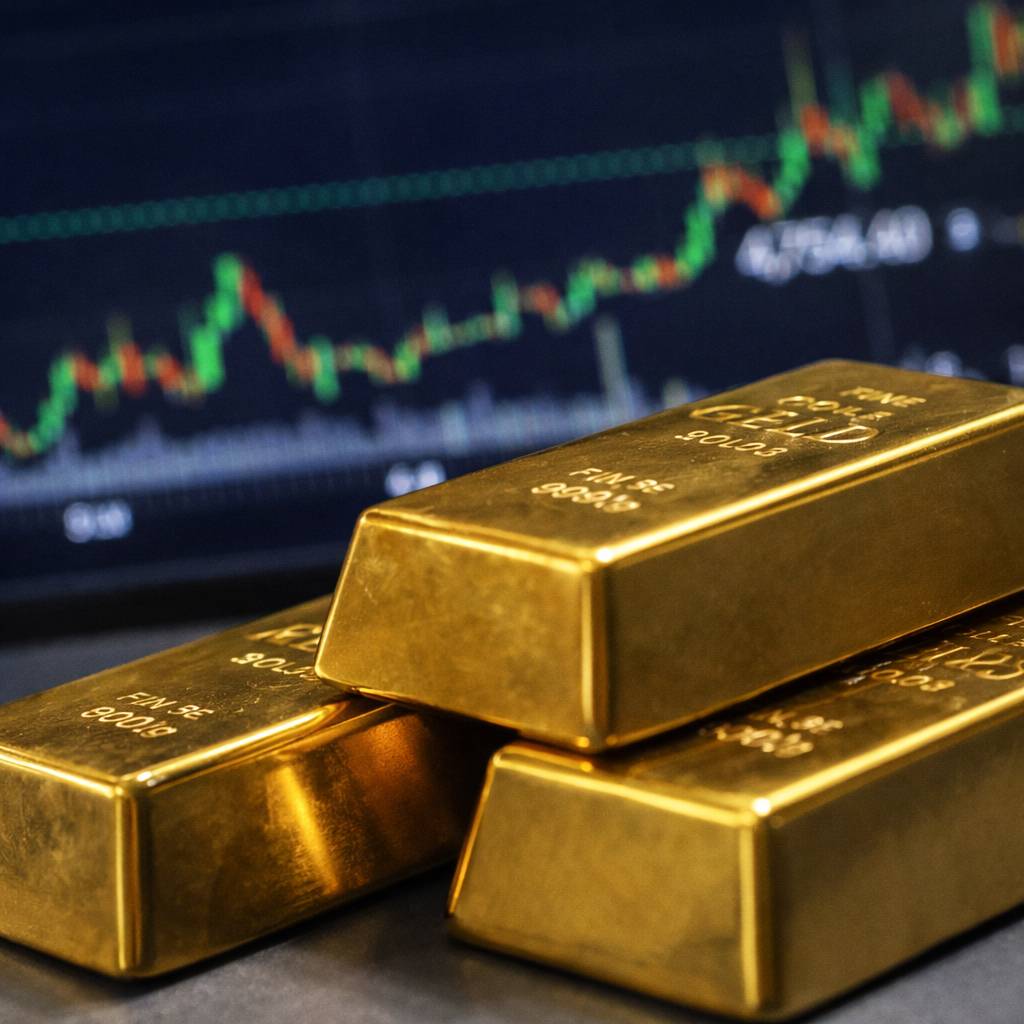

US gold prices declined in volatile trade on Wednesday, with spot gold falling to around $4,802 per ounce (-0.48%) while COMEX June futures slipped to approximately $4,819 (-0.63%), following a sharp rejection near the $4,850 level. The intraday move reflected a clear shift in momentum as prices dropped rapidly before stabilizing near key support, highlighting a phase of profit booking after a strong rally.
The session was marked by heightened volatility, with gold initially attempting to extend gains before facing strong resistance. Once prices failed to sustain above $4,840–$4,850, selling pressure accelerated, triggering a quick drop toward $4,800. However, buyers emerged near this zone, preventing a deeper decline and leading to a modest rebound.
Intraday price action signals short-term weakness
The chart structure indicates a clear intraday downtrend, characterized by lower highs and a sharp sell-off from resistance levels. Spot gold hovered around $4,802, while futures remained slightly elevated at $4,819, reflecting typical futures premium dynamics. The rejection near $4,850 remains the most critical technical signal from the session, suggesting that bulls are struggling to push prices higher in the near term.
Support has now formed around the $4,800–$4,810 zone, where prices bounced after the decline. This level is crucial for short-term traders, as a sustained break below it could open the door for further downside toward $4,780–$4,790. On the upside, resistance remains firmly placed near $4,840–$4,850, and a breakout above this range would be required to restore bullish momentum.
According to market data tracked via Trading Economics, gold continues to trade near elevated levels despite the pullback, reinforcing the view that the broader trend remains intact even as short-term pressure builds.
Market drivers: Dollar strength and profit booking weigh on gold
The decline in gold prices appears to be driven by a mix of macro and technical factors. One of the primary triggers was short-term strength in the US dollar and a slight uptick in bond yields, both of which tend to pressure gold prices. As yields rise, the opportunity cost of holding non-yielding assets like gold increases, prompting some investors to reduce exposure.
At the same time, the recent rally in gold had pushed prices toward overbought territory, leading to profit booking near resistance levels. The sharp rejection at $4,850 suggests that traders were quick to lock in gains, particularly after failing to break higher.
Liquidity-driven moves also played a role. The rapid drop followed by a bounce indicates that algorithmic trading and short-term positioning amplified the move, rather than a fundamental shift in long-term demand.
Investor sentiment remains cautiously bullish
Despite the decline, overall investor sentiment toward gold remains constructive. The fact that prices found support near $4,800 suggests that buyers are still active on dips. This behavior is typical in a strong market, where pullbacks are seen as opportunities rather than signals to exit positions.
Institutional interest in gold continues to be supported by broader macroeconomic themes, including inflation concerns, geopolitical uncertainty, and diversification needs. These factors have helped sustain demand even during periods of short-term volatility.
However, the inability to break above $4,850 may lead to cautious positioning in the near term. Traders are likely to wait for clearer signals before increasing exposure, particularly as global markets remain sensitive to economic data and central bank cues.
Outlook: Key levels to watch in coming sessions
Looking ahead, gold’s next move will largely depend on how it behaves around the current support and resistance levels. The immediate focus is on whether prices can hold above $4,800. A sustained hold above this level would indicate that the current pullback is merely a consolidation phase.
If gold rebounds and breaks above $4,840–$4,850, it could signal a continuation of the broader uptrend, potentially attracting fresh buying interest. On the other hand, a decisive break below $4,800 could trigger further downside toward $4,780 or lower.
In the bigger picture, the trend remains supported unless gold falls significantly below these support levels. The current move appears to be a short-term correction driven by profit-taking and macro adjustments rather than a reversal of the long-term bullish outlook.
For investors, the key takeaway is clear: US gold prices have entered a phase of consolidation near $4,800 per ounce after failing to break higher. While short-term momentum has weakened, the broader structure remains intact, making the next few sessions critical in determining whether gold resumes its upward trajectory or enters a deeper correction.
You may like: BP Shares Fall to 565p as Namibia Deal Signals Shift Back to Fossil Fuels

Make Swikblog your go-to source on Google for reliable updates, smart insights, and daily trends.