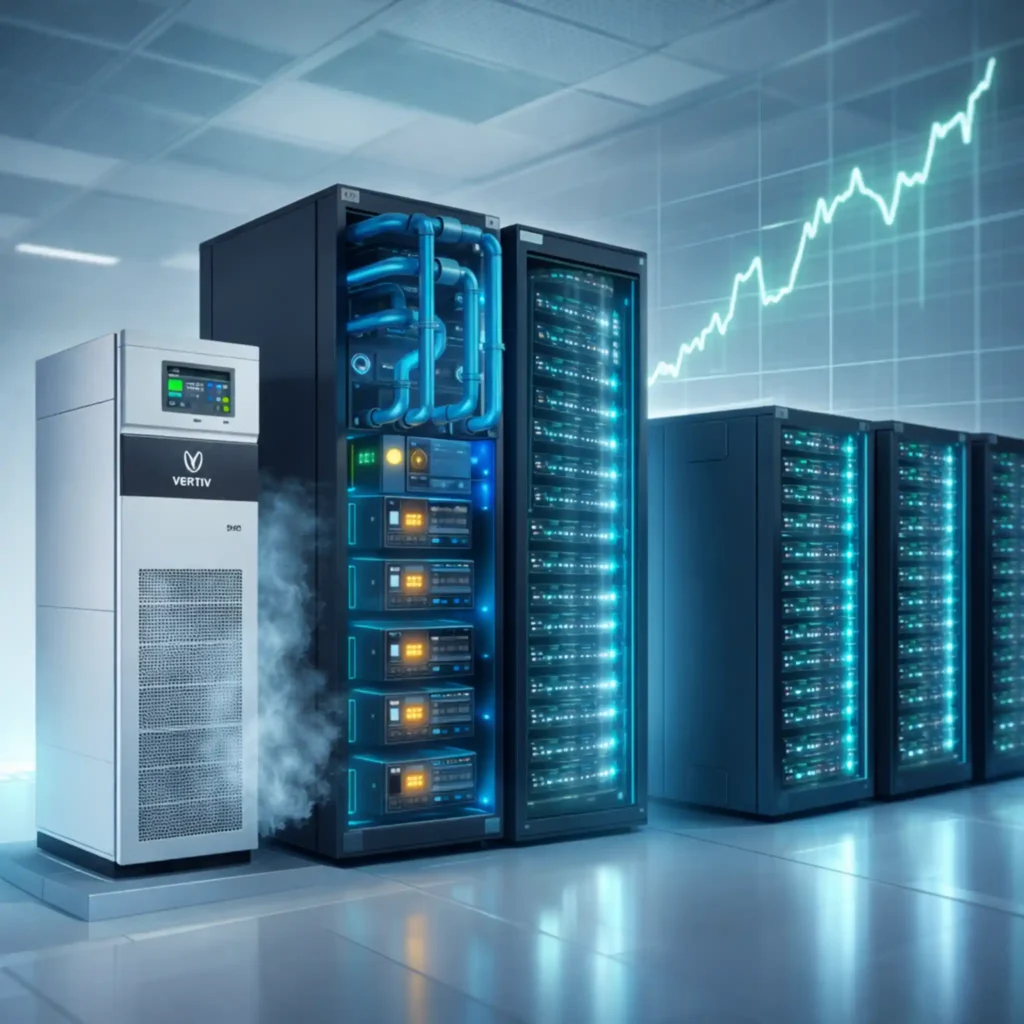

Vertiv Holdings Co. is back in the spotlight after a sharp after-hours move pushed the stock to $254.44, giving investors a fresh reason to revisit one of the market’s most closely watched AI infrastructure names. The rally came after news that Vertiv will join the S&P 500, a milestone that can increase visibility among institutional investors and index-tracking funds. For a company already tied to the rapid expansion of AI data centers, the timing adds even more momentum to a story that has been building for months.
During the regular session, VRT closed at $241.78, down 3.19%. But after the bell, sentiment flipped quickly and shares climbed 5.24% to $254.44. That move placed the stock much closer to its 52-week high of $264.86, reinforcing how aggressively the market continues to reward companies seen as essential to the AI buildout. Vertiv’s market capitalization now stands near $92.5 billion, while the company’s 1-year target estimate of $263.20 suggests Wall Street still sees room for upside even after a huge run.
Key market snapshot: Vertiv opened at $241.00, traded in a day’s range of $238.65 to $251.47, and finished the session with volume of 8.07 million shares, ahead of its average volume of 6.17 million. The stock carries a PE ratio of 70.90, EPS of 3.41, and a modest forward dividend of $0.25.
The big catalyst is simple. S&P 500 membership matters. Once a company is added to the index, it moves onto the radar of a much wider universe of investors, especially funds that must buy benchmark constituents. That can improve liquidity, deepen institutional ownership, and strengthen a stock’s standing in the market. In Vertiv’s case, the inclusion lands at a moment when the company is already benefiting from one of the most powerful investment themes on Wall Street: the race to build enough power and cooling capacity for AI-driven computing.
Vertiv is not a chipmaker, and that is exactly what makes the story interesting. While names linked to GPUs and networking often dominate the AI conversation, the infrastructure behind those workloads is becoming just as important. High-density AI servers generate enormous heat and require highly reliable power systems, thermal management, and integrated deployment solutions. That is where Vertiv has carved out a premium position. Its business sits directly inside the physical backbone of the AI boom, serving hyperscalers, colocation operators, and enterprise customers that need to scale compute without compromising uptime.
Recent announcements have only strengthened that narrative. Vertiv has unveiled collaborations with Generate Capital and Hut 8, both aimed at accelerating next-generation data center deployments. Those deals matter because they go beyond broad AI buzzwords and point to real-world execution. Investors are no longer just paying for exposure to AI in theory. They are increasingly rewarding companies that can help solve practical bottlenecks around energy, cooling, deployment speed, and infrastructure reliability. Vertiv’s positioning in those areas gives it a clearer lane than many companies trying to attach themselves to the AI trade.
The company has also been active on the balance sheet. Vertiv recently refinanced its capital structure with a $2.1 billion senior unsecured notes deal and a new $2.5 billion revolving credit facility, replacing secured debt and extending maturities. That may not be the flashiest part of the story, but it is an important one. For a company scaling alongside a major industry build cycle, access to flexible financing can make a real difference. It gives Vertiv more room to invest, compete for larger projects, and support customers that are making long-term infrastructure decisions tied to AI expansion.
Why Wall Street is paying closer attention
The market is clearly treating Vertiv as more than a short-term momentum trade. The stock’s valuation is rich, and that means expectations are high, but investors appear willing to pay up because the addressable market keeps expanding. AI data centers are not standard server rooms. They demand greater power density, advanced liquid and air cooling strategies, modular deployment models, and tighter integration between electrical and thermal systems. Vertiv is built around those requirements, which helps explain why every new product launch, customer deal, or partnership announcement gets watched so closely.
There is also a second layer to the bull case. As AI infrastructure spending broadens, the winners may not be limited to semiconductor names. Companies supplying the enabling ecosystem, including cooling, power delivery, and modular capacity solutions, could see durable demand even if investor attention rotates away from chips at times. That helps support the argument that Vertiv may remain one of the market’s more important second-wave AI beneficiaries.
What investors should watch next
The next major test is whether Vertiv can translate strong demand into sustained financial performance. Investors will be watching execution closely, especially as the company takes on more complex, high-capacity projects across regions and customer types. Competition remains real, with large industrial and electrical players also chasing the AI data center opportunity. Even so, Vertiv’s latest moves suggest management is trying to widen the moat through product depth, financing flexibility, and partnerships that reduce time to deployment.
For now, the market’s message is clear. Vertiv is no longer just another industrial technology company with exposure to data centers. It is increasingly being valued as a core AI infrastructure name, and its addition to the S&P 500 only amplifies that status. With the stock jumping after hours to $254.44, investors are signaling that index inclusion plus a stronger AI data center narrative may be enough to keep VRT near the top of the watchlist.
For readers tracking the structural AI buildout, Vertiv now sits at the intersection of institutional visibility, capital flexibility, and real-world data center demand. That combination is why the stock is drawing renewed attention even after an already huge run.
Read the official S&P Dow Jones announcement for the index changes behind the move.
You May Also Like
US Gold Price Today as COMEX futures jump after weak jobs data

Make Swikblog your go-to source on Google for reliable updates, smart insights, and daily trends.