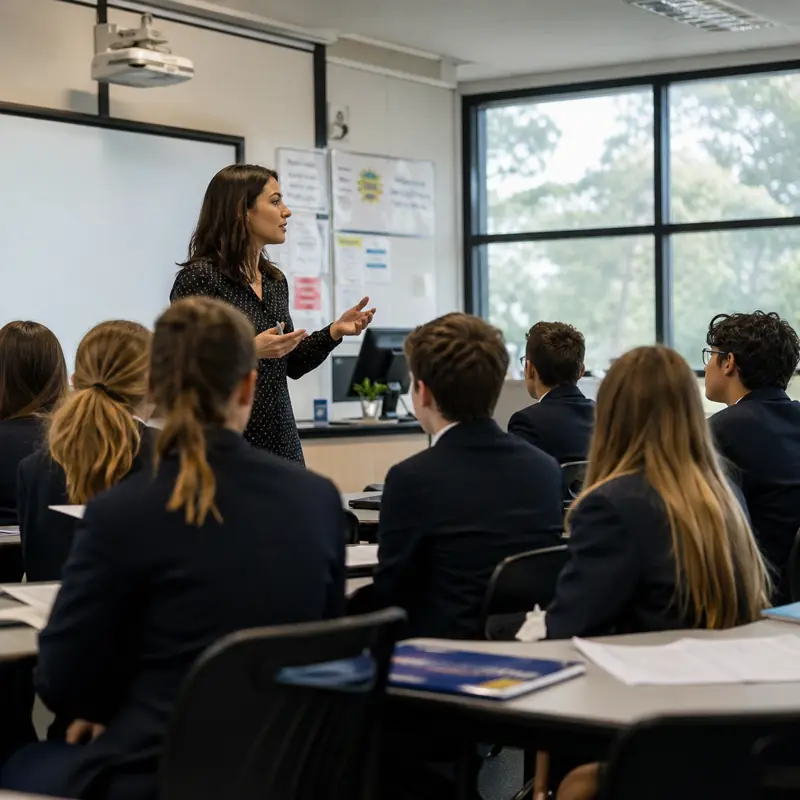

Victoria’s public school pay dispute has reached a decisive point, with teachers expected to receive a revised 28% pay rise offer over four years as the state government moves to prevent another round of strikes across May and June.
The proposed deal is a sharp increase from the government’s earlier 17% wage offer, but it still does not meet the 35% rise being sought by Australian Education Union members. That gap means the latest proposal may reduce pressure on the government, but it is unlikely to end the dispute unless teachers see stronger commitments on workloads, classroom conditions and support staff pay.
The development comes after months of frustration in Victoria’s education sector, where teachers, principals and school support workers have argued that wages have fallen behind other states while daily pressures inside classrooms continue to grow. According to The Age, the revised offer has not yet been formally put to the union, but the Department of Education is preparing the new proposal for around 52,000 teachers.
Why the 28% Offer May Not Be Enough
On paper, a 28% pay rise appears significant. In political terms, it also shows that the government has moved a long way from its original position. But for teachers, the issue is not only about the headline number. The real test will be how the increase is phased across the four-year agreement and whether the package addresses the conditions that pushed educators into strike action in the first place.
Victorian teachers have repeatedly pointed to a widening salary gap with New South Wales. A graduate teacher in Victoria earns about $78,801, while a graduate teacher in NSW earns about $90,177. For experienced classroom teachers, the gap is reported to be about $15,000. That difference has become a powerful argument for union members who say Victoria must lift pay to remain competitive and keep experienced staff in public schools.
The dispute has also exposed deeper strain across the education system. Teachers have raised concerns about unpaid overtime, growing administrative work, large class sizes and the increasing complexity of student needs. Many educators argue that unless these workload pressures are addressed, higher pay alone will not fix burnout or improve retention.
That is why the government’s new offer may still face resistance. The union’s demand for 35% over four years reflects not only inflation and interstate comparisons, but years of frustration over what teachers describe as declining conditions inside schools.
For more coverage on public sector pay, school policy and economic pressure on workers, readers can follow related updates on Swikblog.
Strike Plans Put Pressure on the Government
The government’s revised position comes after one of the largest education protests Victoria has seen in years. In March, up to 35,000 teachers, principals and education support workers walked off the job and marched through Melbourne’s CBD. It was the state’s first mass teachers’ strike in 13 years and sent a clear signal that the workforce was prepared to escalate its campaign.
Further action is already planned. Rolling regional stoppages are expected to begin on May 6, immediately after the state government releases its pre-election budget. The timing places added political pressure on Premier Jacinta Allan’s government, which is already facing scrutiny over public spending, services and workforce negotiations.
The first planned stoppage is expected to involve teachers from schools in Melbourne’s north and west, who are preparing to walk off the job for half a day and gather near Education Minister Ben Carroll’s electorate office in Niddrie. More actions are expected in the weeks that follow, including protests involving educators from Bendigo, Castlemaine, Kyneton and Maryborough near the Premier’s Bendigo East electorate office.
The industrial campaign could also widen further. The Australian Principals Association has indicated it will seek permission from the Fair Work Commission to hold a protected action ballot. If principals join the campaign, the dispute would become more difficult for the government to contain, as school leaders rarely move toward industrial action unless frustration has reached a serious level.
Another unresolved issue is the treatment of education support workers. Around 34,000 classroom assistants have reportedly been offered a 13% pay rise, far below the proposed increase for teachers. That difference could become a major sticking point because support staff are central to school operations, particularly in classrooms with students requiring additional assistance.
The government has said negotiations are continuing in good faith and that meetings between the Department of Education and the union have become more frequent. It has also urged unions not to disrupt students and families with further strikes.
But teachers are likely to compare this offer with other recent public sector outcomes in Victoria. Nurses previously secured a 28.4% pay rise over four years after rejecting an earlier deal, and that result has strengthened expectations that sustained industrial pressure can lead to better terms.
The coming weeks will decide whether the 28% proposal becomes the foundation for a settlement or simply another stage in a larger dispute. If the government can combine stronger wages with meaningful workload protections, it may have a chance to avoid extended disruption. If not, Victoria’s schools could face more stoppages just as families and students look for stability.
For now, the offer represents progress, but not peace. Until teachers see the full details and vote on a final agreement, the strike threat hanging over Victorian schools remains firmly in place.
You may also like: Disney Halloween Party 2026 Dates, Tickets and Magic Kingdom Closures

Make Swikblog your go-to source on Google for reliable updates, smart insights, and daily trends.