
Tens of thousands of Victorian public-school teachers, principals and education support staff stopped work for 24 hours on Thursday, July 23, 2026, after union members narrowly rejected the state government’s revised pay and conditions offer.
The statewide strike disrupted regular classes across Victoria and brought a large demonstration into central Melbourne. Government schools were expected to remain open where possible, but staffing shortages meant some campuses cancelled classes or offered supervision to only a limited number of students.
Victorian teachers’ strike at a glance
- Date: Thursday, July 23, 2026
- Duration: 24 hours
- Sector: Victorian government schools
- Employees involved: Teachers, principals and education support staff
- Melbourne march: Bourke Street Mall to Parliament House
- Main issues: Pay, workload, staffing, class sizes and school funding
What happened at the Melbourne rally?
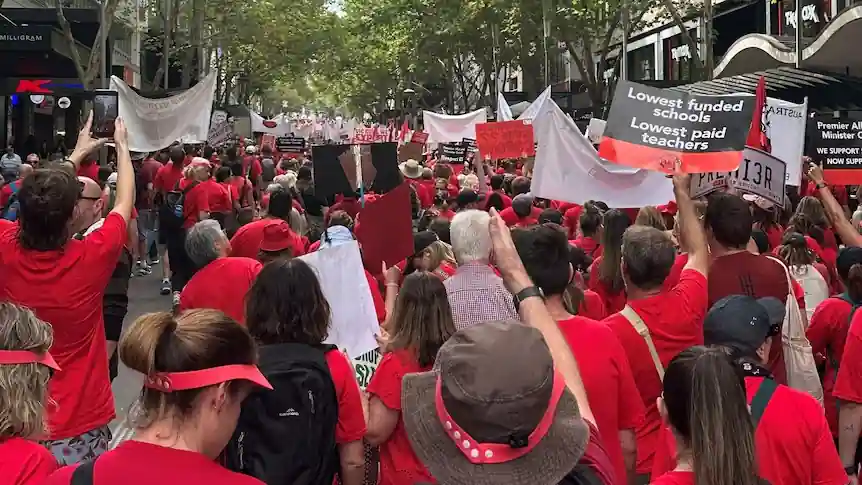
Australian Education Union members assembled at Bourke Street Mall before marching through Melbourne’s central business district to the Victorian Parliament.
Attendance estimates differed. Victoria Police reportedly estimated that approximately 20,000 people attended, while the union placed the crowd at about 30,000. Organisers had expected more than 35,000 employees to participate in the statewide stoppage.
The march temporarily affected traffic and public transport in the city. Demonstrators called on Premier Jacinta Allan’s government to improve its offer and address pressure created by staff shortages and growing workloads.
Industrial action was not limited to Melbourne. More than 150 educators reportedly marched in Wodonga, where participants highlighted the difficulty of retaining staff when schools across the border in Albury, New South Wales, can offer more competitive salaries.
How were Victorian schools affected?
The stoppage applied to government schools throughout Victoria. The Education Department expected schools to open where adequate supervision could be arranged, but normal lessons were not guaranteed.
Arrangements varied between campuses. Some schools cancelled classes for particular year levels, while others asked families to keep children at home unless supervision was essential. Parents and carers were advised to rely on notices issued directly by their child’s school.
Catholic and independent school employees were not part of the protected government-school strike, although some Catholic educators held separate solidarity activities before classes.
Why did education employees walk out?
The Australian Education Union, or AEU, represents public-school teachers, principals and education support workers. It says the dispute extends beyond wages to unpaid work, teacher vacancies, class sizes, support for students with complex needs and the resources available to schools.
The union says Victorian education employees perform an average of 12 hours of unpaid work each week. It argues that excessive workloads and lower salaries compared with some other jurisdictions are making recruitment and retention more difficult.
AEU Victorian Branch president Justin Mullaly said further industrial action could follow if the government did not return with an improved package. The union has previously sought a 35% salary increase over four years alongside smaller classes and stronger workload protections.
School funding remains another point of disagreement. The AEU says Victoria’s delayed timetable for reaching its share of the national Schooling Resource Standard will leave public schools about $2.4 billion short through 2031.
What was included in the rejected offer?
The government’s revised proposal provided salary increases of at least 28.3% over four years, beginning with a 12.75% increase by October 2026. Different employee classifications could have received larger cumulative increases.
The package covered teachers and education support staff. It would also have reduced compulsory meeting time from 80 hours to 40 hours a year and provided an annual lump-sum payment to experienced teachers at the top of the salary scale.
According to the Victorian government’s official statement on the revised education offer, full-time teachers would have received more than $1,000 extra per month by October 2026 and almost $3,000 extra per month by 2030. Some education support employees would have received up to $1,600 more per month by 2030.
The result was exceptionally close. Of the 50,677 AEU members who participated, 51.18% voted against accepting the proposal and 48.82% voted in favour.
The ballot followed the rejection of an earlier Victorian teacher pay agreement in June, when 57.7% of participating members opposed a package that offered different increases depending on an employee’s role.
How does the July strike compare with the March walkout?
The July action was Victoria’s second statewide public-school stoppage of 2026. Police estimated that about 35,000 educators and supporters attended the March 2026 Victorian teachers’ strike, the first statewide walkout by Victoria’s public-school workforce since 2013.
Approximately 500 schools were closed or significantly disrupted during the March action, according to the union. The July stoppage came after further negotiations and two rejected agreement proposals, showing that concerns about workload, staffing and school resources remained unresolved.
Read More:
- VCE Exam Timetable 2026: Full written exam schedule, key dates and important information
- 1,200 drivers fined nearly $700,000 under Adelaide’s new school zone speed limit rules
- Visit the Swikblog homepage for more latest news
What happens after the July 23 strike?
Deputy Premier and Education Minister Ben Carroll described the disruption to families as disappointing. He maintained that the rejected package would have delivered some of Australia’s strongest pay and employment conditions for educators.
The government and union are expected to continue bargaining over a new Victorian Government Schools Agreement. No additional statewide strike date had been confirmed by the end of the July 23 rally, although the AEU warned that its campaign could escalate without a better offer.
Any new stoppage, work ban or change to school operations would require further communication. Families should continue checking official notices from their school and the Victorian Education Department because arrangements may differ between campuses.

Make Swikblog your go-to source on Google for reliable updates, smart insights, and daily trends.