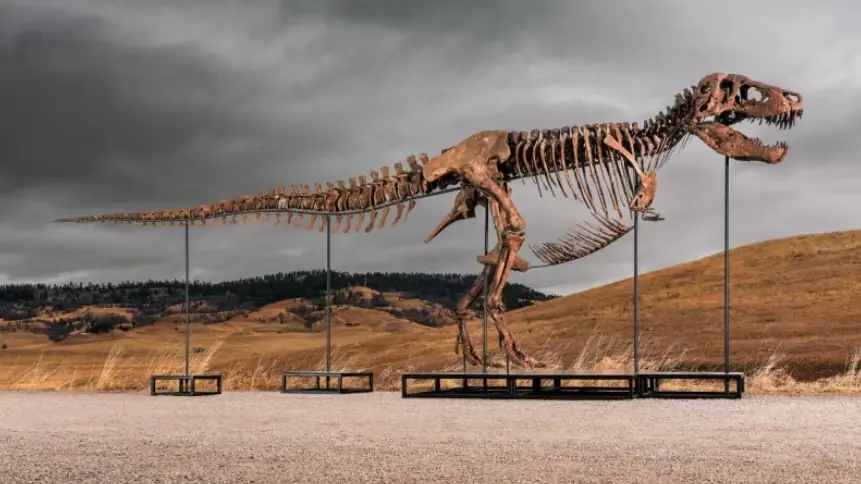

A 67-million-year-old Tyrannosaurus rex skeleton named “Gus” sold for US$50.13 million at Sotheby’s in New York on July 14, 2026, setting a world auction record for a fossil. The anonymous telephone bidder outlasted six rivals during approximately 10 minutes of bidding.
The final price, which includes auction fees, was far above Sotheby’s US$20 million to US$30 million estimate. Bidding reached US$43 million before fees were added.
As of July 23, Sotheby’s had not publicly identified the buyer or announced where the skeleton would be housed. That leaves unanswered whether Gus will enter a museum, remain available for scientific study or be placed in a private collection.
What makes Gus an important T. rex specimen?
Gus measures about 38 feet, or 11.6 metres, from head to tail and stands approximately 12.5 feet, or 3.8 metres, tall. Its 54-inch skull is represented by about 82% original fossil bone.
The skeleton contains 183 catalogued fossil bones from a single animal. Sotheby’s auction catalogue assessed it as approximately 61% complete by formal bone count, with the surviving material representing an estimated 75% to 80% of the animal’s original bone mass.
A later Sotheby’s editorial described the specimen as 63% complete. The difference appears to reflect how particular elements are counted, including 30 preserved gastralia, commonly called belly ribs, which are not traditionally included in the formal bone total.
Other unusual features include a furcula, or wishbone, both upper arm bones, two well-preserved feet and a fully represented pelvis. Missing sections were reconstructed for the exhibition mount, including with three-dimensional printing, rather than being presented as original fossil material.
Full measurements and provenance information remain available in the official Sotheby’s auction record.
Where was Gus discovered?
The first bone was found in 2021 on private ranch land in Harding County, South Dakota. The site lies within the Hell Creek Formation, a major source of fossils from the closing stages of the Late Cretaceous Period.
Excavation continued during the 2021, 2022 and 2023 field seasons. Nearly 1,000 fossil fragments were recovered, documented, cleaned and assembled during the wider preparation process.
The dinosaur was named after ranch owner Gary “Gus” Licking, who died before the completed skeleton was mounted. Its bone development indicates that it was a large, robust adult when it died approximately 67 million years ago.
Research into unusual prehistoric discoveries continues to change how ancient organisms are understood, including the 26-foot-tall fossil linked to early terrestrial ecosystems.
What do the injuries reveal?
Several bones preserve evidence of trauma. Sotheby’s documented bite marks on parts of the skull, lower jaw and post-cranial skeleton, although some damage may have resulted from scavenging after death.
Healed fractures in the ribs and gastralia show that Gus survived serious injuries during its lifetime. Such pathologies can help palaeontologists investigate dinosaur behaviour, recovery from trauma and interactions between large predators.
That scientific potential depends on researchers being able to examine the original bones and their supporting excavation records.
How the price compares with earlier fossil sales
- Gus, Tyrannosaurus rex: US$50.13 million in 2026
- Apex, Stegosaurus: US$44.6 million in 2024
- Stan, Tyrannosaurus rex: US$31.8 million in 2020
- Sue, Tyrannosaurus rex: US$8.36 million in 1997
Gus exceeded the record set by Apex by approximately US$5.5 million. Apex was purchased by billionaire Ken Griffin and placed on a four-year loan at the American Museum of Natural History in New York.
Stan was bought for Abu Dhabi’s Natural History Museum, while Sue was acquired for Chicago’s Field Museum with financial support from several organisations. Those cases show that private or institutional purchases can still lead to public display, but no equivalent plan has been confirmed for Gus.
Why scientists want public access
The Society of Vertebrate Paleontology urged the new owner to place Gus in a permanent public repository where its bones, field records and other information could remain available for research and education.
Scientists generally require specimens used in published research to be accessible for independent examination. A privately held fossil can become unavailable if an owner declines access, moves it without notice or sells it again.
Similar concerns apply to archaeological discoveries such as the Viking woman buried with scallop shells in Norway, where detailed documentation and continued access are important for interpreting the evidence.
The US$50.13 million result also illustrates the financial challenge facing museums. Public institutions rarely have acquisition budgets capable of competing with wealthy collectors for major fossils offered commercially.
Read More:
- Scientists create the largest magnetic map of the universe using data from nearly 4 million galaxies
- Visit the Swikblog homepage for more latest news
Was the sale legal?
Fossils legally excavated from privately owned land in the United States generally belong to the landowner and may be sold. Sotheby’s said the offering included documentation covering authenticity, condition and legal ownership.
Different rules apply to fossils on US federal land. Vertebrate fossils collected from federal property without authorisation cannot be privately removed and sold. Other countries may restrict fossil ownership, commercial trade or export regardless of where a specimen is discovered.
For Gus, the immediate legal ownership question has been settled by the auction. The unresolved issue is whether its new owner will make one of the most substantial T. rex specimens available to museums, scientists and the public.

Make Swikblog your go-to source on Google for reliable updates, smart insights, and daily trends.