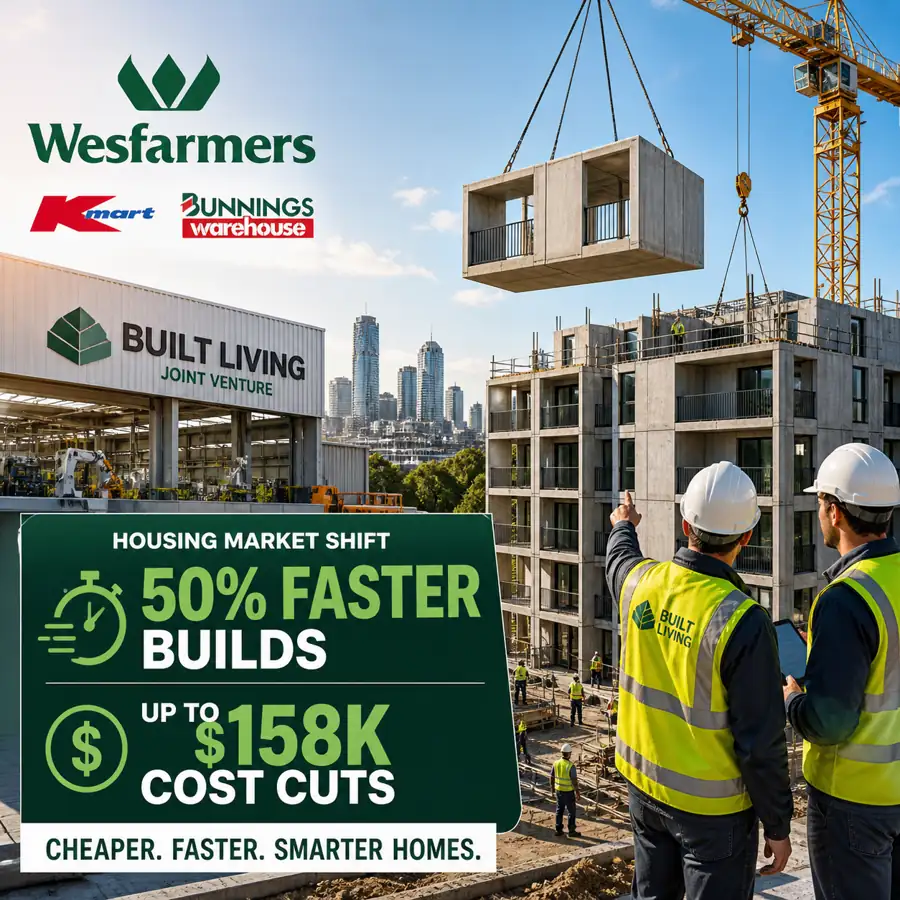

Australia’s housing crisis has triggered a major corporate pivot, with retail giant Wesfarmers stepping into residential construction through a bold new joint venture designed to build apartments up to 50% faster and 20% cheaper.
The company, best known as the owner of Kmart and Bunnings, has partnered with Built Group to launch Built Living, a 50:50 venture focused on large-scale apartment delivery using advanced manufacturing techniques.
The move signals a significant shift in how homes could be built in Australia, as traditional construction struggles with high costs, labour shortages, and supply chain disruptions.
Massive Cost Reduction Could Reshape Housing Prices
The numbers behind the project highlight its potential impact. Based on current estimates, apartment construction costs range between $461,000 and $789,000 depending on complexity and size. A 20% reduction could translate into savings of as much as $158,000 per unit.
This cost efficiency comes from adopting Design for Manufacture and Assembly (DfMA) methods, where key building components are produced offsite in factory conditions and then assembled quickly on location.
The approach has already been used successfully across Europe, including in countries like Germany and the Netherlands, where large-scale housing projects rely heavily on prefabrication to speed up delivery, as seen in global construction models highlighted by the World Economic Forum.
$100 Million Investment to Kickstart Manufacturing Hub
Wesfarmers has committed an initial $100 million investment to build Australia’s first advanced manufacturing facility dedicated to precast concrete construction for mid- and high-rise apartments.
The facility will be located in Western Australia’s Neerabup Automation and Robotics Precinct, with construction expected to begin in the second half of 2026. Once fully operational, it is projected to produce more than 2,000 apartments annually.
A portion of these homes will be allocated to government-backed housing projects, including social housing and essential infrastructure developments.
Speed Advantage Targets Housing Shortage
At the core of the strategy is speed. By shifting much of the construction process into a controlled factory environment, Built Living aims to cut project timelines by up to 50%, reducing delays caused by weather, labour shortages, and site inefficiencies.
This could be critical in addressing Australia’s ongoing housing shortage, which has been worsened by declining construction output and rising demand.
Recent data shows new home completions have dropped significantly in recent years, highlighting the growing gap between supply and demand.
China Fireworks Factory Explosion in Hunan Leaves 21 Dead and 61 Injured
Global Model Meets Australian Market
Built Group’s leadership has emphasized that the model is not experimental but based on proven international systems. The focus will be on mid-rise buildings (4–10 storeys) and high-rise developments exceeding 30 storeys, where efficiency gains are most significant.
Beyond residential apartments, the manufacturing facility is expected to support construction across hospitals, civic buildings, and other infrastructure, helping stabilize demand across economic cycles.
There is also potential for expansion into other major housing markets, including New South Wales and Queensland, where supply pressures and rising property prices continue to dominate headlines.
Strategic Shift for Wesfarmers
For Wesfarmers, the move represents a broader diversification strategy, combining its retail supply chain expertise with industrial manufacturing capabilities developed in its chemicals and energy divisions.
The company has previously expanded into building materials production through timber frame and truss manufacturing, and this latest venture extends its reach deeper into the construction ecosystem.
While the joint venture is not expected to materially impact earnings in the current financial year, it positions the company at the center of one of Australia’s most pressing economic challenges.
As housing affordability continues to dominate public debate, initiatives like Built Living could redefine how quickly and efficiently new homes are delivered — and ultimately influence property prices across the market.

Make Swikblog your go-to source on Google for reliable updates, smart insights, and daily trends.