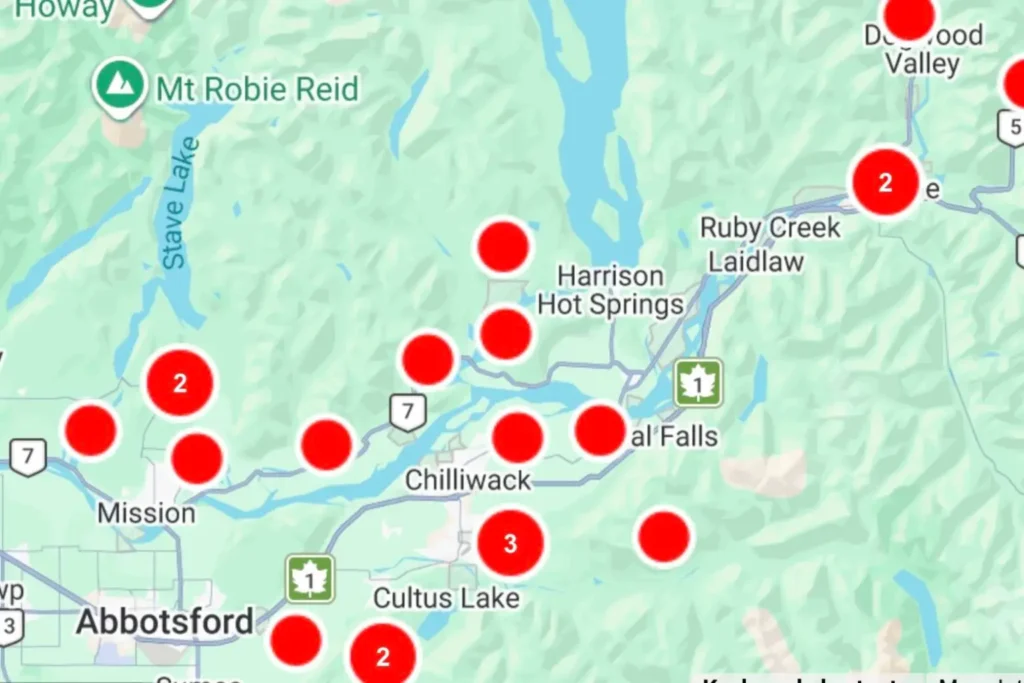

Strong winds swept across British Columbia’s eastern Fraser Valley late Wednesday, leaving thousands of residents without electricity and prompting emergency responses across several communities. Utility provider BC Hydro reported widespread outages as powerful gusts battered the region, with more than 11,000 customers across the Lower Mainland and Sunshine Coast losing power at the height of the storm.
The hardest-hit community was Chilliwack, where thousands of homes went dark as the storm intensified during the evening. By around 10 p.m., BC Hydro reported at least 36 separate outages affecting more than 8,200 customers in the city. Earlier in the evening, over 6,000 customers in Chilliwack were already without power as strong winds continued to move through the Fraser Valley.
The outages came after a sharp cold front pushed across British Columbia’s South Coast, triggering powerful wind gusts that shook homes and sent debris flying. Residents across Chilliwack, Abbotsford and Hope reported dramatic conditions as the winds strengthened after sunset. Many people said their houses were shaking from the force of the gusts, highlighting the intensity of the storm.
Environment Canada warning preceded the storm
Earlier in the day, Environment Canada issued a yellow wind warning before noon, cautioning that strong winds capable of causing damage were expected across south Metro Vancouver and the Fraser Valley. Meteorologists said the incoming cold front would bring powerful southwesterly winds through the evening.
Forecasts warned that wind gusts could reach around 90 km/h by nightfall across several areas, while parts of the eastern Fraser Valley could experience gusts as high as 100 km/h. Those speeds are strong enough to damage roofs, fences and tree branches while also increasing the risk of local power outages.
Environment Canada also warned residents that even though the strongest winds were expected to ease after midnight, gusty conditions could persist through Thursday, creating the potential for ongoing disruptions and cleanup efforts across affected communities.
Chilliwack emerges as the outage hotspot
The concentration of outages in Chilliwack made the city the focal point of the storm’s impact. With more than 8,000 customers affected and dozens of outages reported, the city experienced one of the largest electricity disruptions in the Fraser Valley that night.
Storm-related power failures in the region are commonly caused by trees or branches striking power lines during periods of extreme wind. Fallen debris can damage equipment or trigger automatic safety shutdowns in the grid. Utility crews typically need to inspect lines, remove hazards and restore infrastructure before electricity can safely return to affected neighborhoods.
In many cases, outages during windstorms occur in waves. As crews repair major lines, smaller localized outages become easier to identify and restore. That process can take several hours when storms affect large areas simultaneously.
Residents report intense nighttime conditions
Across the Fraser Valley, residents shared accounts of the storm’s strength as it passed through. Many people said the winds were among the strongest they had experienced in recent months, with homes rattling and outdoor objects being blown around.
Social media posts from across the region described loud gusts shaking buildings and bending trees. In several areas, homeowners reported bringing in loose items from yards and balconies to prevent damage as the storm intensified.
Authorities typically advise residents to secure outdoor furniture, decorations and other loose objects during high wind events. Even lightweight items can become dangerous projectiles when wind speeds approach 100 km/h.
Storm part of wider Western Canada wind events
The Fraser Valley storm occurred during a period of volatile weather across Western Canada. Just days earlier, parts of Alberta experienced an intense windstorm that produced gusts ranging from roughly 80 km/h to more than 120 km/h.
In the town of Swan Hills, northwest of Edmonton, powerful winds tore sections of the roof from Swan Hills School, damaging parts of the structure and forcing the building to close temporarily. The Pembina Hills School Division said the K–12 school would remain closed while engineers conducted a structural safety assessment.
Environment Canada reported that some of the strongest winds during the Alberta storm reached 121 km/h in Two Hills. Several other communities also recorded gusts above 100 km/h, including Waterton Lakes National Park at 116 km/h, Slave Lake at 109 km/h, and Medicine Hat and Vegreville at 107 km/h.
Meteorologists said the Alberta event was driven by a large-scale low-pressure system and a sweeping cold front that generated widespread gusty conditions across the province.
Power outages highlight infrastructure vulnerability
Storm-driven outages like the one seen in the Fraser Valley highlight the challenges utilities face during severe weather events. High winds can topple trees, damage poles and cause electrical equipment to fail, often within minutes of a storm’s arrival.
For residents, outages can disrupt heating, internet access, refrigeration and home safety systems. Businesses may also experience temporary closures or operational interruptions when electricity fails during nighttime storms.
As BC Hydro crews worked through the evening to assess damage and restore electricity, many residents across the Fraser Valley monitored outage updates while waiting for service to return.
While winds were expected to gradually weaken after midnight, officials warned that conditions could remain gusty through Thursday. That means crews may continue restoration work even after the worst of the storm passes.
The Fraser Valley windstorm serves as a reminder that powerful weather systems moving across the Pacific coast can quickly escalate into large-scale disruptions. For thousands of households affected by Wednesday night’s outages, the combination of strong winds and widespread power loss turned an ordinary evening into a region-wide weather emergency.

Make Swikblog your go-to source on Google for reliable updates, smart insights, and daily trends.