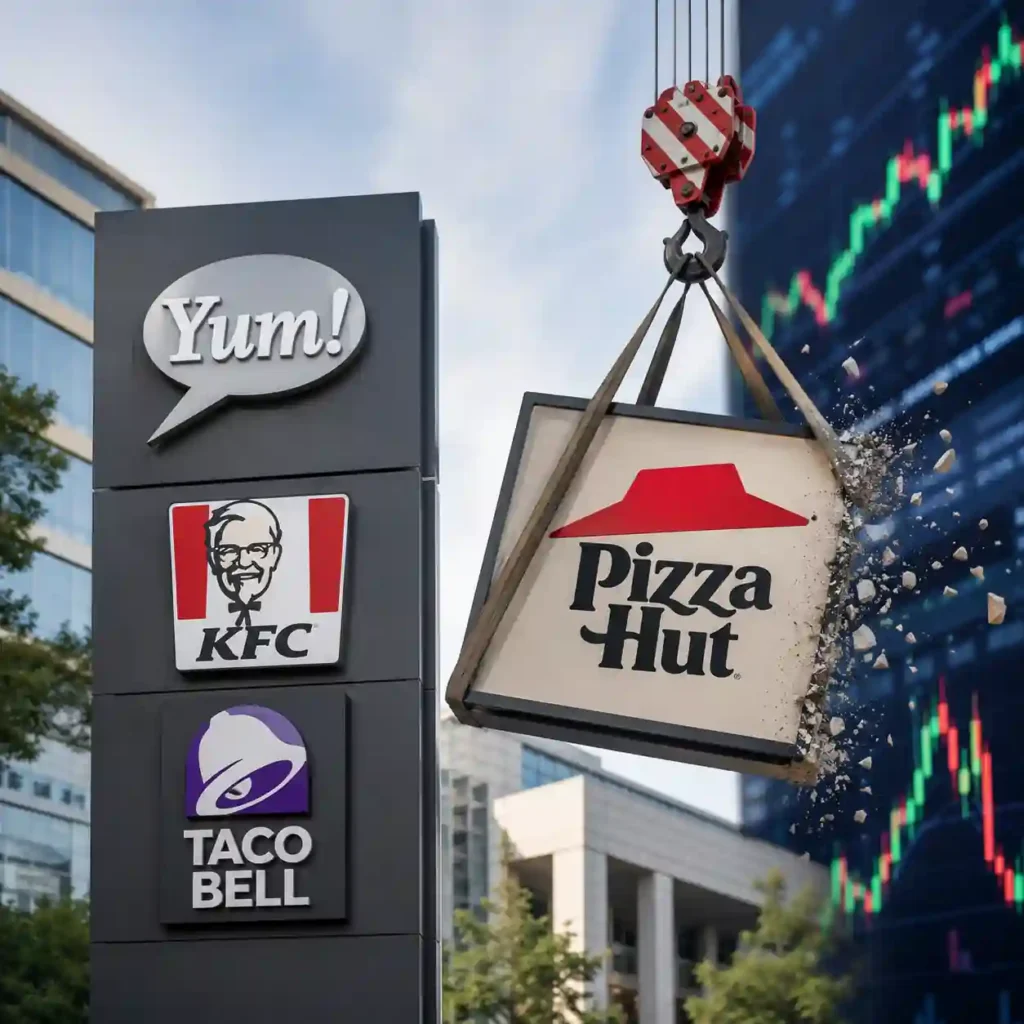

Yum! Brands is making a major bet on its future after agreeing to sell Pizza Hut in transactions valued at approximately $2.7 billion. The move will leave the restaurant giant focused on KFC and Taco Bell, two brands that have delivered stronger growth in recent years, while providing billions of dollars that can be returned to shareholders.
The decision marks one of the most significant portfolio changes in the company’s history. While investors initially welcomed the announcement and the accompanying $4 billion share repurchase plan, the transaction has also sparked debate about whether Yum! Brands is becoming too dependent on just two major restaurant concepts.
Pizza Hut’s China operations will be acquired by Yum China Holdings, while private equity firm LongRange Capital will purchase the rest of the pizza chain. Yum! Brands expects to receive approximately $2.3 billion in proceeds after taxes and expenses once the transactions are completed.
Why Yum! Brands Chose to Exit Pizza Hut
The sale follows several years of slower performance from Pizza Hut compared with the company’s other major brands. In 2025, Pizza Hut generated approximately $12.8 billion in system sales, making it the smallest of Yum!’s three core restaurant businesses.
By comparison, KFC generated $36.4 billion in system sales during 2025, while Taco Bell contributed $18.4 billion. The growth gap became even more apparent when looking at same-store sales trends.
Pizza Hut reported a 4% same-store sales decline in 2024, followed by another 1% decline in 2025. During the first quarter of 2026, same-store sales remained flat.
KFC and Taco Bell moved in the opposite direction. KFC recorded same-store sales growth of 3% in 2025 and 2% during the first quarter of 2026. Taco Bell remained the strongest performer, posting 7% growth in 2025 and 8% growth in the latest quarter.
For management, those numbers likely made the decision easier. The company is now concentrating resources on brands that are generating stronger momentum and attracting more consumer demand.
The $4 Billion Buyback Could Be Just as Important
Alongside the Pizza Hut sale, Yum! Brands announced an incremental $4 billion share repurchase authorization. The move signals that management intends to return a significant portion of the transaction’s value directly to shareholders.
Stock buybacks can improve earnings per share by reducing the number of shares outstanding. They are often viewed positively by investors, particularly when a company has excess cash and limited acquisition opportunities.
However, buybacks alone do not guarantee long-term growth. The larger question is whether Yum! Brands can create more value by focusing on KFC and Taco Bell than it could by retaining Pizza Hut and attempting a turnaround.
The Diversification Debate Is Growing
One of the biggest concerns raised by investors is the reduction in diversification. Before the sale, Yum! Brands operated major restaurant concepts across three different categories: pizza, chicken and Mexican-inspired fast food.
Once the transaction closes, the company will rely much more heavily on KFC and Taco Bell to drive revenue growth and earnings performance.
That creates a different risk profile. Consumer preferences change over time, and restaurant brands can move in and out of favor. While Taco Bell and KFC are performing well today, history has shown that even dominant chains can face slower growth periods.
Pizza Hut’s recent struggles were largely concentrated in the United States, while several international markets continued to perform better. The brand also posted same-store sales growth in both 2021 and 2022, illustrating how restaurant concepts can recover as consumer trends evolve.
The broader restaurant industry is facing similar challenges as companies balance growth investments with operational efficiency. Competitive pressures have also pushed chains to rethink their long-term strategies, as highlighted in our coverage of McDonald’s new restaurant overhaul, where major brands are investing heavily to strengthen customer engagement and improve performance.
Read More
What Investors Will Watch Next
The success of the Pizza Hut sale will ultimately depend on what happens after the deal closes. Investors will be watching whether Taco Bell can sustain its impressive growth trajectory and whether KFC continues expanding its global footprint.
Attention will also focus on how effectively Yum! Brands uses the proceeds from the sale and whether the $4 billion buyback generates meaningful shareholder value over the long term.
For now, the company has chosen a clearer, more focused strategy built around its strongest-performing brands. Whether that decision strengthens Yum! Brands or leaves it more vulnerable to future shifts in consumer demand will become clearer over the coming years.
Additional information regarding the transaction can be found through Yum! Brands Investor Relations.

Make Swikblog your go-to source on Google for reliable updates, smart insights, and daily trends.