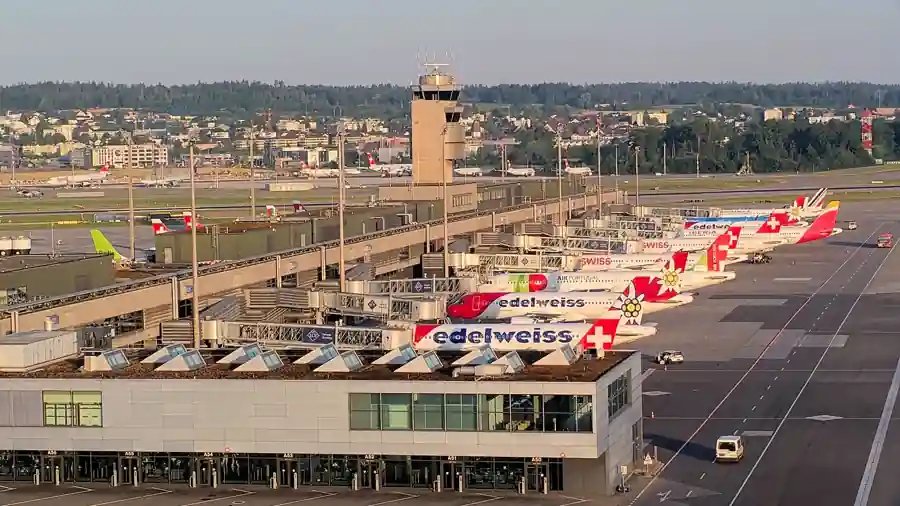

Thousands of travelers saw their plans disrupted at Zurich Airport on Sunday morning after a radar failure forced authorities to suspend departures from Switzerland’s busiest aviation hub. The technical issue, which affected systems operated by air navigation provider Skyguide, triggered emergency procedures, temporary airspace restrictions and a wave of delays that continued even after operations resumed.
While the disruption lasted less than two hours, its effects spread across airline schedules, airport operations and passenger journeys. The incident also renewed attention on the resilience of critical air traffic control infrastructure, an area that has faced scrutiny in Switzerland following previous technical failures.
Radar Failure Brings Zurich Airport Departures to a Halt
The disruption began shortly before 6 a.m. local time as the airport’s first departure wave was preparing to leave. Aircraft that would normally be taxiing toward the runway remained at gates or holding positions while air traffic controllers worked under emergency procedures.
According to information released during the incident, the problem was linked to a radar system failure affecting Skyguide. Because radar data plays a central role in tracking aircraft and maintaining safe separation between flights, authorities were unable to continue normal departure operations until the issue was addressed.
Zurich Airport was the primary location affected by the outage. Operations at Basel and Geneva continued largely as scheduled while specialists investigated the fault.
Swiss Airspace Restrictions Added to the Disruption
The impact extended beyond airport terminals. As a precaution, Skyguide temporarily closed Swiss airspace east of Bern and activated a crisis management team to coordinate the response.
Although safety remained the top priority, the restrictions created an immediate operational challenge. Aircraft that had been scheduled to depart within minutes of one another suddenly had to wait for revised clearances, creating a growing queue across the airport.
Even after the technical issue was identified, capacity within the affected airspace remained reduced by roughly 40%, preventing an instant return to normal operations.
How the Morning Recovery Unfolded
After approximately 90 minutes of disruption, Skyguide indicated that the source of the problem had been identified and departures could gradually resume.
The first aircraft to take off following the outage was a Rega medical jet at around 7:29 a.m. Passenger services followed shortly afterward. The first commercial departure was a Swiss flight to Thessaloniki operated by Helvetic Airways, which left Zurich at approximately 7:46 a.m.
However, restarting flights was only part of the recovery process. Airlines still had to secure updated departure slots, reposition aircraft and manage delayed passenger connections. That meant many travelers continued experiencing delays long after the radar system issue had been addressed.
Passengers Faced Delays and Flight Cancellations
The outage affected dozens of scheduled morning flights. Swiss reportedly cancelled several services, including routes to Porto, Barcelona, Prague and Berlin as airlines attempted to stabilize operations.
Passengers shared reports of extended waits onboard aircraft and inside terminals. Some travelers bound for holiday destinations remained seated in parked aircraft for prolonged periods while crews awaited clearance to depart.
The disruption also created pressure on arriving flights. With aircraft unable to leave on schedule, airport stands remained occupied longer than planned, leaving some arriving passengers waiting before they could disembark.
Large-scale operational interruptions like this often create a chain reaction across airport networks, similar to recent airport ground stop incidents where delays continued well beyond the original cause of the disruption.
Why Radar Systems Are So Critical to Air Travel
Modern aviation depends on a complex network of surveillance and communication systems. Radar provides controllers with real-time visibility of aircraft positions, allowing them to manage traffic safely and efficiently.
When a radar system becomes unavailable, controllers can rely on backup procedures, but those procedures typically require lower traffic volumes and increased spacing between aircraft. As a result, airports often experience significant slowdowns even when contingency systems are functioning correctly.
For passengers, the immediate consequence is delayed departures. For airlines, the challenge is much broader, affecting aircraft utilization, crew schedules, maintenance planning and connecting itineraries throughout the day.
Read More
Another Challenge for Swiss Air Traffic Control
The latest outage is unlikely to go unnoticed within the aviation industry. Skyguide has faced previous technical disruptions, including a major 2022 incident that temporarily closed Swiss airspace nationwide.
More recently, Zurich Airport experienced capacity reductions linked to separate technical issues earlier in 2026. While Sunday’s radar failure was resolved relatively quickly, repeated disruptions inevitably raise questions about system redundancy, modernization efforts and long-term infrastructure resilience.
Authorities are expected to review the incident in detail to determine exactly what caused the radar failure and whether additional safeguards can reduce the risk of similar disruptions in the future.
For travelers, Sunday’s events served as a reminder that modern air transport depends not only on aircraft and airports but also on highly specialized technology operating behind the scenes. When one of those systems fails, the effects can be felt across an entire travel network within minutes.
Additional information about Swiss air traffic management is available through Skyguide.

Make Swikblog your go-to source on Google for reliable updates, smart insights, and daily trends.