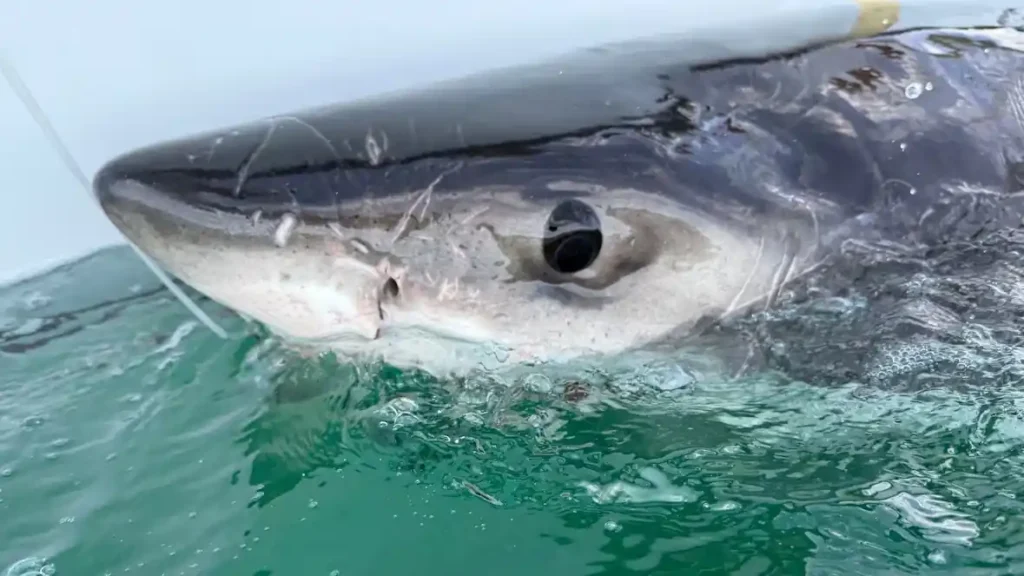

A 730-pound great white shark named Bella has been tracked in the Gulf of St. Lawrence near Quebec’s Magdalen Islands, becoming the first documented great white shark recorded in the Gulf during the 2026 season. While the sighting has captured attention across Canada during the busy summer holiday period, marine scientists say Bella’s arrival is part of a well-established seasonal migration rather than an unusual event.
The juvenile female shark, measuring 10 feet 2 inches, was first tagged in Nova Scotia last summer before travelling thousands of kilometres to the Gulf of Mexico for winter. Her return north is giving researchers another valuable opportunity to study how great white sharks move through Atlantic Canadian waters and how the species is recovering after decades of conservation efforts.
Instead of signalling increased danger, Bella’s latest satellite ping highlights an important ecological story. Scientists say the Gulf of St. Lawrence has long been part of the species’ natural range, and modern tracking technology is simply making these annual movements easier to observe than ever before.
Bella’s movements can be followed through the official OCEARCH Shark Tracker, which records the locations of tagged sharks whenever they surface long enough to transmit a satellite signal.
Bella’s remarkable migration back to Atlantic Canada
Bella was tagged in Mahone Bay, Nova Scotia, during July 2025 by researchers studying white shark movements in Atlantic Canada. After leaving Canadian waters in autumn, she migrated south to the Gulf of Mexico, following the same broad seasonal pattern seen in many great white sharks.
Her northbound journey this year took her past Cape Cod, through the Gulf of Maine, along Nova Scotia’s south shore and north of Prince Edward Island before entering the Gulf of St. Lawrence.
Researchers first detected Bella off eastern Prince Edward Island on June 29. She was then recorded near Quebec’s Magdalen Islands on July 4, where satellite data indicates she has remained for several days.
That makes Bella the first documented great white shark observed in the Gulf during the 2026 monitoring season, providing another useful dataset for scientists tracking seasonal movements.
Why experts say the sighting is not unusual
Great white sharks often receive intense public attention because of their size and reputation, but researchers emphasize that Bella’s appearance should not be interpreted as evidence that sharks are suddenly expanding into new waters.
According to marine scientists, white sharks have occupied Atlantic Canadian waters for thousands of years. The Gulf of St. Lawrence forms part of their natural seasonal range, where they arrive during warmer months before moving south again as conditions change.
Conservation measures introduced after decades of population decline have also contributed to encouraging signs of recovery. White shark numbers were heavily reduced from the 1960s through the early 1990s because of unregulated fishing, but stronger protections have helped stabilize the species.
At the same time, Atlantic Canada’s seal population has increased significantly over recent decades. Since seals are one of the shark’s preferred prey species, healthier seal numbers naturally attract more great whites into Canadian waters.
Researchers also caution that increasing sightings do not necessarily mean there are dramatically more sharks. Improved satellite tracking, underwater cameras, drones and public reporting mean many sharks that previously went unnoticed are now successfully documented.
How many great white sharks visit Canadian waters?
Estimating the total population remains challenging because only a small percentage of white sharks carry satellite tags. Scientists say several more years of research will be needed before producing a highly accurate estimate.
Current research suggests between 70 and 90 tagged white sharks travel through Mahone Bay each year between June and November. Based on broader observations, marine biologists believe more than 2,000 white sharks may use Atlantic Canadian waters annually.
Another notable finding from OCEARCH research is that approximately 88% of great white sharks tagged in the southeastern United States eventually migrate into Atlantic Canada, demonstrating how connected marine ecosystems are across the western North Atlantic.
Bella is not the only shark making headlines this summer. Similar public safety concerns recently prompted authorities to temporarily close an Australian beach after a shark sighting at Point Lookout Beach, although scientists note that sightings alone do not necessarily indicate elevated danger.
What swimmers should know this summer
Researchers consistently stress that great white sharks do not actively target humans. Shark attacks remain exceptionally rare in Canadian waters despite growing awareness of the species.
According to Canada’s Shark Attack Registry, there have been only 15 confirmed shark attacks across roughly 330 years of recorded history, with just one confirmed shark-related fatality.
That fatal incident occurred in 1953 near Fourchu, Nova Scotia, when a white shark struck a fishing boat and a fisherman drowned.
Scientists nevertheless recommend sensible precautions for anyone entering the ocean. Swimming should be avoided at dawn and dusk, when sharks are generally more active. People are also advised to stay out of murky water, avoid areas where seals are present and pay attention to any local marine safety advisories.
These recommendations are intended to reduce already very small risks while allowing people to continue enjoying Canada’s beaches responsibly.
Read More:
- Starbucks Pink Drink merch launches with limited-edition Bearista cup
- Virgin Media fined £28 million by Ofcom
- Visit the Swikblog homepage for more latest news
Bella’s journey reflects a healthier marine ecosystem
Bella’s latest tracking record forms part of a much larger conservation story. Every satellite ping helps researchers better understand migration routes, feeding behaviour and habitat use across thousands of kilometres of ocean.
Recent years have produced several notable Canadian sightings, including the arrival of Contender, a 1,653-pound male recognized as the largest great white shark ever tagged in the western North Atlantic. Researchers have also documented encounters near Hubbards, Halifax and Cape Breton, while another tracked shark, Kara, confirmed that great whites naturally occur along Canada’s Pacific coast as well.
Taken together, these observations point toward improving scientific knowledge rather than increasing danger. Bella’s return to the Gulf of St. Lawrence offers another reminder that healthy oceans support healthy predator populations, and that understanding those animals through research remains one of the most effective ways to improve both conservation and public awareness.

Make Swikblog your go-to source on Google for reliable updates, smart insights, and daily trends.