When Raghav Tripathi, a simple, soft-spoken teacher from a small town in Madhya Pradesh, received the letter saying he had cleared the Central Government School Teacher Exam, his house exploded with joy. His mother started distributing sweets to neighbours before even reading the full letter.
And then she read it.
“Kashmir?!” she screamed, as if the paper had suddenly caught fire.
His father froze mid-bite of jalebi.
His aunt fainted theatrically on the sofa.
His younger brother Googled “how dangerous is Kashmir for teachers.”
And Raghav stood there in a brand-new kurta, smiling like a man who still didn’t know his life was about to take a sharp U-turn.
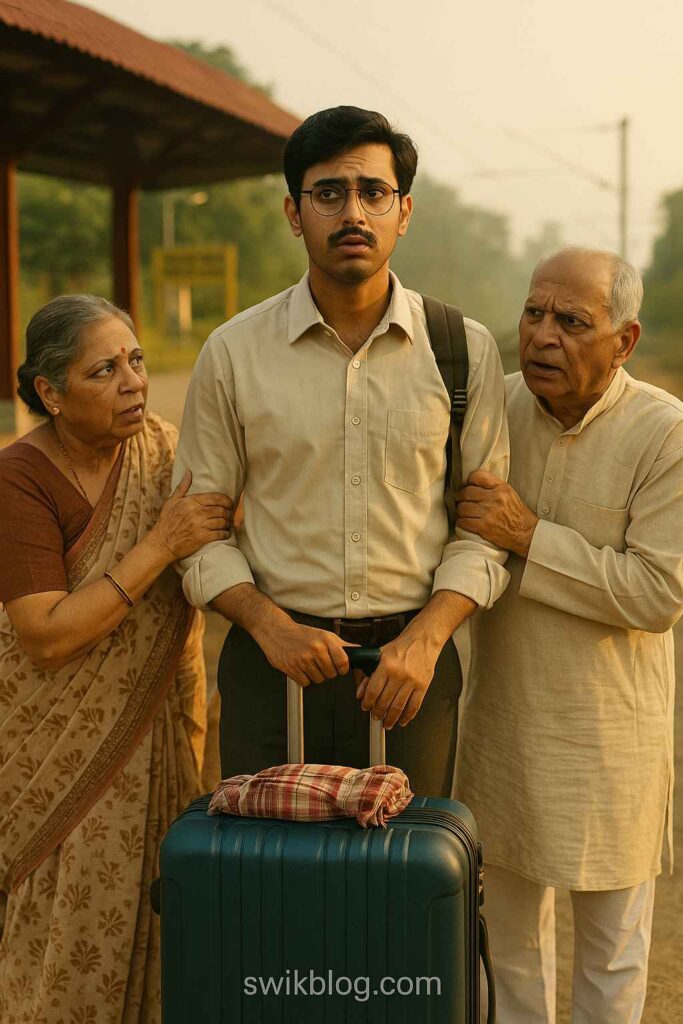
The next morning, his mother stuffed his suitcase with so many blankets, woollen socks, and pickle jars that even the coolest Himalayan breeze would have struggled to get through.
“Beta, don’t talk to strangers,” she warned.
“Maa… I’ll be teaching strangers,” he said.
“Exactly!” she replied dramatically.
Arrival in Kashmir
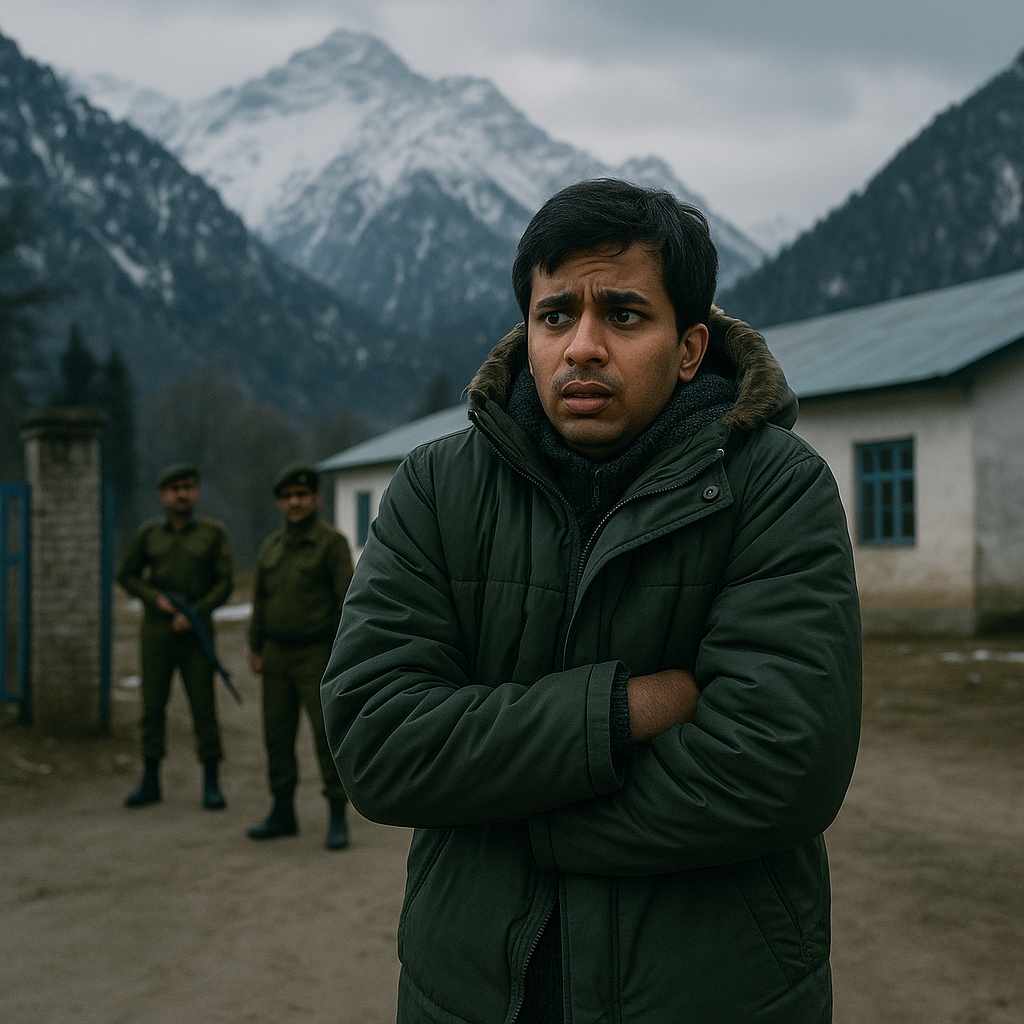
On 20 November, the air in Kashmir carried a cold that sliced straight through Raghav’s Madhya Pradesh bones. He stepped off the bus wearing a jacket so oversized he looked like a scared caterpillar hiding in a sleeping bag.
The school gate stood at the edge of a long valley, and behind it—soldiers, snow, and silence.
“Welcome, sir,” a guard greeted him.
Raghav nodded nervously. “Is… is everything safe here?”
The guard smiled. “Saab, even the pigeons are safe here. Don’t worry.”
But Raghav worried anyway.
Every time a loud sound echoed, he jumped.
Every time the wind whistled, he imagined trouble.
Every time a leaf fell, he turned around, ready to run.
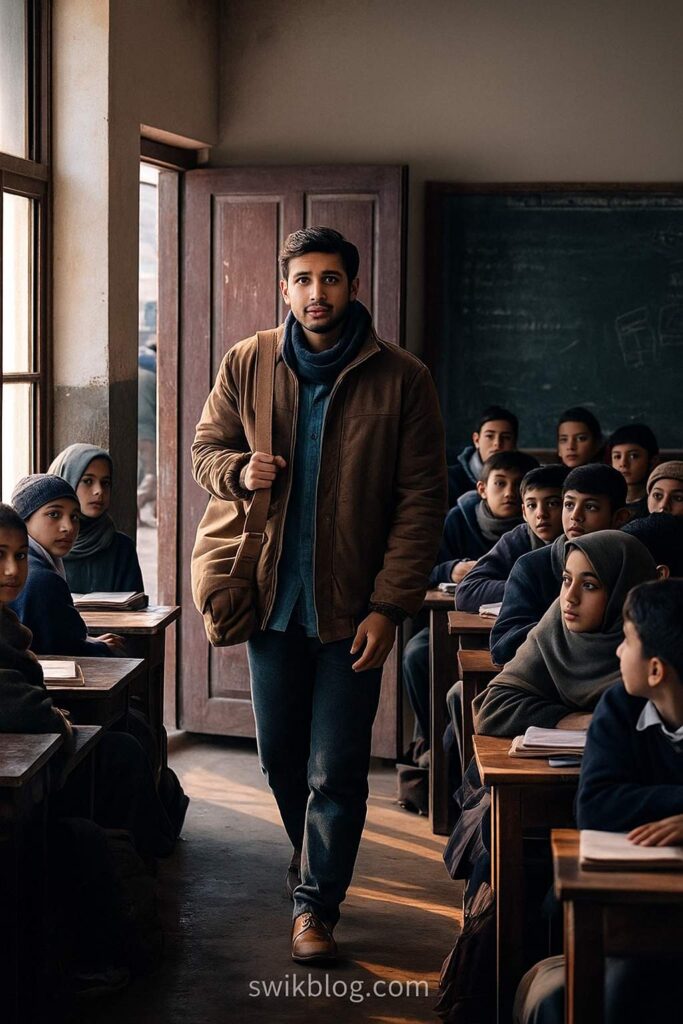
The principal, a warm-faced Kashmiri woman named Madam Gul, introduced him to his class with a hopeful smile.
“Students, meet your new Hindi and Math teacher from Madhya Pradesh.”
The students stared at him. Not one blinked.
He swallowed. They swallowed.
A cold wind passed. Nobody moved.
The First Class Disaster
When he attempted his first sentence, half the class giggled.
His Hindi sounded too “Madhya-Pradesh-wala.”
Their Urdu-Hindi mix sounded too “Kashmir-wala.”
They spoke fast.
He spoke carefully.
They teased him.
He pretended he didn’t notice.
When he wrote “Good Morning” on the board, a boy whispered loudly,
“Sir, we already know English.”
By the end of Day 1, he felt like the chalkboard respected him more than his students.
That night, sitting under three blankets, he called his mother.
“Maa, they don’t like me.”
“Beta, you didn’t like karela when you were small. But now you eat it daily.”
“That doesn’t help, Maa…”
“Still, it’s true. People change.”
The Boy in the Corner
Day after day, he noticed one student who never looked up:
Ayaan, a thin boy with soft eyes who sat in the back corner—always alone, always silent.
He didn’t laugh with the others.
He didn’t tease the teacher.
He barely existed.
When attendance was taken, he only raised his hand halfway.
Raghav sensed something deeper.
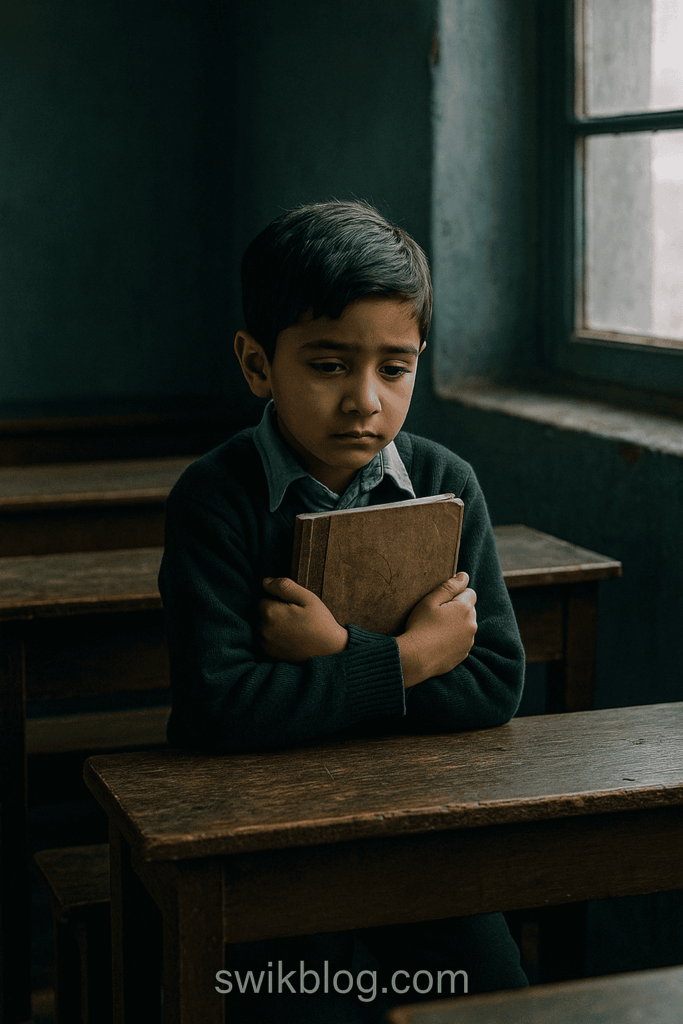
One afternoon, Ayaan stayed behind after class, still silent. Raghav gently asked, “Why don’t you sit with others?”
Ayaan hesitated, eyes fixed on his notebook.
“My… my father…” he whispered, “was killed years ago. People talk… so I don’t talk.”
It wasn’t the words—it was how heavy they sounded.
Raghav’s chest tightened.
He wanted to say something comforting, but emotions held his tongue still.
Instead, he simply sat beside him, breaking the silence with presence, not advice.
That was the beginning.
The Slow Transformation
Raghav decided he wouldn’t let Ayaan fade into an invisible corner.
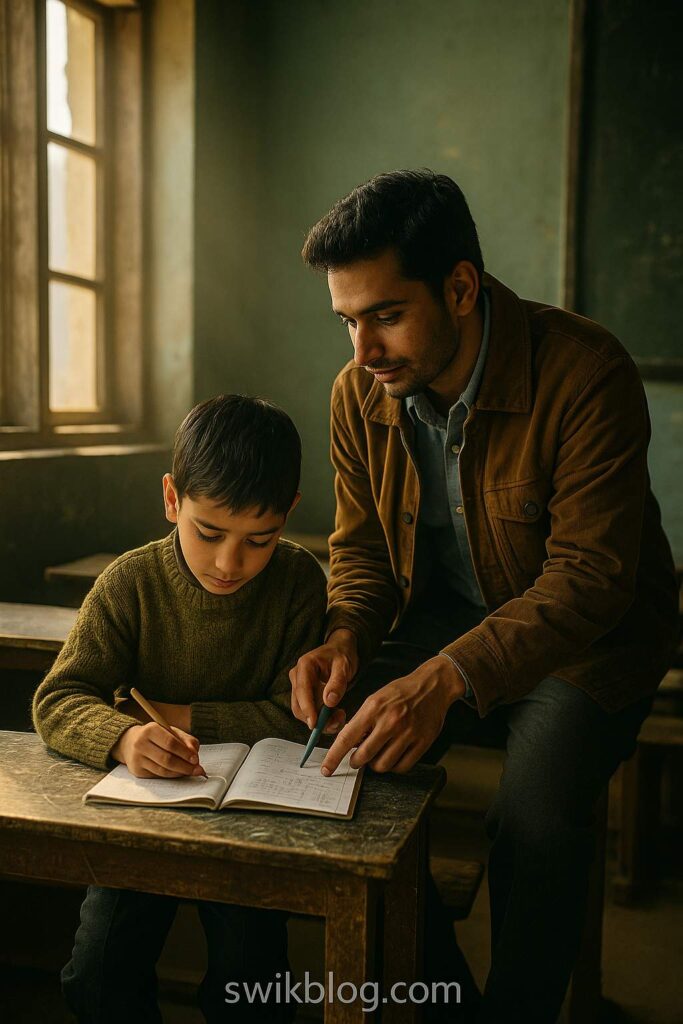
The next day, he called him to solve a small math problem.
Ayaan froze.
“It’s okay,” Raghav said softly, “I’ll help.”
He solved half the problem.
Ayaan solved the other half—his hands trembling, but doing it.
The class watched in surprise.
And something shifted.
Ayaan’s eyes lifted for the first time.
There were evenings when Raghav would simply sit with a few students on the school steps, talking about dreams they had never dared to say out loud. One wanted to become a doctor, another wished to open a bakery with his mother, and Ayaan quietly whispered that he hoped to become a teacher “just like Sir.” Raghav noticed how their eyes softened whenever they spoke about the future, as if someone had finally handed them permission to imagine one. In those quiet moments, he wasn’t just their teacher — he was the first adult who listened to them without judgement, who believed in them without hesitation. And in return, they became the reason he never felt lonely in a land he once feared.
Gradually:
- Ayaan started raising his hand.
- Sometimes, he smiled softly.
- He began making one-word jokes.
- He answered confidently in Math.
The boy who once avoided the world now held a pencil like it was his passport to a new life.
And the Class Changed Too
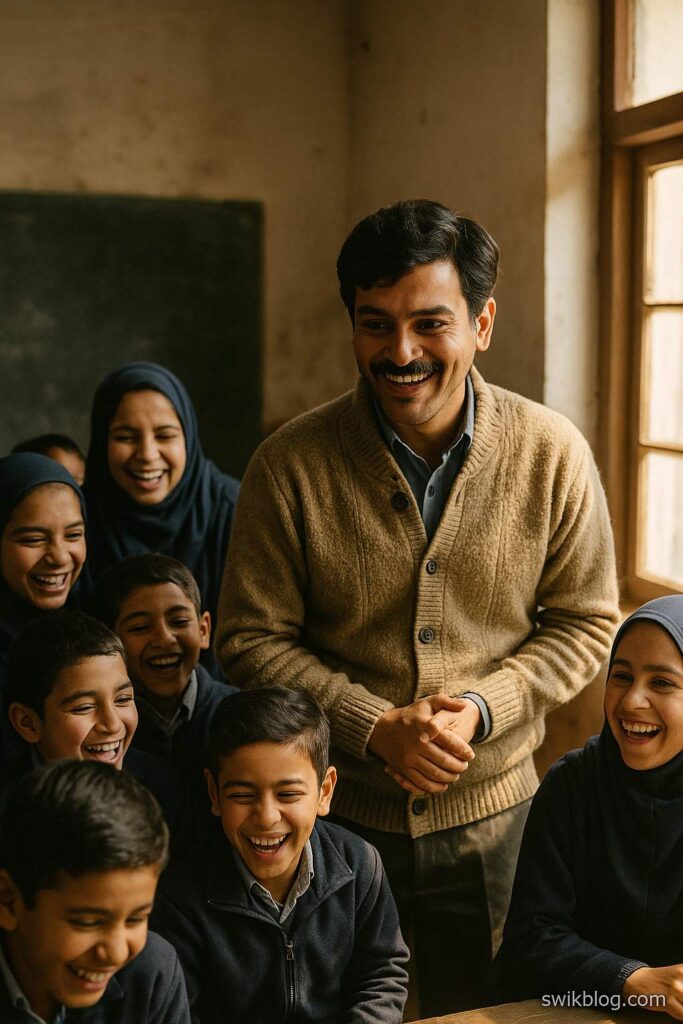
Their bond also grew through chaos and comedy. Once, during recess, the students decided to teach Raghav how to walk on snow “like a real Kashmiri.” Within five seconds, he slipped, flailed his arms like a confused chicken, and landed straight on a snow pile. The entire schoolyard exploded with laughter — including Raghav, who couldn’t stop laughing at himself. Another time, he mispronounced a common Kashmiri word so badly that even the principal choked on her tea. The students declared him “honorary Kashmiri” only after he survived a full week of noon-chai, snowfall, and their never-ending pranks.
There were many small moments that stitched Raghav and his students together like family. On weekends, a few boys proudly showed him the hidden beauty of their town — the old wooden bridge, the walnut orchards, and the river trail where sunlight danced on the water like tiny lanterns. They taught him how to drink kahwa properly without burning his tongue, and he, in return, taught them how to overcome their fear of Maths by turning equations into funny stories and everyday examples.
Soon:
- Students waited for his classes.
- They brought him kangri (traditional hand warmers).
- They taught him Kashmiri words.
- They asked about Madhya Pradesh food.
- They walked with him to the bus stop.
The teacher who had once feared his posting now felt safer inside this classroom than anywhere else.
The Day of Realisation
One night, a sudden snowstorm covered the entire town in silence. The electricity went out, the temperature dropped brutally, and the school staff quarters felt colder than anything Raghav had ever imagined. Wrapped in three blankets, he started coughing uncontrollably. The next morning, before he could even step outside, he heard soft knocks — four students stood there with their parents, carrying thermos flasks of hot kahwa, kangris to keep him warm, and a thick pheran to protect him from the cold. One mother gently rubbed his forehead and said, “Sir, you are alone here… but not alone for us.”
That day, as he sat surrounded by warmth that had nothing to do with fire, Raghav understood the true spirit of Kashmir.
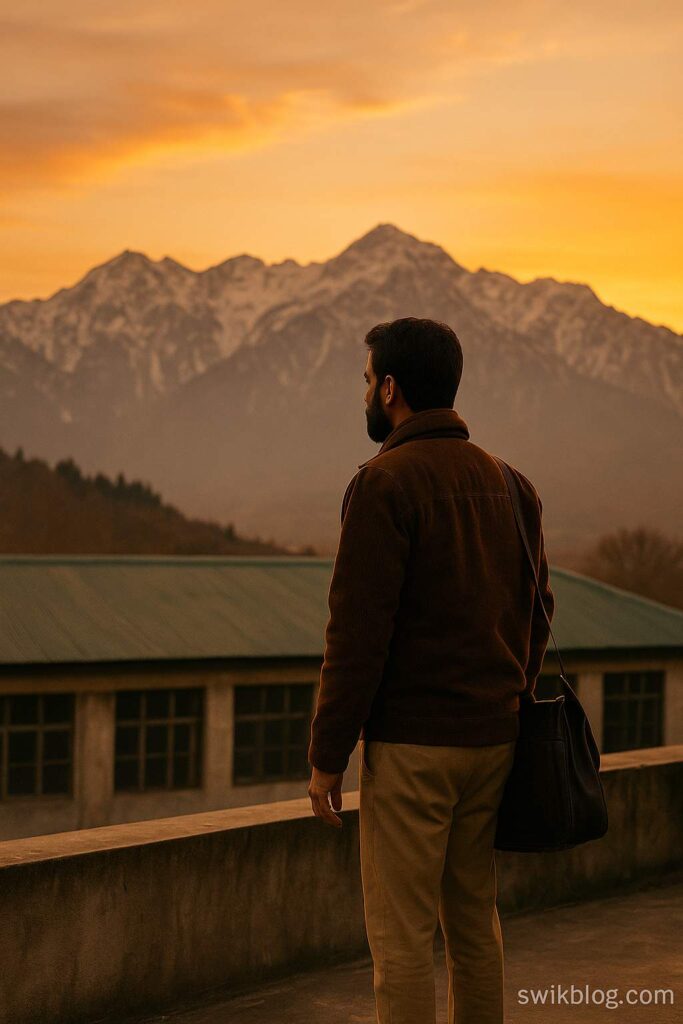
One evening, standing on the school rooftop at sunset, he watched the snow-brushed mountains glowing gold.
For the first time since arriving, he felt… peaceful.
“This is home,” he whispered.
He didn’t know when fear had turned into comfort, or when strangers had turned into family.
Farewell That Broke Him
At the end of the academic year, his transfer letter arrived.
He was supposed to return closer to his home state.
He expected the students to be happy.
After all, they had bullied him the first month.
Instead, that morning, he walked into a silent classroom.
On every desk lay a handwritten note:
“Thank you, Sir.”
Ayaan’s letter was the shortest, yet the deepest:
“Sir, you taught me to look up again.”
When he looked at the class, students rushed to him—hugging, crying, holding handmade cards, begging him not to leave.
Raghav cried too.
The teacher who once trembled on arrival now trembled at the thought of leaving.
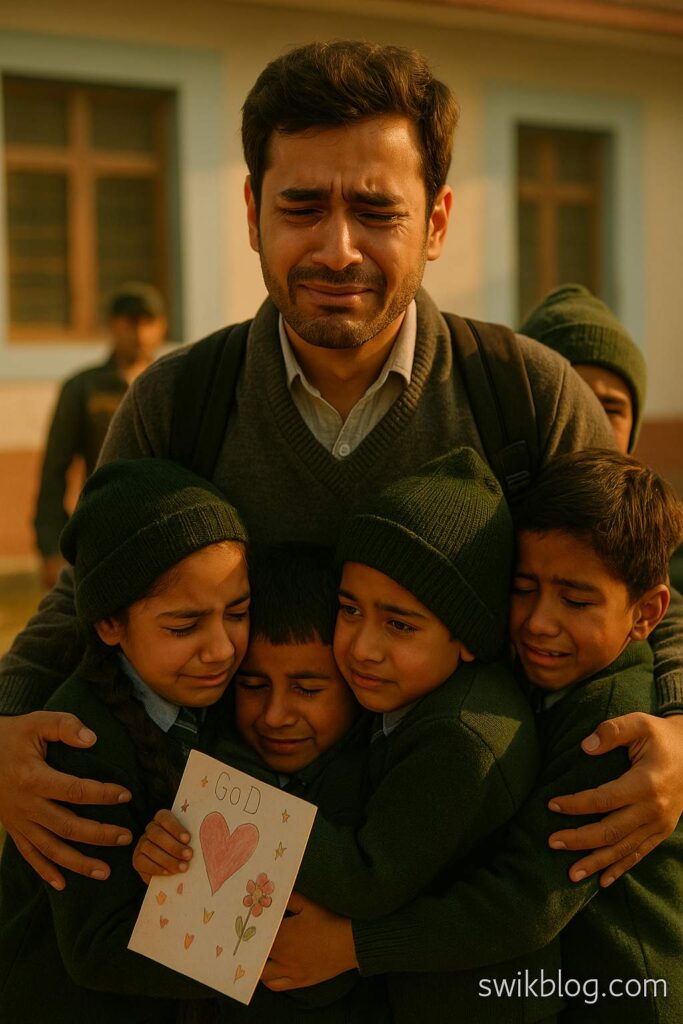
“I came here scared…” he whispered, choking up, “…but you all turned fear into love.”
A student shouted from the back,
“Sir, Kashmir misses those who leave! Don’t go!”
He laughed through tears. “Your sir will come back someday.”
And he meant it.
What Kashmir Gave Him
It wasn’t just a job posting anymore.
It was the chapter of his life that changed him forever.
He arrived terrified.
He left loved.
He came as a teacher.
He left as someone’s hope, someone’s role model, someone’s friend.
And for Ayaan…
He became the person who helped him rewrite a destiny everyone had written for him too early.
Some postings are not destinations—they are transformations.
And Raghav’s journey was one of them.
Just like Raghav found courage in unexpected places, India too needs mentors who inspire transformation — something beautifully reflected in this powerful analysis on India’s need for real-life Mohan Bhargava and Karan Shergil.

Make Swikblog your go-to source on Google for reliable updates, smart insights, and daily trends.