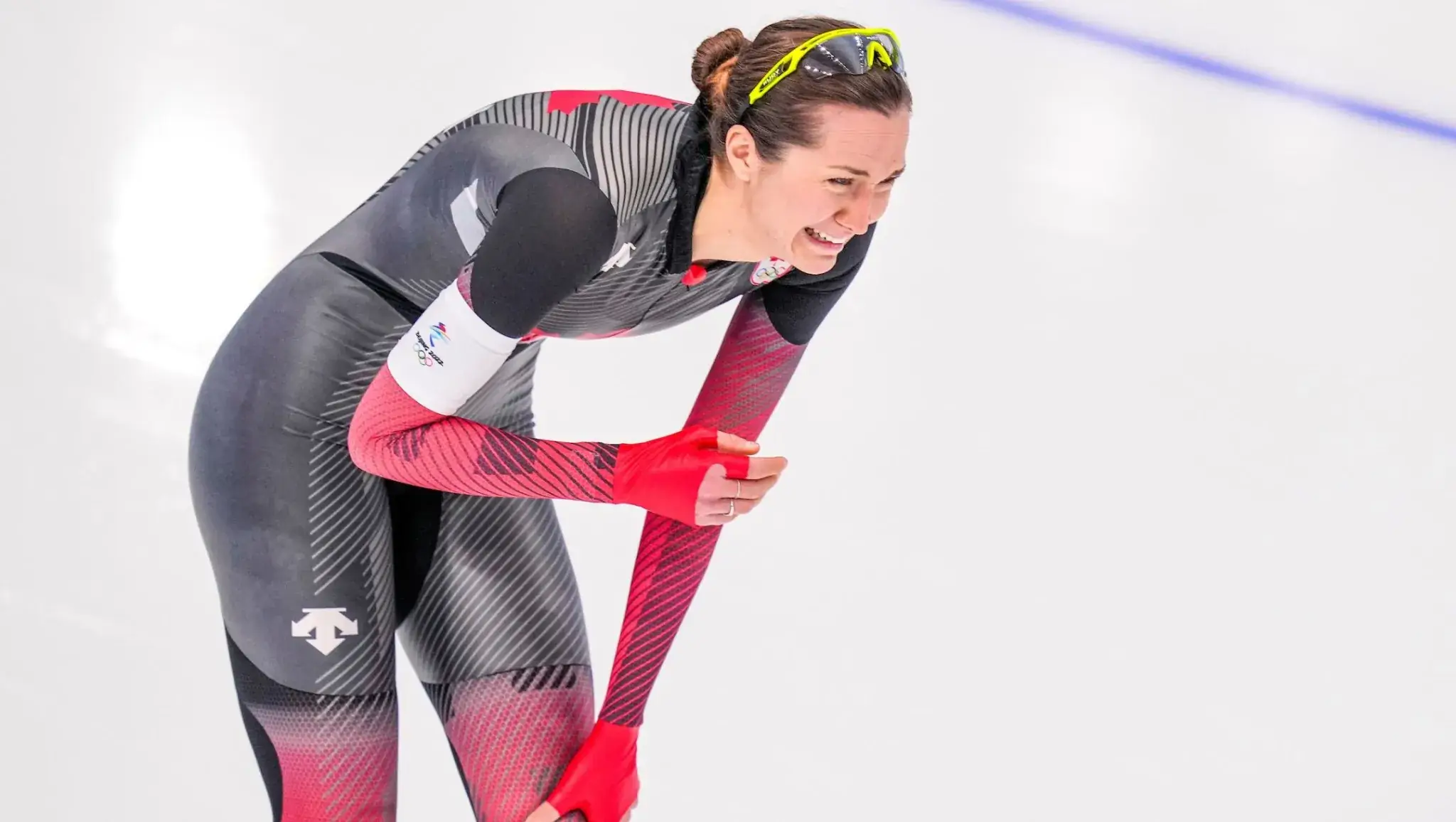
Canadian long-track speed skater Isabelle Weidemann continued her strong World Cup season with a silver medal in the women’s 3,000 metres on Saturday at an ISU World Cup stop in Hamar, Norway, delivering another composed podium performance against one of the deepest fields in women’s distance skating.
The Ottawa native and three-time Olympic medallist stopped the clock at 4:01.30 to finish second in a tightly contested race. Dutch skater Marijke Groenewoud captured gold in 4:00.95, while Norway’s Ragne Wiklund took bronze in 4:01.41 after skating in the same pairing as Weidemann. The narrow margins highlighted both the quality of the field and the precision required to reach the podium at World Cup level.
Skating in front of a home crowd, Wiklund set an aggressive tempo early, but Weidemann matched the pace through the middle laps and held her form over the closing stages. Her controlled approach, built around even lap splits and efficient technique, proved decisive on fast ice where small mistakes are quickly punished. Hamar’s Olympic Oval rewarded skaters who could maintain rhythm and balance under pressure, traits that have long defined Weidemann’s racing style.
The silver medal marked Weidemann’s second individual distance podium of the season. Earlier this month, she also claimed silver in the women’s 5,000 metres at the World Cup stop in Heerenveen, Netherlands. Together, the results underline her consistency across the two longest Olympic distances and point to a strong early-season trajectory as athletes accumulate World Cup points and refine race strategies.
Canada narrowly missed adding another medal in the 3,000 metres, with Valérie Maltais finishing fourth in 4:03.62, just over two seconds shy of the podium. Fellow Canadian Ivanie Blondin placed 10th in 4:07.08, rounding out a competitive showing for the national team. The depth of Canadian results reflected the country’s continued strength in women’s long-track speed skating, particularly in endurance events.
In other action on Saturday, Béatrice Lamarche of Quebec City finished 10th in the women’s 1,000 metres, crossing the line in 1:16.35. Japan’s Miho Takagi won the race, pulling clear of the field to secure gold. While sprint events often hinge on venue-specific conditions, Lamarche’s performance added valuable experience as the season moves deeper into the World Cup calendar.
For Weidemann, the podium in Norway reinforces a career built on delivering when competition tightens. Since emerging as a medal contender on the Olympic stage, she has repeatedly translated championship-level fitness into strong World Cup results, often peaking at the right moments. Her ability to contend in both the 3,000 and 5,000 metres provides Canada with medal potential across multiple distances and adds tactical flexibility as the international season unfolds.
The World Cup circuit remains a key proving ground, allowing skaters to test equipment, pacing, and execution against the world’s best. With back-to-back individual podiums in two different countries, Weidemann has shown she can adapt to varying ice profiles and competitive dynamics. According to reporting from CBC Sports, her early-season form places her among the most reliable performers on the Canadian team as the schedule builds toward its major championships.
As the tour continues, Canada’s focus will be on sustaining momentum and turning close finishes into medals. For now, Weidemann’s silver in Hamar stands as another disciplined, high-quality performance, highlighting her place among the world’s elite and setting a confident tone for the races ahead.
You may also like:
Quinn Hughes Trade: Why the Minnesota Wild–Canucks Deal Could Be the Biggest of the Decade

Make Swikblog your go-to source on Google for reliable updates, smart insights, and daily trends.