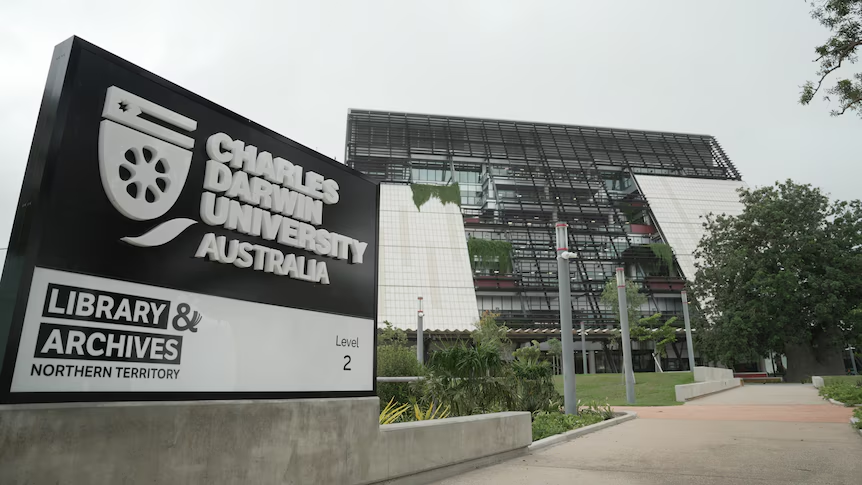

Charles Darwin University (CDU) has agreed to repay more than A$4 million to current and former employees after a long-running payroll review found hundreds of staff were underpaid between 2016 and 2022. The legally binding agreement with Australia’s Fair Work Ombudsman follows the university’s self-reporting of the issue in 2022 and requires CDU to strengthen its payroll systems while completing repayments to affected workers.
The Fair Work Ombudsman announced the enforceable undertaking in 2026 as part of broader efforts to improve wage compliance across Australia’s university sector. The agreement requires CDU to complete outstanding repayments, improve payroll governance and undergo independent compliance checks.
The case affects casual academic and professional employees who worked across the university’s campuses in Darwin, Alice Springs, Palmerston, Katherine and Sydney. The repayments include unpaid wages, superannuation and interest.
More Than 800 Workers Identified in Payroll Review
According to the regulator, 823 current and former employees have already been identified as being underpaid. By the time the undertaking was signed, 612 workers had received more than A$3.5 million in repayments.
The average repayment has been about A$1,700, although individual outcomes vary significantly. The largest payment exceeded A$242,000 after interest and superannuation were added.
The review is not yet complete. CDU is continuing to examine payroll records for another 1,483 current and former employees, most of whom worked in higher education academic roles. The university expects all remediation work to be completed before the end of September 2026.
Why Employees Were Underpaid
The Fair Work Ombudsman said the problems were linked to weaknesses in payroll administration rather than intentional wage theft.
Its investigation found that CDU’s decentralised payroll processes resulted in some overtime not being recorded correctly, while payroll settings did not always apply the correct rates under the university’s enterprise agreements.
The underpayments involved casual hourly rates, overtime, penalty rates and minimum engagement provisions contained in the university’s workplace agreements.
Large universities often manage thousands of casual teaching and professional staff across multiple campuses. When payroll, rostering and time-recording systems are not fully aligned, errors can remain unnoticed for years before comprehensive audits uncover them.
The issue reflects wider scrutiny of workplace compliance in Australia, where regulators have increased enforcement of wage obligations across both public and private employers. Similar concerns have emerged in recent Australian wage compliance disputes.
Legally Binding Measures CDU Must Complete
Under the enforceable undertaking, CDU must introduce several measures designed to prevent similar payroll failures from happening again.
The university will commission up to two independent payroll compliance audits, provide additional workplace law training for relevant staff and continue operating a formal employee payment complaints process.
CDU must also report on improvements made to its payroll systems and internal processes.
As part of the agreement, the university has committed to making a A$200,000 contrition payment to the Cleaning Accountability Framework, an independent not-for-profit organisation that promotes fair employment practices in the cleaning industry.
University Sector Remains Under Regulatory Scrutiny
Payroll compliance has become a major focus across Australia’s higher education sector.
Since 2020, the Fair Work Ombudsman has worked with dozens of universities after identifying wage compliance concerns. Several institutions have entered enforceable undertakings following reviews of payroll systems and employee entitlements.
The growing number of investigations has prompted many universities to invest in stronger payroll controls, better record-keeping and more frequent internal audits.
Union Calls for Faster Repayments
The National Tertiary Education Union (NTEU) welcomed the legally enforceable agreement but said affected employees should not have had to wait years for money that was rightfully owed to them.
Union representatives have argued that additional resources should have been dedicated earlier to reviewing payroll records and processing repayments more quickly.
For many casual employees, delayed wages can affect day-to-day finances as well as retirement savings because unpaid superannuation is calculated from those missing earnings.
Read More
Recent Challenges Facing Charles Darwin University
The payroll case comes during a period of heightened scrutiny for CDU following several unrelated operational issues.
Earlier in 2026, the university faced criticism after an accreditation failure affected hundreds of TAFE students, leading to leadership changes. It also abandoned plans for a proposed London campus after investing approximately A$2 million in the project. While separate from the payroll matter, these events have increased attention on the university’s governance and oversight.
Why This Case Matters
The CDU agreement demonstrates that wage compliance has become a major governance issue for Australian universities, particularly those relying on large casual workforces and complex employment arrangements.
Beyond repaying employees, institutions are increasingly expected to demonstrate that payroll systems are accurate, transparent and regularly audited. Regulators have made clear that correcting historic errors alone is not enough if underlying systems remain vulnerable to future mistakes.
For employees, the focus now shifts to completing the remaining payroll review so anyone who was underpaid receives outstanding wages, superannuation and interest. For universities across Australia, the case reinforces the importance of maintaining payroll systems that comply with workplace laws before problems grow into large-scale remediation programs.
Further information about Australian workplace rights, minimum pay obligations and wage recovery is available through the Fair Work Ombudsman.

Make Swikblog your go-to source on Google for reliable updates, smart insights, and daily trends.