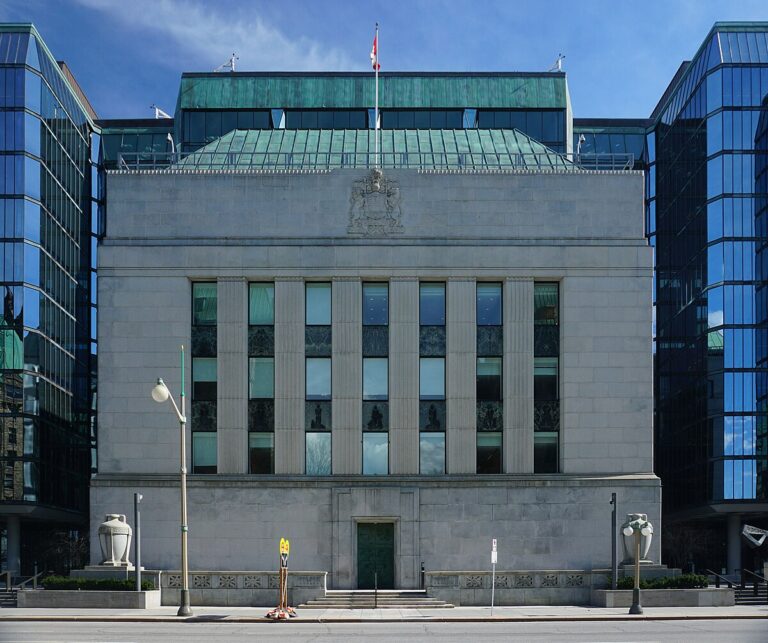

Canada’s central bank is expected to keep borrowing costs unchanged as policymakers weigh uneven inflation signals against escalating trade risk, and try to avoid overreacting to a shifting tariff landscape.
The Bank of Canada is widely expected to stand pat on its policy rate, holding at 2.25% for a second meeting in a row, as officials wait for clearer evidence on how much damage Canada’s economy might absorb from fresh trade shocks. The key point is not that inflation has vanished or growth is booming—it’s that the risks now cut in opposite directions, and trade policy has become the variable that’s hardest to model.
In recent months, the Bank has signaled that interest rates are “about right” to keep inflation near target while still supporting growth. That message has effectively turned the current rate into a staging point: high enough to stay credible on inflation, but not so high that it crushes demand in an economy where consumers are slowing and businesses remain cautious about investing.
The complication: trade tension with the US is once again dominating the conversation. Comments and tariff threats from President Donald Trump have injected uncertainty into export planning, cross-border supply chains, and corporate decision-making—exactly the areas that tend to freeze first when businesses don’t know what the rules will be six months from now.
Why a hold looks likely: When trade uncertainty rises, central banks often prefer to wait rather than gamble on the wrong move. Cutting too early can reignite price pressure; hiking too soon can amplify the shock if export demand softens.
One reason this moment matters is that Canada is still adjusting structurally after a period of rapid population growth and post-pandemic distortions. Recently, population growth has cooled sharply, which changes the demand picture for housing, services, and everyday consumption. At the same time, it can also affect the economy’s “speed limit”—how fast Canada can grow before inflation re-accelerates. If that potential growth rate is lower than assumed, the Bank can’t rely on old models of slack to guide policy.
Inflation signals, meanwhile, are mixed. Headline inflation has ticked higher in recent readings, but some of that reflects base effects rather than a fresh surge in underlying demand. Food inflation has become a flashpoint in household budgets, and comparisons across the G-7 have put Canada in an uncomfortable spotlight—yet the story is complicated by temporary distortions, including prior tax relief effects that warp year-over-year numbers.
The Bank of Canada’s preferred “core” inflation measures have eased, and policymakers often stress that a broader set of indicators still points to underlying inflation running around the mid-2% range. That’s close enough to target to justify patience, but not low enough to make rate cuts an obvious next step—especially with the risk that trade-related disruptions could lift prices for certain goods even as they dampen demand overall.
Growth, too, is a story of contrasts. Canada’s economy is expected to expand in 2026 at a pace that looks respectable by advanced-economy standards, with some forecasts placing it among the stronger performers in the G-7 behind the US. But “stronger than expected” doesn’t mean smooth. Consumer spending is slowing, investment plans remain uncertain, and firms have signaled that they’re prioritizing replacement and maintenance over major capacity expansion.
That unevenness is why guidance may stay cautious. If the Bank leans too hard into a single narrative—either “inflation is beaten” or “growth is safe”—it risks being forced into abrupt reversals as data and trade headlines move. A steadier approach is to keep rates unchanged while monitoring whether weakening consumption translates into broader disinflation, and whether trade turbulence shows up in business surveys, export volumes, and hiring plans.
There’s also a global timing factor: the Bank’s decision lands around the same time markets are watching the US Federal Reserve for its own hold. That matters because financial conditions travel across the border. If US rates stay higher for longer, Canada’s room to cut can narrow without weakening the currency and importing inflation—especially through food and other essentials priced in global markets.
For households and borrowers, a hold isn’t the same as relief—but it may offer predictability. Mortgage renewals, variable-rate borrowers, and small businesses can plan around a baseline that isn’t shifting every meeting. For investors, the bigger question becomes not “what happens Wednesday,” but “what breaks the stalemate”—a decisive slide in demand and core inflation, or a renewed wave of price pressure that forces the Bank’s hand.
For the full decision guide and market context, read the original report from Bloomberg.

Make Swikblog your go-to source on Google for reliable updates, smart insights, and daily trends.